
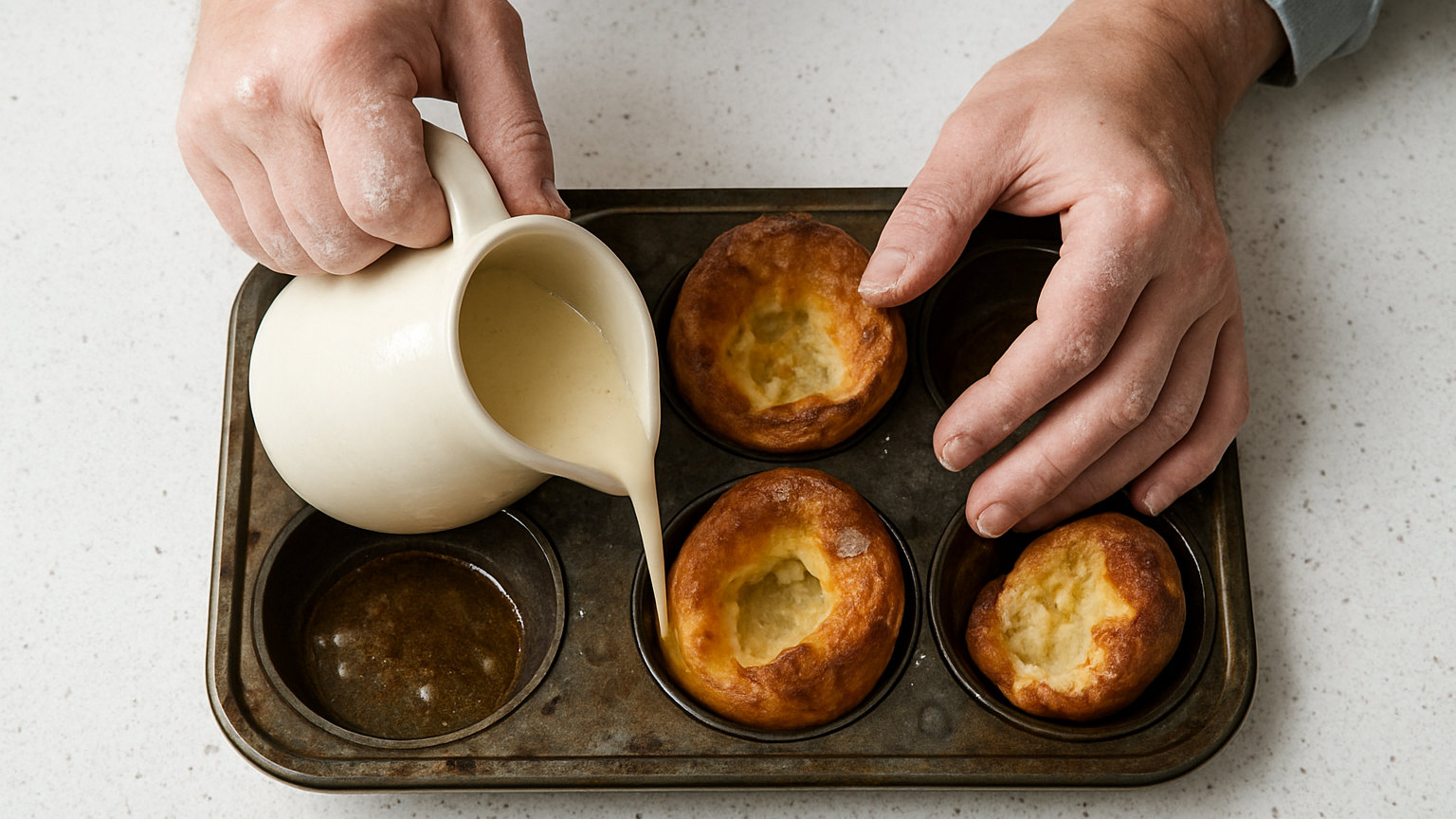
Most Yorkshire pudding recipes make twelve, which is a lot for two people even allowing for the widely held view that two each is a minimum. Scaling down is straightforward because the ratio does the work, but the method does not shrink in the same way. The fat still has to smoke and the oven still has to be at full heat for six puddings just as much as for eighteen.
What do you need for 6 puddings?
- 2 large eggs
- 70g plain flour
- 100ml whole milk
- A good pinch of salt
- 6 teaspoons beef dripping or sunflower oil
How do you make them?
- Whisk the eggs and salt until frothy, then whisk in the flour until smooth.
- Add the milk gradually to the consistency of single cream.
- Rest for 30 minutes or overnight in the fridge.
- Heat the oven to 220C fan, gas mark 9.
- Put a teaspoon of fat into six holes of a 12 hole tin and heat for 10 minutes until smoking.
- Fill each hole two thirds full and return to the oven immediately.
- Bake for 20 to 25 minutes without opening the door for the first 20.
Use only half the tin and leave the other holes empty. Empty holes are fine and cause no problems, whereas a smaller flimsier tin will conduct heat less well and give you a worse rise.
Does the ratio still hold?
Exactly. Two eggs come to roughly 100ml, so 100ml of flour and 100ml of milk, which is the same equal parts by volume rule at half scale.
Nothing else changes, including the temperature, the resting time or the cooking time.
Should you use a smaller tin?
Only if it is heavy metal. A thin six hole tin will perform worse than half of a good twelve hole one, since mass and conductivity are what matter.
Avoid silicone entirely, which conducts heat too slowly to produce a proper rise at any batch size.
Is it worth making more anyway?
Usually. Once the oven is at 220C fan and the batter is made, filling twelve holes instead of six costs nothing beyond a little more flour and milk.
The extras freeze for a month and reheat from frozen in seven minutes, which effectively gives you next Sunday off.
Can you make just one large one?
Yes. Pour the two egg batter into a small metal roasting tin or a cast iron skillet and bake for 25 to 30 minutes, then cut it in half.
This makes a good base for sausages and onion gravy and is essentially toad in the hole without the sausages.
Does one egg work?
It makes three puddings and is perfectly viable, though the quantities become fiddly. Around 35g of flour and 50ml of milk.
Measuring by volume is easier at this scale than trying to weigh small amounts accurately.
What should you serve them with?
A small roast for two, a piece of sirloin or a couple of lamb chops, with plenty of onion gravy. Six puddings suits that scale of meal well.
They also work as a supper on their own, filled with sausages and gravy, which uses the whole batch in one go.
How much fat for a half batch?
A teaspoon per hole, exactly as for a full batch. Do not put fat in the empty holes, since it will burn and smoke through the whole cooking time.
Use the holes towards the middle of the tin, which heat most evenly.
Does a small batch cook faster?
No. Each pudding cooks at the same rate whether there are six or twelve in the tin, so the timing is unchanged.
A half full tin does heat up marginally faster, which is a small argument for checking at 20 minutes rather than 22.
What do you do with spares?
Cool them on a rack and freeze them, or keep them two days in the fridge. Reheat at 200C fan for 5 minutes until piping hot throughout.
Cool quickly, refrigerate within two hours and reheat once only, in line with Food Standards Agency guidance.
If that was useful, How Many Eggs Do Yorkshire Puddings Need? covers related ground, and there is plenty more in Roasts recipes.


