
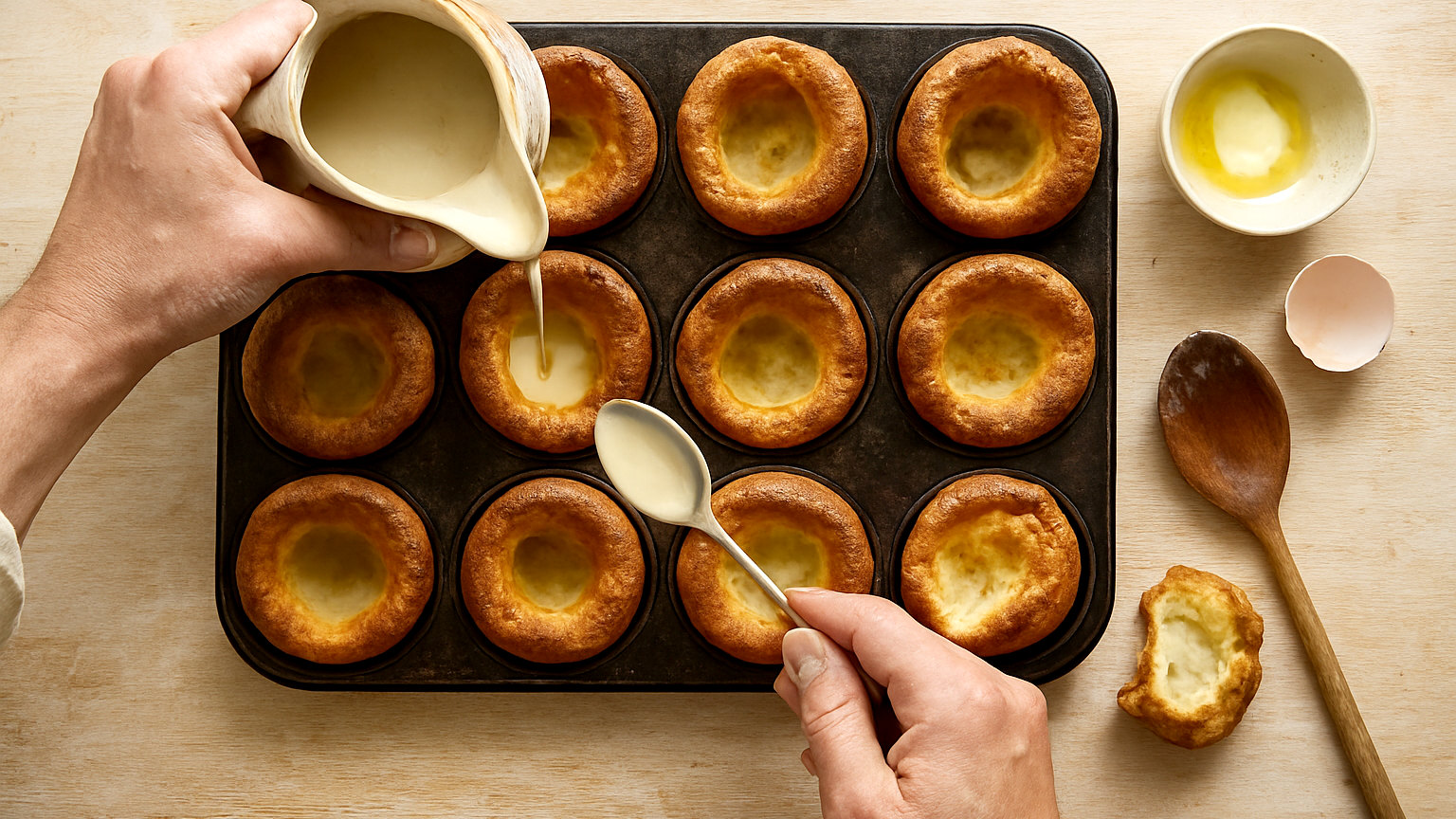
Eggs are doing most of the structural work in a Yorkshire pudding. They set into a framework as the steam inflates the batter, and that framework is what holds the shape once the pudding comes out of the oven. Get the quantity wrong in either direction and the result is either flat and heavy or tall and inclined to collapse.
How many for a standard batch?
Four large eggs make twelve puddings in a standard 12 hole bun tin, alongside 140g of plain flour and 200ml of milk.
Two eggs make six, three make nine, and six make eighteen or two tins. The proportions scale cleanly.
What does an extra egg do?
It gives a taller rise, a richer flavour and a slightly chewier, more custardy interior. Five eggs to 140g of flour is a common variation.
Push it much further and they stop being puddings. At seven or eight eggs to the same flour the result is closer to an omelette, with a heavy base and a strongly eggy taste.
Does egg size matter?
More than most recipes acknowledge. A large egg is around 60g and a medium one around 50g, so four medium eggs are a whole egg short of four large.
If you only have medium eggs, use five in place of four, or measure by volume instead.
How do you measure by volume?
Crack the eggs into a measuring jug and read the total. Use the same volume of plain flour and the same volume again of milk.
This removes the egg size question entirely and is why the volume ratio is the version most experienced cooks use.
Should the eggs be at room temperature?
It makes no meaningful difference, since the batter will be rested and probably chilled afterwards anyway.
What matters is that the finished batter is cold when it meets the smoking fat, not the temperature of the eggs going in.
Can you use just egg whites?
They will rise, and they will be pale, dry and rather tasteless. The yolks provide the fat and flavour that make a pudding worth eating.
Whipping the whites separately and folding them in is sometimes suggested and makes little difference, since the rise comes from steam rather than trapped air.
Is there an eggless version?
Not one that behaves the same way. Aquafaba and commercial egg replacers give a modest rise and a soft, pancake like result.
A better vegan approach is a batter based on gram flour and cornflour with plenty of liquid, which produces something crisp and useful even though it is not a Yorkshire pudding in the traditional sense.
Do the eggs need to be fresh?
Older eggs have thinner whites and whisk more easily, which is a small advantage rather than a problem. Any egg within its date works.
What matters more is that they are whisked thoroughly with the salt before the flour goes in, which prevents lumps forming.
How do you adjust the liquid?
Match the liquid to the egg volume rather than the count. If you add a fifth egg, add roughly 50ml more milk to keep the batter at single cream consistency.
Judge by how it pours rather than by the numbers, since flours vary in how much they absorb.
Does whisking the eggs first help?
Yes. Whisk the eggs with the salt until frothy before any flour goes in, which gives a smoother batter with fewer lumps.
Adding flour to whole unbeaten eggs makes lumps almost inevitable and they are hard to whisk out later.
Do fewer eggs ever work?
Three large eggs to 140g of flour gives a flatter, more bread like pudding with sturdier walls, which is useful if you are filling them.
Below that the batter has too little protein to set into a structure and the puddings will be dense and pale.
What about duck eggs?
They work and produce a richer, taller pudding, since they are larger and have proportionally more yolk. Use three duck eggs in place of four hen eggs.
Measure by volume if you are unsure, which handles any egg of any size without arithmetic.
For something along the same lines, see Yorkshire Puddings for Two: A Small Batch, or browse all our Roasts recipes.


