
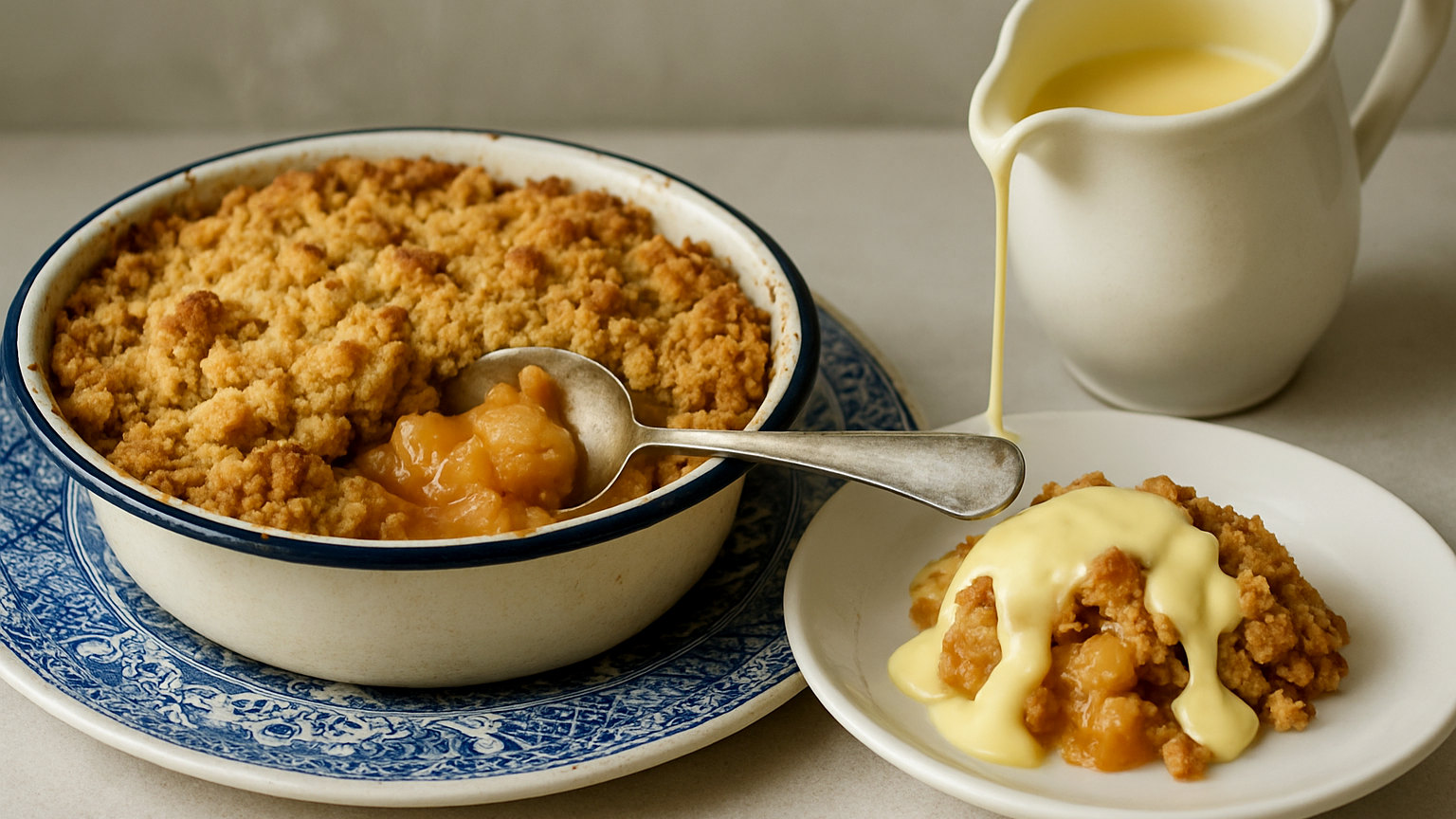
The crumble topping ratio is one part butter, two parts sugar and three parts flour by weight. Once you know that, you never need to look up a topping again: 100g butter, 200g sugar and 300g flour makes enough for a large family crumble, and it scales in both directions without any arithmetic worth worrying about.
Ingredients, serves 6
For the filling:
- 1kg Bramley apples, peeled, cored and cut into thick slices
- 75g caster sugar, or more to taste
- 1 tablespoon plain flour
- Half a teaspoon of ground cinnamon, optional
- Juice of half a lemon
For the topping:
- 100g cold butter, cubed
- 200g sugar, half caster and half demerara
- 300g plain flour
- A pinch of salt
Which apples
Bramleys are the traditional choice because they collapse into a soft puree, which is what most people mean by apple crumble. They are sharp, so they need the sugar.
Eating apples such as Braeburn or Cox hold their shape and give a chunkier filling with more apple flavour and less sweetness required. A mixture of the two gives you both, which is arguably the best result of all.
Method
- Heat the oven to 180C fan, 200C conventional, gas mark 6.
- Toss the apples with the sugar, flour, cinnamon and lemon juice, and tip into a deep ovenproof dish of about 2 litres.
- Rub the butter into the flour and salt with your fingertips until it looks like coarse breadcrumbs with some larger lumps left in.
- Stir in the sugar.
- Scatter the topping over the fruit without pressing it down.
- Bake for 40 to 45 minutes until the top is golden and the fruit is bubbling up at the edges.
- Leave it for 10 minutes before serving, or the filling will be molten.
Do not press the topping down. Crumble stays crisp because steam escapes between the loose crumbs. Compacting it produces a solid lid that goes soft from underneath, which is the most common way a crumble disappoints.
Why the flour goes in the fruit
A tablespoon of flour tossed with the apples thickens the juice they release. Without it the fruit sits in a watery pool that soaks into the topping from below.
Cornflour works too, and a spoonful of ground almonds does the same job while adding flavour.
Keeping the top crisp
Use some demerara in the topping, since the larger crystals do not dissolve fully and give a proper crunch. Keep the butter cold and stop rubbing while there are still pea-sized lumps.
Bake it high enough in the oven that the top gets direct heat, and if it colours before the fruit is soft, cover it loosely with foil rather than turning the oven down.
How much fruit
Fill the dish generously, because apples collapse considerably as they cook and a modest layer disappears into almost nothing. The fruit should come close to the rim before the topping goes on.
The topping wants to be about 2cm deep. Much thinner and it cannot crisp properly; much thicker and the middle stays pale and floury while the surface browns.
Additions
Fifty grams of rolled oats or chopped nuts folded into the topping gives more texture. Replace 50g of the flour rather than adding on top, or the ratio goes off.
Blackberries are the natural partner for apple and need no extra sugar. Rhubarb, plums and pears all work with the same topping, though rhubarb releases more liquid so use two tablespoons of flour.
Making ahead and freezing
The topping keeps in a bag in the freezer for three months and is used straight from frozen, which makes a crumble a fifteen minute job whenever there is fruit to use up.
An assembled unbaked crumble freezes for three months and bakes from frozen at the same temperature for about an hour. A baked crumble reheats at 160C fan for 20 minutes and is better for it than a microwave, which softens the top.
What to serve with it
Proper custard is the traditional accompaniment and the one most people want, and a jug of it made with real vanilla is worth the twenty minutes. Double cream, clotted cream or vanilla ice cream all work, and the contrast of something cold against the hot fruit is part of the point.
For something along the same lines, see Blackberry and Apple Crumble, or browse all our Puddings recipes.

