
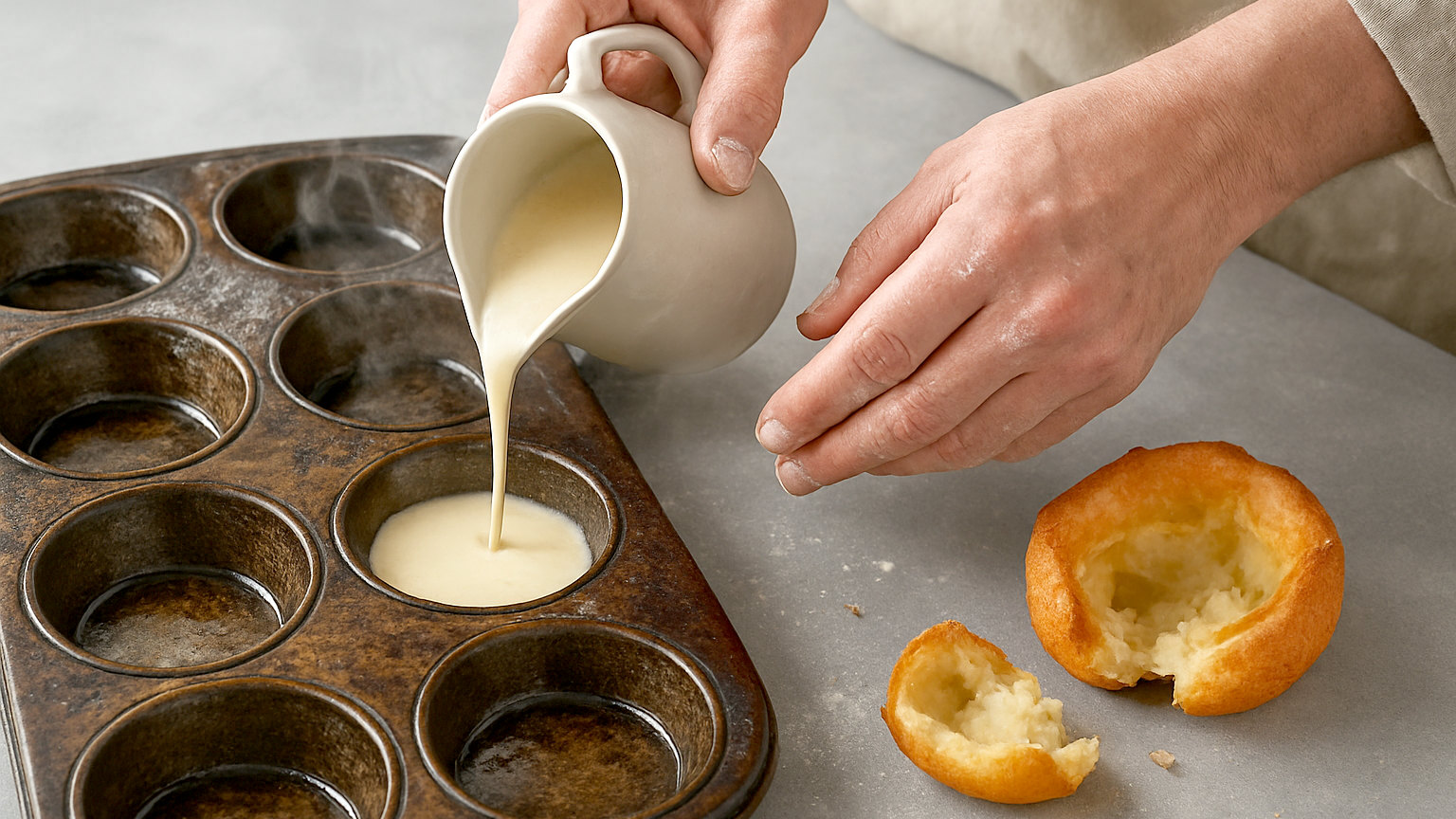
The most useful thing to know about Yorkshire puddings is that they do not need a recipe. The traditional ratio is equal parts egg, flour and milk measured by volume, and once that is in your head you can make any quantity from any number of eggs without looking anything up. It also explains what goes wrong when a recipe is followed carelessly.
How does the ratio work?
Crack your eggs into a measuring jug and read the volume. Use that same volume of plain flour, and that same volume again of milk.
Four large eggs come to around 200ml, so you need 200ml of flour, which weighs about 120g, and 200ml of milk. That makes twelve puddings.
Why measure flour by volume?
Because the ratio only works in volume, not weight. Flour is far lighter than milk for the same space, so an equal weights version would be dense and heavy and would barely rise.
If you prefer scales, the weight equivalent is roughly 4 eggs to 140g flour to 200ml milk, which is the same thing expressed differently.
How do you scale it?
- 2 eggs: about 100ml flour and 100ml milk, makes 6 puddings
- 3 eggs: about 150ml of each, makes 9
- 4 eggs: about 200ml of each, makes 12
- 6 eggs: about 300ml of each, makes 18 or two large tins
What consistency should it be?
Single cream. It should coat the back of a spoon thinly and run off freely, and it should pour easily from a jug.
Thicker than that and the puddings will be heavy. Thinner and they may rise dramatically then collapse.
What happens with more egg?
A higher proportion of egg gives a richer, more custardy pudding with a taller rise and a chewier texture. Some Yorkshire recipes deliberately push this.
Too far and they become almost like a popover or an omelette, with a heavy base and a strong eggy flavour.
What happens with more flour?
A thicker batter that rises less and produces a denser, more bread like pudding. It will be sturdier and better at holding gravy without collapsing.
This is the direction to go for giant filled Yorkshires, where structure matters more than height.
What happens with more liquid?
More steam and a more dramatic rise, followed by more collapse as they cool. The walls will be thinner and crisper and the middle emptier.
Replacing some of the milk with water pushes further in this direction, which is why some cooks use half and half.
Does the flour type matter?
Plain flour is standard. Self raising gives a slightly softer, cakier result and is not an improvement, since the rise comes from steam rather than raising agents.
Strong bread flour produces a chewier pudding with more structure, which suits giant Yorkshires.
Does salt belong in the ratio?
It is not part of the proportions but it should always be there. Half a teaspoon per four eggs, whisked in with the flour.
Unsalted Yorkshire puddings taste noticeably flat, and gravy alone does not fix it.
Does the milk have to be whole?
No. Semi skimmed works and gives a slightly lighter pudding. Skimmed works too, though the flavour is thinner and the browning slightly paler.
Some cooks replace a third of the milk with water for a crisper, taller pudding with a hollower middle, which is a matter of preference rather than correctness.
Can you use the ratio for other batters?
The same batter makes toad in the hole and the base for a savoury pancake, and a thinner version with more milk makes ordinary pancakes.
For toad in the hole, thicken it slightly with extra flour so it can support the sausages as it rises.
How much batter per hole?
Fill each hole of a standard 12 hole tin about two thirds full, which is roughly 3 tablespoons.
Divide the total batter by the number of holes if you are unsure, and pour quickly so they all go into the oven at once.
Next, try Should You Rest Yorkshire Pudding Batter?, or see the rest of our Roasts recipes.


