
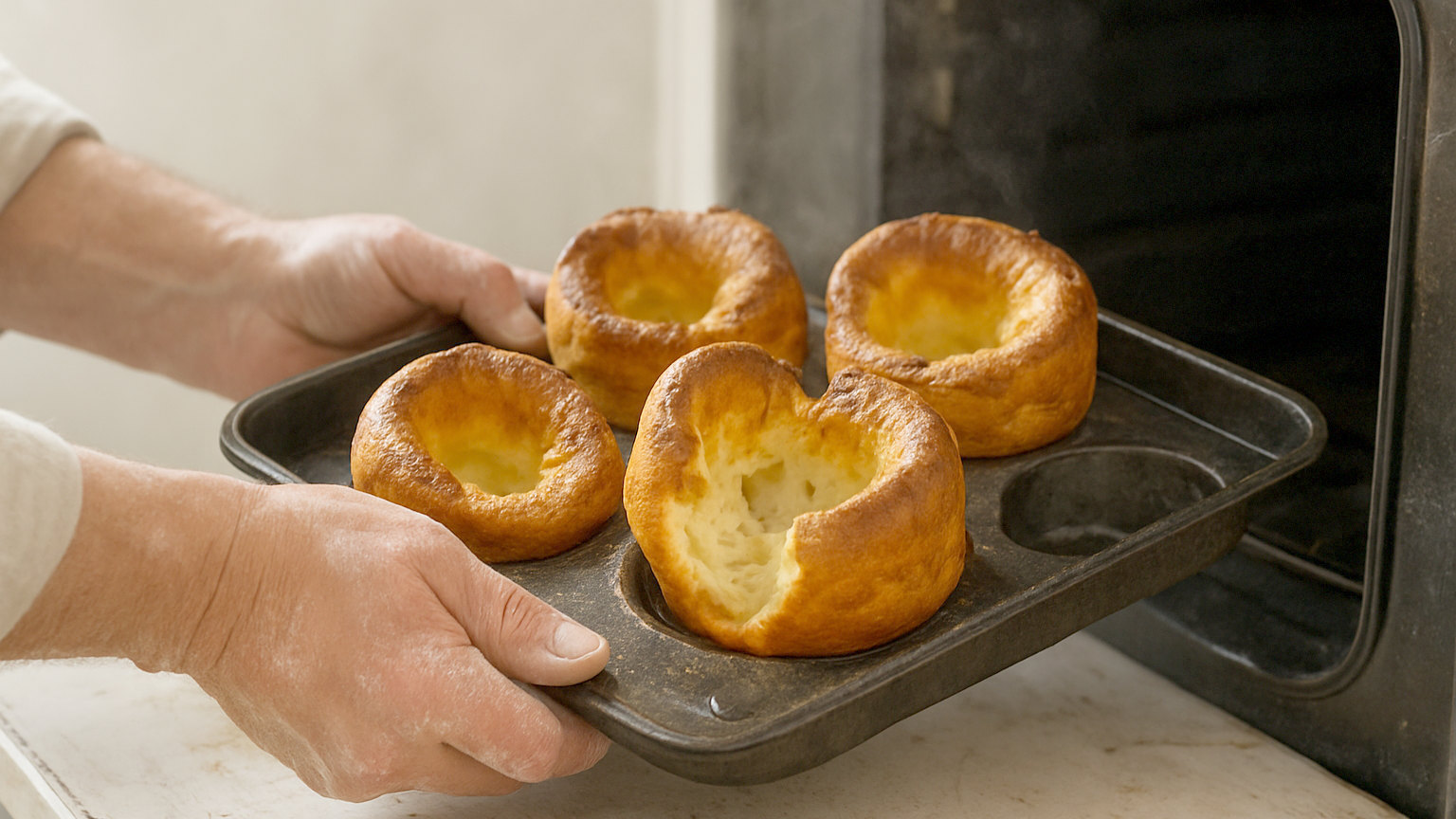
Yorkshire puddings are one of the best things in the freezer, because they take up little space, reheat from frozen in minutes and lose almost nothing in the process. Making a large batch when you have the oven hot anyway is one of the more sensible bits of household cooking, and it removes a difficult job from every subsequent Sunday.
Should you freeze them cooked or raw?
Cooked, without question. Fully baked puddings freeze reliably and reheat well, while frozen batter is inconsistent because the emulsion breaks during freezing.
Cooked puddings also take up far less freezer space than the equivalent volume of liquid batter.
How do you freeze them?
- Bake the puddings fully, until deep golden on the sides as well as the tops.
- Cool them completely on a wire rack, not stacked.
- Open freeze on a tray for two hours until solid.
- Transfer to a bag or rigid box and label with the date.
Cool them completely before freezing. Warm puddings put into a bag steam themselves, and the resulting soft patches will never crisp up again.
Why open freeze first?
Puddings bagged while soft crush each other and fuse into a solid mass. Freezing them separately on a tray first means you can take out two or twelve as needed.
A rigid box protects them better than a bag, since they are fragile once frozen.
How long do they keep?
A month at good quality. They remain safe for longer but start to dry out and pick up freezer flavours after that.
Label with the date, since a bag of frozen Yorkshires looks much the same at one month as at four.
How do you reheat them from frozen?
Do not defrost. Put them straight onto a hot baking tray or oven shelf at 200C fan for 7 to 8 minutes until piping hot throughout.
An air fryer at 200C takes about 5 minutes and gives a slightly crisper result. Reheat once only, following Food Standards Agency guidance.
Do they need any fat when reheating?
No. They already contain the fat they were cooked in, and adding more makes them greasy rather than crisp.
Put them straight onto the shelf or a preheated tray so heat reaches the base as well as the sides.
How do they compare with fresh?
Slightly crisper and slightly less soft in the middle. Under gravy the difference is hard to detect, which is why so many households keep a bagful.
They are certainly better than shop bought frozen ones, which are smaller and more uniform.
Can giant Yorkshires be frozen?
Yes, and they hold up better than small ones because the walls are thicker. Reheat from frozen at 200C fan for about 12 minutes.
Freeze them in a rigid box rather than a bag, since they crush easily.
What about leftovers that were never served?
Puddings cooked and cooled but never reheated can go into the freezer as normal, provided they were cooled within two hours of coming out of the oven.
Cool them quickly on a rack rather than leaving them in a warm tin, which slows cooling considerably.
Can you refreeze leftovers?
No. Puddings that have been frozen, reheated and served should not go back in the freezer.
Any that were reheated and not eaten should be discarded rather than kept, since they have already been through a full heating cycle.
Do they need to be wrapped individually?
No. Once frozen solid they can go loose into a bag or box, and they separate easily without sticking together.
Squeeze the air out of the bag before sealing, since air is what causes freezer burn and the drying that follows it.
Is it worth making a large batch?
Once the oven is at 220C fan and the batter is made, a second tin costs almost nothing in time or energy. Twenty four puddings take barely longer than twelve.
Doing this once in autumn covers most of the Sundays until Christmas.
If that was useful, Giant Yorkshire Puddings for Filling covers related ground, and there is plenty more in Roasts recipes.


