
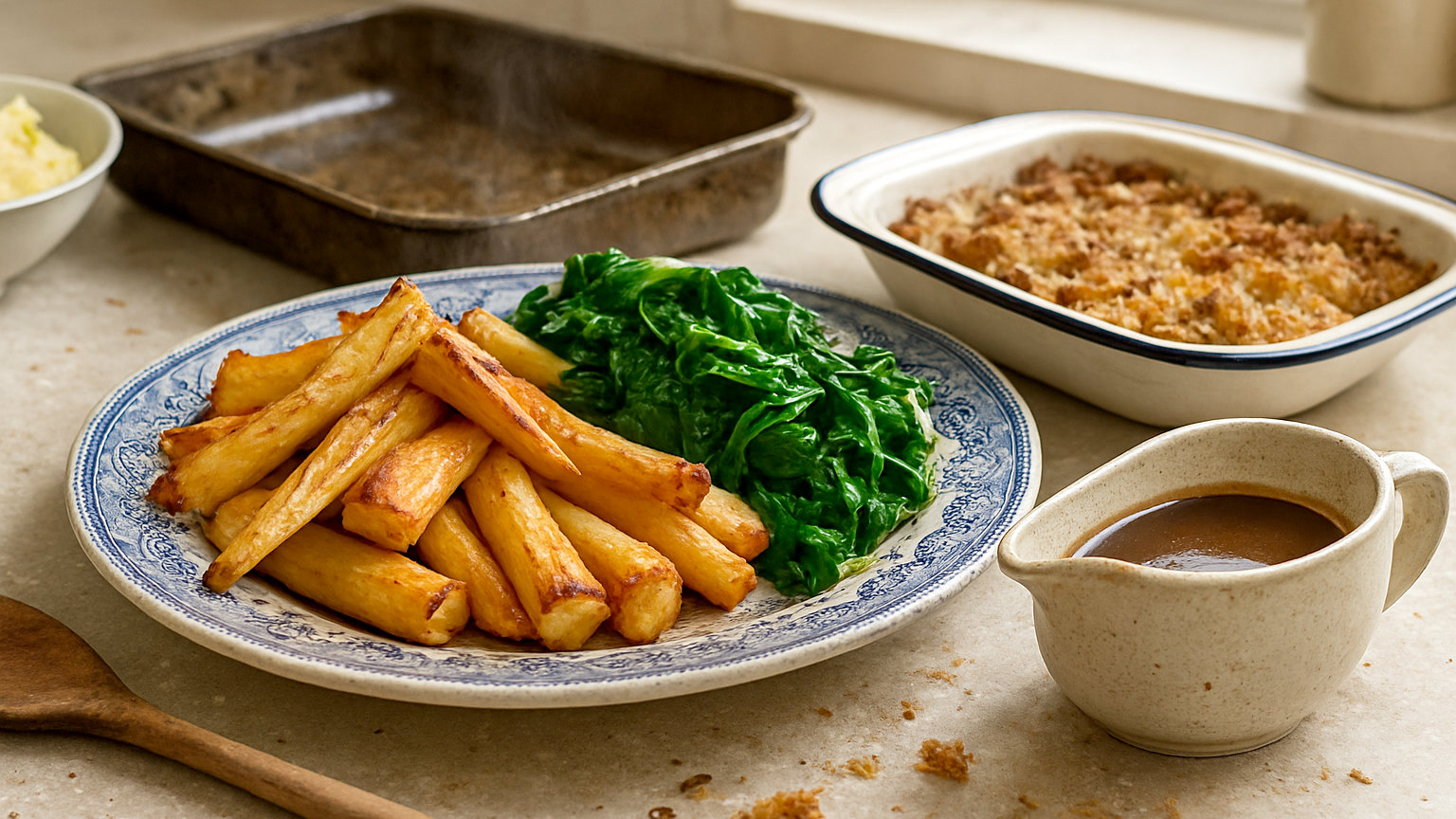
Working out quantities for a roast is where most household food waste starts, usually because people scale up the vegetables in proportion to the number of guests without noticing that appetite does not increase in a straight line. There are reliable figures to start from, and a few points where they need adjusting.
What are the standard quantities?
- Potatoes for roasting: 200g raw per person
- Green vegetable: 100g per person
- Root vegetable: 100g per person
- Gravy: 150ml per person
- Stuffing: 60g per person
Those figures assume two vegetables alongside the potatoes, which is the usual British Sunday plate.
How much does peeling lose?
Around 20 per cent for potatoes, more for celeriac and swede, which can lose a third. Buy 250g unpeeled for every 200g you want on the plate.
Weigh what you want to serve, not what you buy. A 2kg bag of potatoes is closer to 1.6kg once peeled, which is eight portions rather than ten.
What changes at Christmas?
Increase the potatoes to 250g per person and add more items rather than more of each. With sprouts, parsnips, red cabbage, stuffing and pigs in blankets on the plate, each individual portion is smaller.
Allow 100g of sprouts, 130g of parsnips and three pigs in blankets per person.
How much for children?
Roughly half an adult portion for a young child and two thirds for an older one. Roast potatoes are the exception, since children tend to want as many as anyone.
Rather than calculating finely, cook the full amount and plan to use the leftovers.
Does the number of dishes matter?
A great deal. Four vegetables means smaller portions of each, so scale down to about 70g per person per dish rather than 100g once you go past three.
The total on the plate stays roughly constant however many bowls it arrives in.
What about the meat?
Allow 250g per person for boneless joints and 350g for anything on the bone. For a whole chicken, about 400g of bird per person.
Buying a little extra is rarely wasted, since cold roast meat and a pie the following day are half the reason for cooking a joint.
How much should you allow for vegetarians?
Slightly more of everything, since the vegetables are carrying the meal rather than supporting it. Add about 50g per person to each dish and make sure one of them is substantial.
A nut roast or a stuffed squash needs the same 250g per person you would allow for meat.
Does the time of year change it?
People eat more in winter and less in summer, which is worth a rough 10 per cent adjustment either way. A July roast with a chicken and new potatoes is a smaller meal than a February one with beef.
Which items run out first?
Gravy, roast potatoes and Yorkshire puddings, in that order, at almost every table. All three are cheap, so make more than the figures suggest.
Nobody has ever complained about a second jug of gravy.
How do you scale for a large group?
Quantities per head drop slightly as numbers rise, because a big table always contains a range of appetites. For twelve, calculate for ten and a half.
Oven capacity becomes the real limit before quantity does, so plan the tins before the shopping list.
How much gravy is enough?
Allow 150ml per person and then make more, because it runs out at almost every table. It keeps three days in the fridge and freezes for three months, so there is no such thing as too much.
What if guest numbers are uncertain?
Scale the vegetables to the number you expect and the potatoes and gravy to two more. Those are the cheap items and the ones people go back for.
Meat is the expensive part and the hardest to stretch, so that is the figure worth confirming rather than guessing.
What can you do with what is left?
Bubble and squeak uses potatoes and greens together. Leftover roots go into a soup, and cold meat becomes sandwiches, a pie or a curry.
Cool leftovers quickly, refrigerate within two hours and use within two days, following Food Standards Agency guidance.
For something along the same lines, see One Tray Roast Root Vegetables, or browse all our Roasts recipes.


