
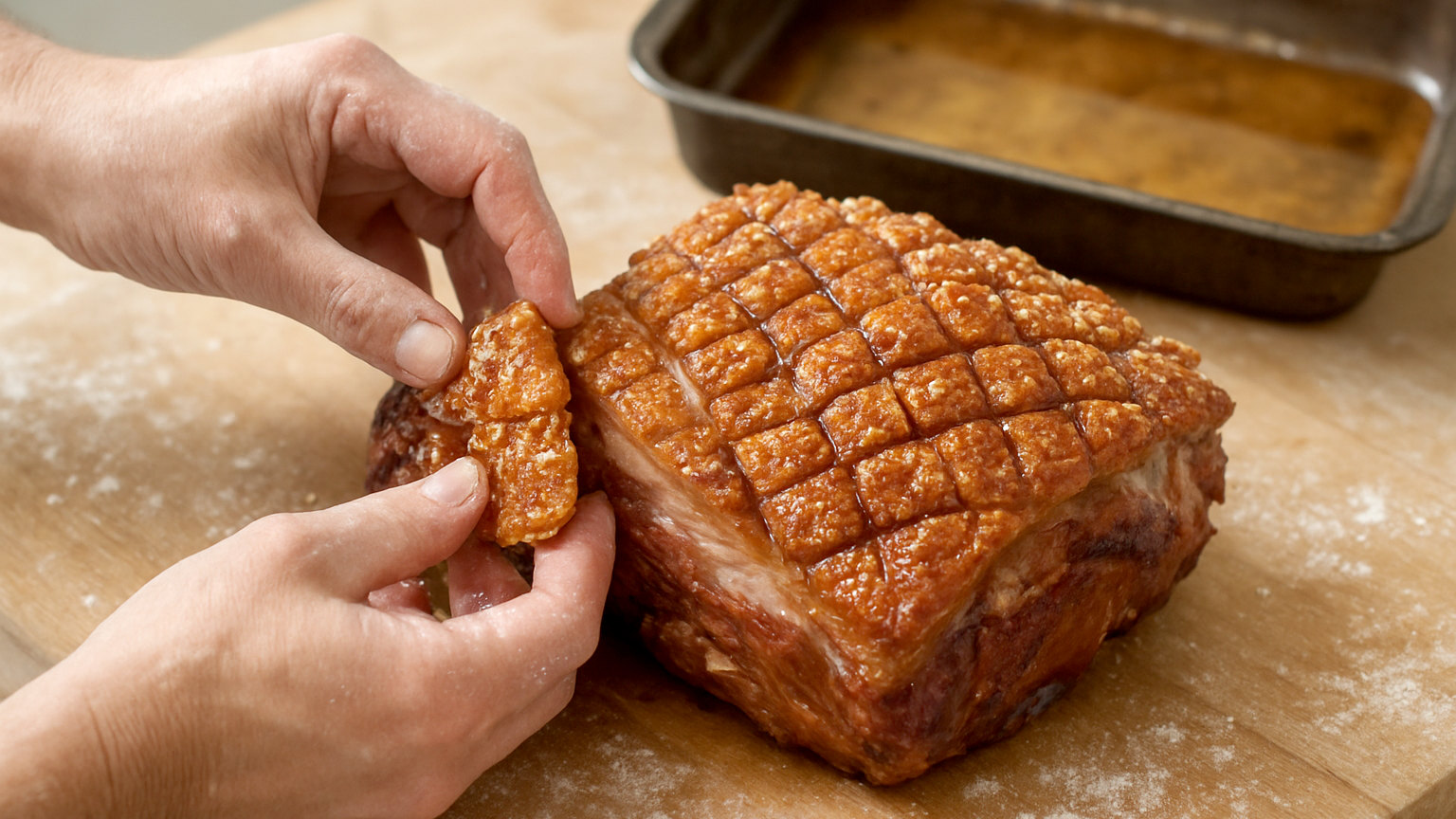
Crackling fails for one of three reasons, and all of them are avoidable. The skin was damp, the scoring was too shallow, or the oven was never hot enough at the right moment. Fix those and crackling becomes reliable rather than a matter of luck, which is how most people seem to treat it. Everything else you may have been told about it is optional.
Why does the skin need to be dry?
Water has to be driven off before the skin can begin to blister and crisp. Every drop still sitting on the surface is turning to steam, and steam keeps the skin at 100C, which is far below the temperature at which it puffs up.
Leave the joint uncovered in the fridge overnight. A refrigerator is a drying environment, and eight hours on a rack does more for the skin than anything you can do in the last twenty minutes.
How deep should the scoring be?
Through the skin and into the fat beneath it, but not into the meat. Cutting into the meat lets the juices out and they will keep the skin wet from below.
Score at intervals of about 1cm. Closer lines give you more edges, and edges are where crackling crisps first.
What is the best tool for scoring?
A clean craft knife or a scalpel, which sounds odd until you have tried one. Pork skin is tough and slippery and most kitchen knives skid across it.
Ask the butcher to score it for you, which is free and takes them thirty seconds. Supermarket joints usually come scored, though often not deeply enough, so go over the lines yourself.
Does salt actually help?
Yes, in two ways. It draws moisture out of the surface, and it seasons the skin so the crackling itself tastes of something.
Rub it in the night before along with the drying, then wipe off any liquid that has been drawn out and add a fresh scattering just before roasting. Use flaky salt rather than fine, which dissolves and disappears.
What temperature makes it crackle?
Very high heat, either at the start or the end. Twenty to thirty minutes at 240C fan will do it, after which the oven drops to 160C fan for the rest of the cooking.
The alternative is to roast the joint low and slow and then blast it at the end. Both work, and the second is more forgiving because you can see how the skin is doing before committing.
Should you add oil?
A light rub of oil helps the salt stick and conducts heat into the skin, so it is worth doing. It is not what makes the crackling crisp, and pouring on more will not improve matters.
Never baste the skin. Spooning fat and juices over it is exactly the opposite of what the surface needs.
Why does crackling go soft again?
Because it has been covered while resting. Foil traps steam against the skin and softens it within ten minutes, undoing an hour of work.
Cut the crackling off the joint before resting, put it on a rack somewhere warm, and rest the meat under foil separately.
Can soft crackling be rescued?
Usually. Cut it away from the joint, lay it flat on a baking tray and give it 10 to 15 minutes at 220C fan on its own. Without the wet meat underneath it, it often crisps perfectly.
A very hot grill does the same job faster, though it needs watching, since crackling goes from pale to burnt in about ninety seconds.
Which cuts give the best crackling?
Belly and shoulder, because they have a thick layer of fat under the skin that renders and effectively fries it from below. Loin works well if the fat has been left on.
Avoid any joint sold with the skin already removed, and check before buying, since a good deal of supermarket pork is trimmed of the one thing you want.
Worth reading next: Roast Pork Loin with Crackling and Gravy. There is more in our Roasts recipes.


