
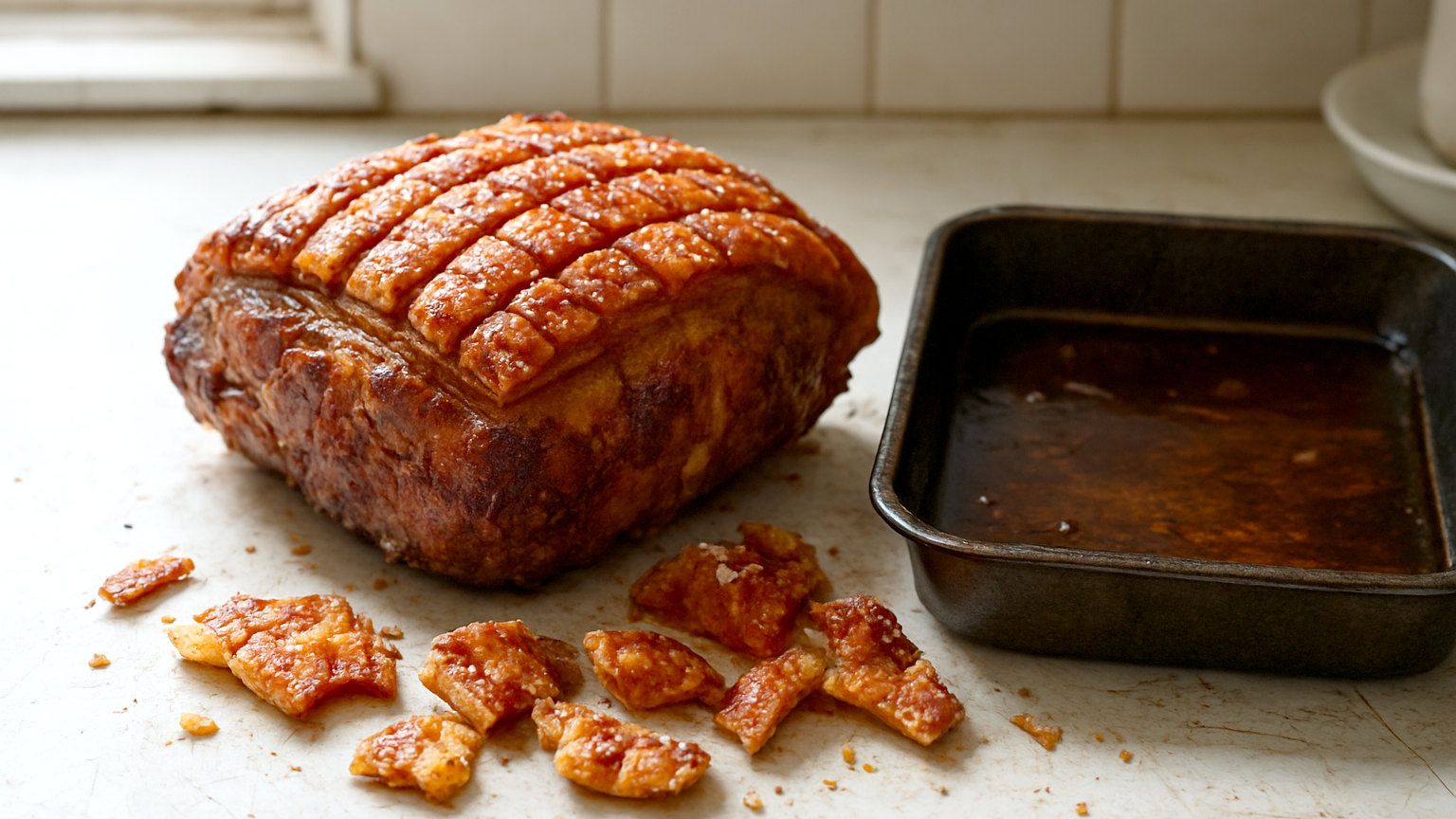
Pork divides into cuts that want speed and cuts that want time, and applying one timing chart to both is how roast pork goes wrong. A loin cooked for four hours is inedible; a shoulder cooked for ninety minutes is worse. What both have in common is a spell at very high heat for the crackling, either at the start or the end.
How long for a pork loin?
Start with 25 minutes at 240C fan for the crackling, then reduce to 160C fan and allow 25 minutes per 500g.
- 1kg loin: about 50 minutes after the blast
- 1.5kg loin: about 75 minutes
- 2kg loin: about 100 minutes
Check with a probe from about fifteen minutes before the chart says, since ovens vary and loin punishes overcooking quickly.
How long for a shoulder or belly?
Think in hours rather than per kilo. After 30 minutes at 240C fan, a 2.5kg shoulder needs 5 to 6 hours at 140C fan, and a 1.5kg belly needs 3 to 3 and a half hours.
Both are done when a fork twists in the meat without resistance, somewhere around 90C to 95C internally, and an extra half hour causes no harm.
What temperature should pork reach?
Whole cuts should reach 75C, or be held at 70C for two minutes, according to Food Standards Agency guidance. Minced pork and sausages should reach 75C throughout with no pinkness.
Take a loin out at about 72C. Carryover heat carries it the rest of the way during resting, and pulling it at 75C means it will arrive at the table nearer 80C and noticeably drier.
How long should pork rest?
Twenty minutes for a loin, thirty for a large joint and thirty for slow roast shoulder. Cut the crackling off before resting and keep it separately on a rack.
Never cover crackling with foil. Trapped steam softens it within ten minutes, which undoes the whole point of the high heat.
Does bone in change the timing?
A bone in loin cooks slightly faster than a boned and rolled joint of the same weight, since the bone carries heat towards the centre. Allow around 5 minutes less per 500g.
Weigh the joint yourself after any stuffing goes in, since the stuffing counts towards the cooking time.
Should the crackling blast come first or last?
Either works. Starting hot is simpler and suits shoulder and belly. Finishing hot lets you see how the skin is doing and suits a loin, where you are watching the internal temperature anyway.
What does not work is a moderate oven throughout, which leaves you with chewy skin rather than crackling.
Should pork come out of the fridge first?
An hour for a loin and ninety minutes for a large shoulder. A cold centre keeps the outside in the heat for longer, which dries the meat under the skin.
If you have dried the skin overnight in the fridge, leave the joint uncovered while it sits so the surface does not pick up moisture again.
What about a stuffed or rolled joint?
Weigh it after stuffing and use the total weight for the timing, adding roughly five minutes per 500g because a rolled joint is denser.
The stuffing itself must reach 75C, so probe the centre of the stuffing rather than the meat around it.
Is pork chop or tenderloin timing different?
Very. A pork tenderloin of about 500g needs only 20 to 25 minutes at 200C fan, and thick chops need 12 to 15 minutes in the oven after searing.
Both are small enough that five minutes matters, so a probe is worth more here than on a large joint.
How do you plan the rest of the meal?
Use the resting period for the roast potatoes at 220C fan. If you are giving the pork its crackling blast at the end instead, the potatoes can go in alongside it at the same temperature.
Stuffing, apple sauce and red cabbage can all be made a day ahead, which takes the pressure off the last half hour entirely.
Next, try Roast Pork Belly with Crisp Skin, or see the rest of our Roasts recipes.


