
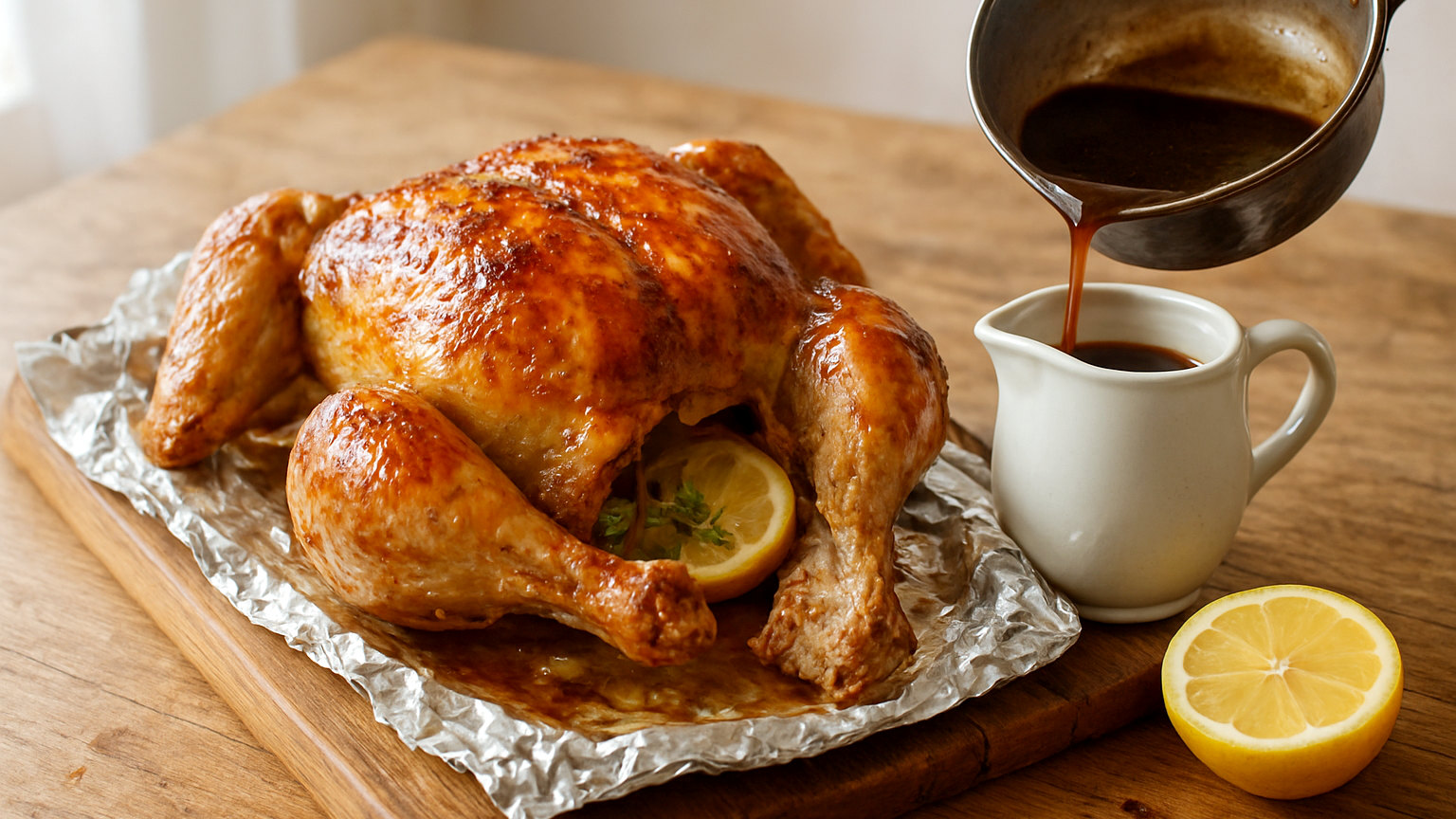
Spatchcocking means cutting out the backbone and pressing the bird flat, and it solves the central problem of roast chicken in one move. With everything at roughly the same thickness, the legs and the breast finish at the same time. It also halves the cooking time, which turns a Sunday roast into a weeknight dinner.
What do you need for 4 people?
- 1 chicken, about 1.6kg
- 3 tablespoons olive oil or 50g softened butter
- 3 cloves of garlic, crushed
- Zest and juice of 1 lemon
- 1 tablespoon chopped thyme or oregano
- 1 teaspoon smoked paprika, optional
- Flaky salt and black pepper
How do you spatchcock a chicken?
- Sit the bird breast down on a board with the legs towards you.
- Using strong kitchen scissors, cut up one side of the backbone from tail to neck.
- Cut up the other side and lift the backbone out. Keep it for stock.
- Turn the bird over and press hard on the breastbone with the heel of your hand until it cracks and the bird lies flat.
- Tuck the wing tips behind the shoulders.
Use scissors rather than a knife. The ribs alongside the backbone are thin and cut easily with shears, while a knife tends to slip and the job becomes considerably more difficult than it needs to be.
How long does it take to cook?
About 45 minutes at 200C fan, 220C conventional, gas mark 7, for a 1.6kg bird. Larger birds take up to an hour.
Check the thickest part of the thigh reaches 75C with juices running clear, in line with Food Standards Agency guidance. Rest for 15 minutes.
Why does it cook so much faster?
Heat has to travel to the centre of whatever it is cooking. A whole bird is a thick round shape with a hollow middle, while a flattened one is an even slab a few centimetres thick.
The same principle explains the evenness. Legs and breast are now at similar distances from the oven air rather than one being shielded by the other.
Should it be marinated?
It responds far better to marinating than a whole bird does, because there is so much more exposed surface. Four hours is plenty and overnight is better.
Salt it at the start rather than the end, so it has time to travel into the meat rather than sitting on the surface.
How do you cook it on a barbecue?
Bank the coals to one side. Start the bird skin side up over the cooler part with the lid on for 30 minutes, then move it skin side down over direct heat for 6 to 8 minutes to char.
Watch for flare ups when the fat drips, and move the bird rather than spraying water, which throws ash onto the meat.
What do you do with the backbone?
Roast it alongside the bird and use it for stock, or freeze it until you have a bag of them. It contains a good deal of flavour and there is no reason to throw it away.
Roasted with the vegetables under the chicken, it also enriches the pan juices considerably.
Can you butterfly other birds the same way?
Yes. Poussin and small guinea fowl spatchcock beautifully and cook in about 30 minutes. A duck can be done the same way, though the fat needs somewhere to drain.
A turkey crown is too thick to flatten usefully, but a whole small turkey can be spatchcocked and it cuts hours off Christmas Day.
How far ahead can it be prepared?
Spatchcock and marinate the bird up to 24 hours in advance and keep it covered on the bottom shelf of the fridge. Take it out an hour before cooking.
What should you serve with it?
Because it is quick, this suits lighter accompaniments than a full roast. Crushed new potatoes, a tomato salad and a green vegetable, or flatbreads and a yoghurt sauce.
Roast potatoes still work if you want the full Sunday plate, and they can share the oven at 200C fan for the whole 45 minutes.
Next, try Should You Truss a Chicken Before Roasting?, or see the rest of our Roasts recipes.


