
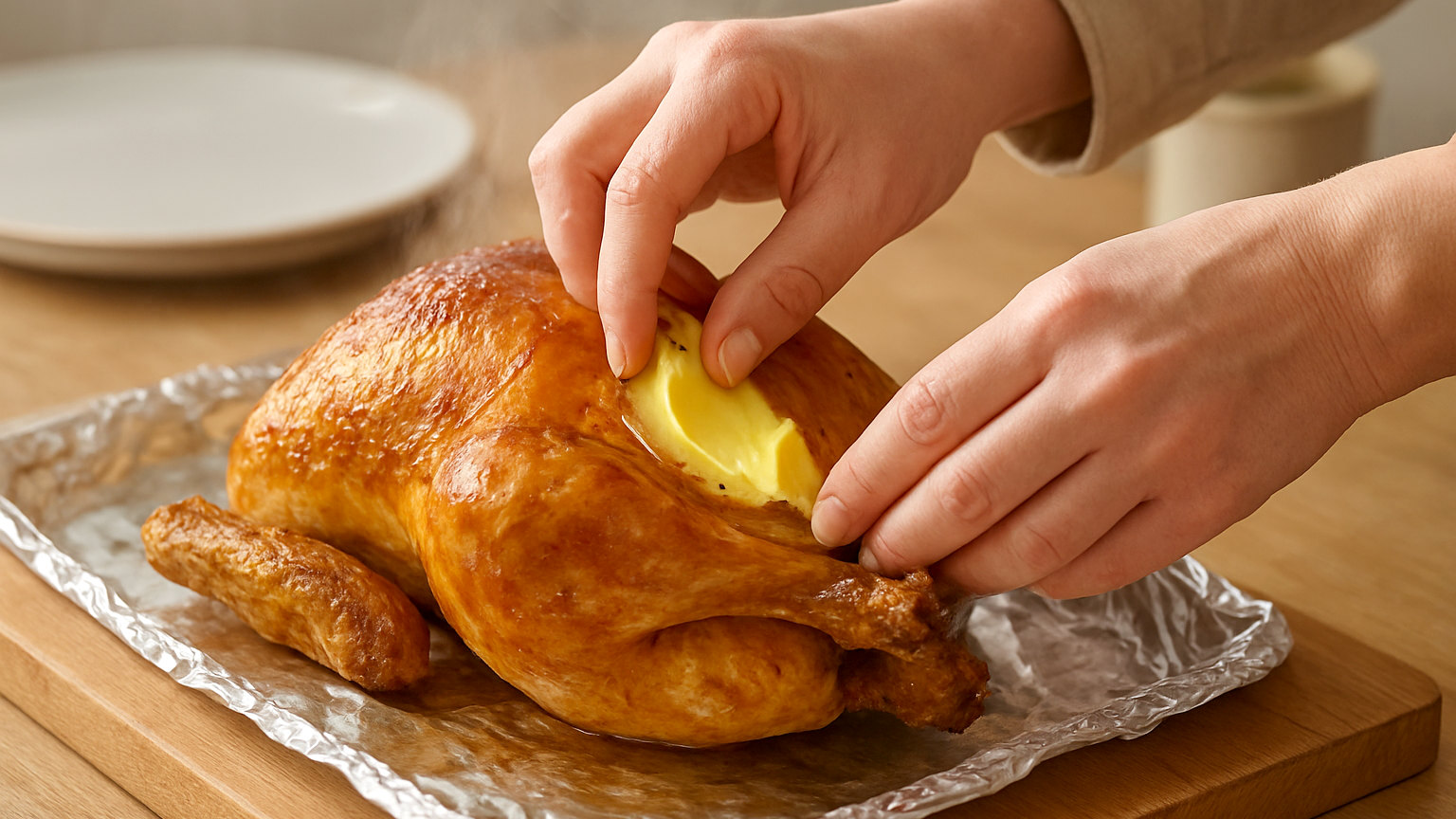
Trussing is one of those steps that appears in nearly every roast chicken recipe without much explanation of why. It ties the legs together and tucks the wings in, which produces a tidier bird. Whether that helps or hinders depends entirely on what you are struggling with, and for most home cooks the honest answer is that it slightly makes the main problem worse.
What does trussing actually do?
It pulls the legs against the body, closing the cavity and making the bird more compact. It also stops the wing tips sticking out where they will burn.
The result is a rounder shape that cooks more slowly overall, because heat has to travel further to reach the middle.
Why might that be a problem?
The perennial difficulty with roast chicken is that the breast is done before the legs are. Trussing shields the legs from the heat and slows them down further.
Leaving the legs splayed helps them cook. Open legs sit exposed to the oven air, so they catch up with the breast rather than lagging behind it, which is exactly what most people want.
When is trussing worth doing?
When the cavity is stuffed and you want to keep the stuffing in. When the bird is going to be carved at the table and appearance matters. And when the legs are so loose that the bird will not sit upright in the tin.
It is also useful for very large birds, where a compact shape browns more evenly.
How do you truss with one piece of string?
- Cut a length of string about 80cm.
- Sit the bird breast up and slide the middle of the string under the tail end.
- Cross the ends over the ankles and pull them together.
- Bring both ends down along the sides of the bird, between the legs and body.
- Pull them tight over the wings to pin them against the body, and tie at the neck end.
Is there a simpler version?
Tie the ankles together with a single loop and tuck the wing tips behind the shoulders. That takes ten seconds, achieves most of the tidiness and does far less to slow the legs down.
Tucking the wings is the part genuinely worth doing every time, since burnt wing tips add nothing.
What can you use instead of string?
Butchers string is best because it does not scorch. Plain cotton kitchen twine works, and in an emergency a strip cut from a clean cotton tea towel will do.
Do not use anything synthetic or coloured, since it can melt or leach dye. Dental floss is sometimes suggested and is fine only if it is unflavoured.
Does it change the cooking time?
A trussed bird takes roughly 10 minutes longer than an untrussed one of the same weight, and a stuffed and trussed bird longer still.
Judge by the thigh temperature rather than the clock. It should reach 75C with clear juices, in line with Food Standards Agency guidance.
What goes in the cavity if not stuffing?
A halved lemon, a head of garlic cut across, an onion and some herbs. These flavour the steam inside the bird and cost nothing, and they can go into the gravy afterwards.
Do not pack the cavity tightly with anything, since airflow through it helps the inside of the bird come up to temperature.
Does it matter for other birds?
It matters more for a turkey, where the shape is bulkier and the legs take considerably longer than the breast. Most cooks truss a turkey and then remove the string partway through so the legs can catch up.
A duck or goose is usually left untrussed, since the priority is rendering the fat and letting air reach as much of the skin as possible.
Is there a better way to solve the leg problem?
Spatchcocking, which removes the backbone and flattens the bird so everything cooks at the same rate. It halves the cooking time as well.
Starting the bird breast down for the first half is the other approach and requires no butchery at all.
If that was useful, Chicken Gravy From the Roasting Tin covers related ground, and there is plenty more in Roasts recipes.


