
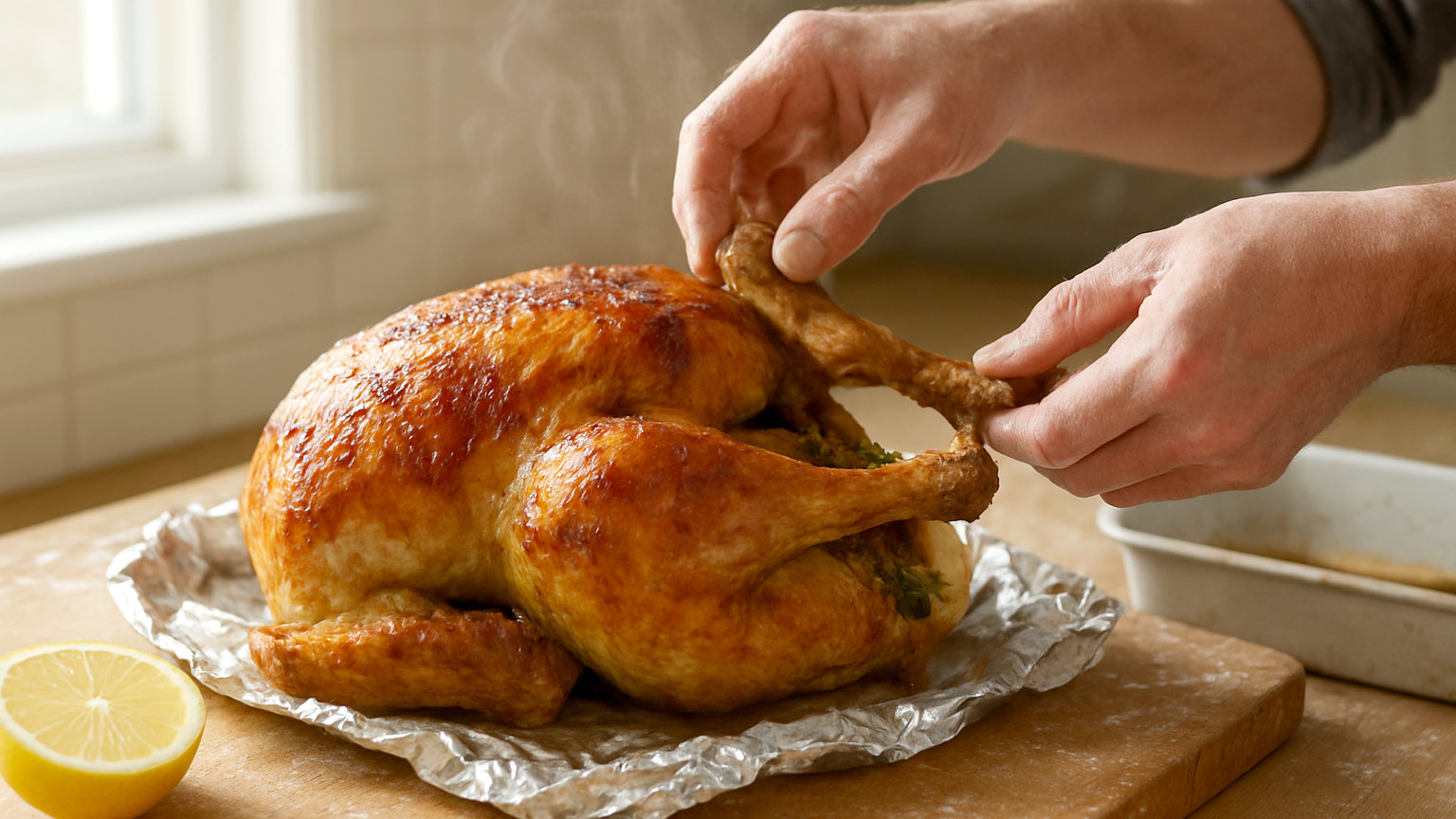
Carving a chicken looks awkward when it is done on the carcass, with the knife trying to work around bones at odd angles. It becomes straightforward the moment you take the pieces off the frame first and slice them on a flat board. The whole job takes about two minutes once you know the order, and it produces far more usable meat than hacking at the bird does.
What do you need?
A sharp knife with a blade of 15cm to 20cm and a board with a channel to catch the juices. A carving fork or a pair of tongs to hold the bird steady.
A very long knife is unnecessary here, unlike with beef. What matters is that it is sharp enough to slice rather than tear.
What is the order?
- Rest the bird for twenty minutes first.
- Cut the skin between the leg and the body, then push the leg outwards until the joint pops.
- Cut through the exposed joint to remove the whole leg. Repeat on the other side.
- Separate each leg into thigh and drumstick by cutting through the joint in the middle.
- Run the knife down one side of the breastbone, then follow the ribcage down to release the whole breast in one piece.
- Repeat on the other side.
- Slice each breast across into three or four thick pieces.
- Cut off the wings and pick the oysters from the underside.
Do not forget the oysters. There are two small pieces of dark meat in hollows on the underside of the carcass near the thighs, and they are the best mouthfuls on the bird.
Why take the breasts off whole?
Because slicing downwards through the breast while it is attached forces the knife against the bone, which tears the meat and leaves a good deal stuck to the carcass.
Off the bone and laid flat, it cuts cleanly into even pieces, and you can carve across the grain rather than along it.
How do you find the leg joint?
Pull the leg away from the body until it dislocates. The joint will now be visible as a pale ball, and the knife goes straight through the gap rather than trying to cut bone.
If you are meeting resistance, you are in the wrong place. Move the knife a centimetre and try again rather than pressing harder.
How do you portion it for four or six?
For four, give each person a leg or thigh piece and a share of breast. For six, separate the thighs and drumsticks and slice the breasts more thinly.
Mix light and dark meat on each plate rather than serving one or the other, since the two eat very differently and most people want some of each.
Should you carve at the table?
A chicken is small enough that it is manageable, unlike a large turkey. It does need a proper board and a bit of room.
Carving in the kitchen and bringing out a warmed dish of arranged pieces is easier and keeps the meat hotter, since it can be covered on the way.
How do you keep the pieces hot?
Warm the serving dish and the plates first. Lay the carved pieces skin side up and overlapping rather than spread out, and spoon a little hot gravy over just before serving.
Carve only what will be eaten. Meat left on the carcass stays moist far longer than a plate of slices.
What about a spatchcocked or portioned bird?
A spatchcocked chicken is carved by cutting straight down between the legs and breasts with heavy scissors or a knife, which takes about thirty seconds and needs no technique.
The same applies to a bird jointed before cooking. This is one of the arguments for spatchcocking when you are cooking for people who are waiting.
What do you do with the carcass?
Make stock. Simmered for three hours with an onion, a carrot, a stick of celery and a bay leaf, it gives you something far better than anything in a carton.
Strip any remaining meat the same evening rather than leaving the bird out overnight. Cool it quickly, refrigerate within two hours and use within two days, in line with Food Standards Agency guidance.
Worth reading next: Why Is My Roast Chicken Dry?. There is more in our Roasts recipes.


