
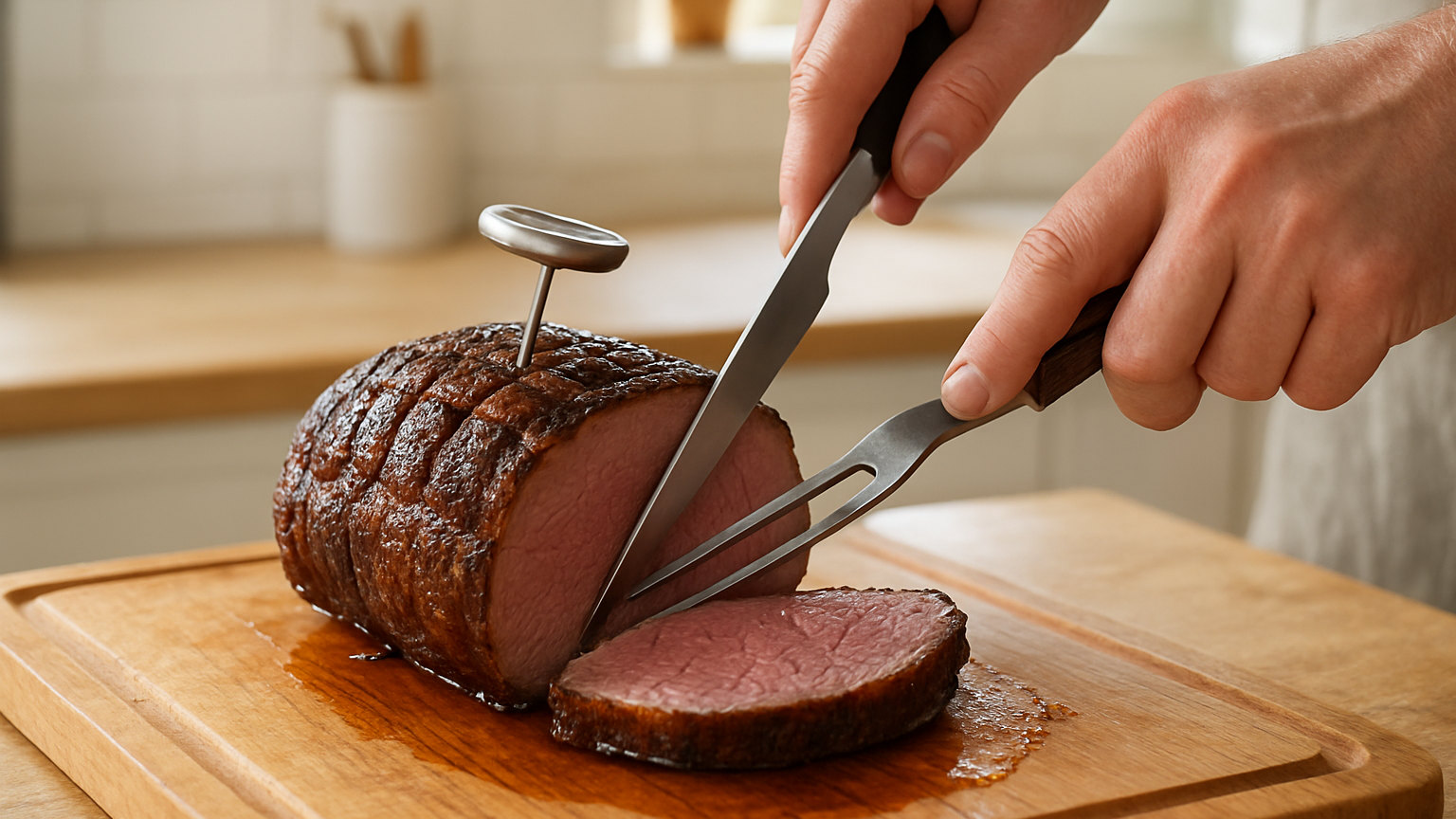
Roasting for two is not simply a matter of buying less beef. Small joints are genuinely harder than large ones, because heat has only a short distance to travel and the whole thing can go from rare to well done in the time it takes to lay the table. The window is perhaps eight minutes wide, which is why the browning happens in a pan and the finish is judged by probe.
Ingredients, serves 2 with leftovers
- 700g thick piece of rolled sirloin or a short topside joint
- 1 tablespoon beef dripping
- 1 onion, thickly sliced
- 2 garlic cloves, crushed
- A knob of butter and a sprig of thyme
- 1 tablespoon plain flour
- 100ml red wine
- 300ml beef stock
- Flaky salt and coarse black pepper
Method
- Take the joint out of the fridge an hour ahead and dry the surface thoroughly.
- Heat the oven to 200C fan, 220C conventional, gas mark 7.
- Season heavily, then brown the joint hard in the dripping in a small ovenproof pan, about 6 minutes in total for all sides.
- Add the butter, garlic and thyme and baste for a minute.
- Scatter the onion into the pan and sit the joint on top, fat side up.
- Roast for 20 to 22 minutes, checking from 18 minutes.
- Remove at 51C in the centre and rest for 15 minutes on a warm board.
- Set the pan over a low heat, stir the flour into the juices, cook for a minute, add the wine and reduce, then whisk in the stock and simmer for 8 minutes.
Sear a small joint in a pan rather than in the oven. It cannot spend twenty minutes at 220C building a crust without cooking through, so the browning has to be done separately and fast.
Why are small joints so difficult?
In a 3kg rib the centre is a long way from any hot surface, so the temperature climbs slowly and there is a wide window in which to catch it. In a 700g joint that distance is a few centimetres.
Small joints also lose moisture faster, because they have far more surface area relative to their weight.
What shape should you buy?
Short and thick rather than long and slim. A stubby sirloin joint is much easier to control than a slender rolled one of the same weight, because the middle is better protected.
A single rib on the bone, sold as a cote de boeuf, is the luxury option and behaves like a very thick steak.
Does the tin size matter?
Considerably. A small joint marooned in a large tin has hot metal all around it, which scorches the juices and leaves nothing for gravy. Use the smallest pan it fits, or sit it on sliced onion to protect the base.
Is a thermometer essential?
More here than for any other joint. Twenty minutes is short enough that a five minute misjudgement is the difference between rare and medium well. Probe from the end towards the centre and check twice.
How do you scale the trimmings?
The joint shrinks but the accompaniments do not. Allow four roast potatoes each, make a full batch of Yorkshire pudding batter and make the full quantity of gravy, since two people can get through 300ml without difficulty.
Would a thick steak work better?
Often, yes. A 500g sirloin or rump cut at 5cm thick, seared hard and given eight minutes in the oven, delivers the same eating experience with far less risk and half the time.
Carved into thin slices and covered in gravy it looks no different on the plate, and it removes the awkwardness of roasting a joint too small to behave predictably.
Should you buy more than you need?
Yes. An extra 200g costs little, roasts more evenly and turns into sandwiches the next day. Cool any leftovers quickly, refrigerate within two hours and use within three days, in line with Food Standards Agency advice.
If that was useful, Roast Sirloin of Beef with Red Wine Gravy covers related ground, and there is plenty more in Roasts recipes.


