
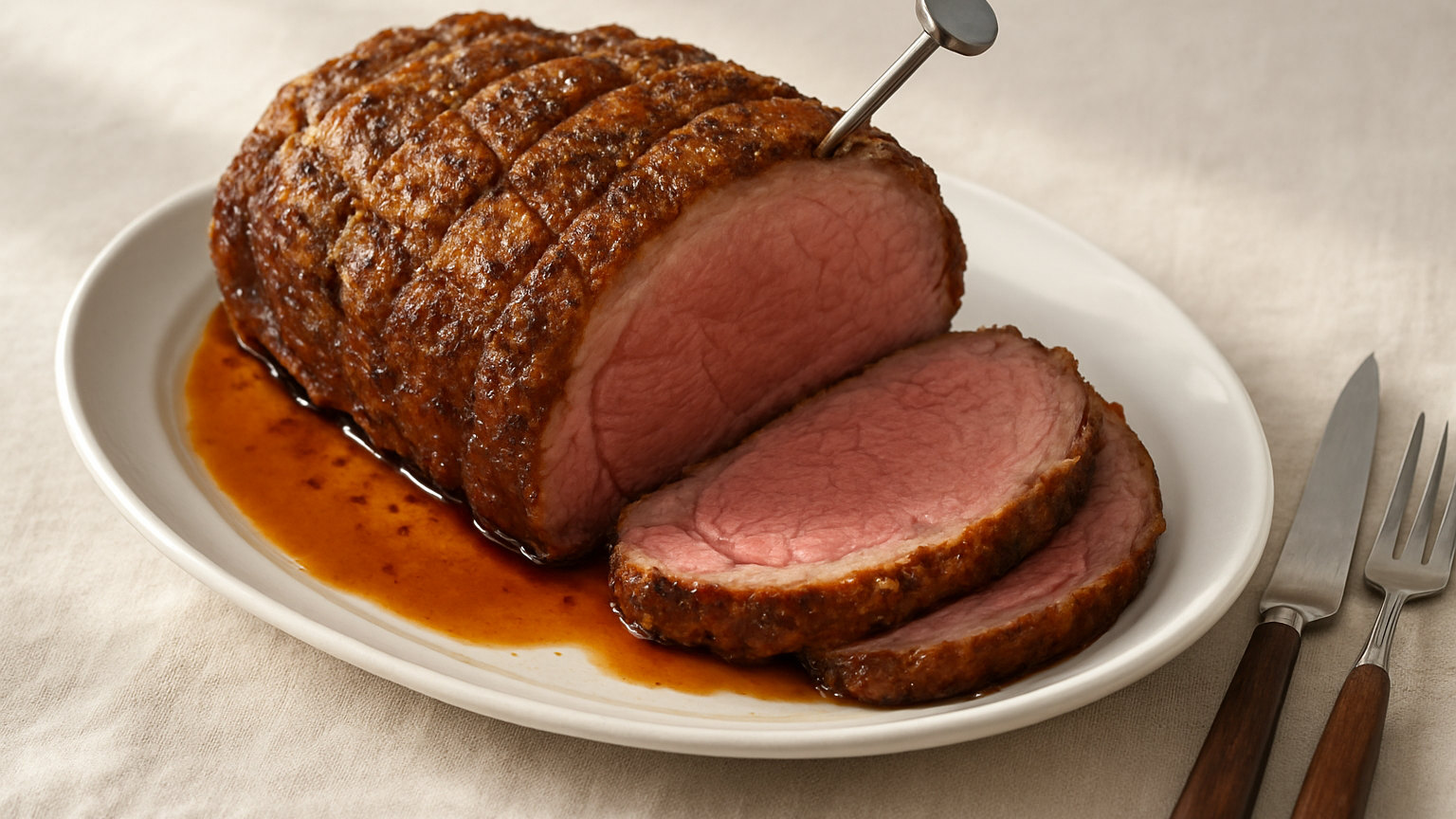
A mustard and herb crust does two useful things to a roasting joint. It seasons the outer layer far more thoroughly than salt alone, and it gives a savoury, crunchy surface that makes lean beef considerably more interesting. The technique works on topside, sirloin or rump, and it costs about four minutes of preparation on top of an ordinary roast.
Ingredients, serves 6
- 1.6kg topside or rolled sirloin of beef
- 3 tablespoons English mustard
- 1 tablespoon wholegrain mustard
- 75g fresh white breadcrumbs
- 3 tablespoons chopped parsley
- 1 tablespoon chopped thyme leaves
- 1 tablespoon chopped rosemary
- 2 garlic cloves, crushed
- 2 tablespoons beef dripping, melted
- 2 onions, thickly sliced
- Flaky salt and coarse black pepper
Method
- Take the beef out of the fridge an hour ahead and dry the surface thoroughly.
- Heat the oven to 220C fan, 240C conventional, gas mark 9.
- Mix the breadcrumbs, herbs, garlic and melted dripping in a bowl and season well.
- Season the joint all over, sit it fat side up on the onions in a roasting tin, and roast for 20 minutes.
- Take the tin out and turn the oven down to 180C fan.
- Spread both mustards over the top and sides of the joint, then press the herb crumbs firmly onto the mustard.
- Return to the oven and cook for 17 minutes per 500g for medium rare, roughly 55 minutes for this joint.
- Cover loosely with foil if the crust darkens before the beef is ready.
- Remove at 51C in the centre and rest for 25 minutes.
Put the crust on after the first 20 minutes, not before. Applied at the start it burns during the initial high heat, and the mustard loses its sharpness over the full cooking time.
Why does mustard hold the crumbs on?
It is thick and slightly sticky, and it sets as it heats, gluing the breadcrumbs to the meat. Egg white does the same job but adds nothing to the flavour, and oil alone lets the crumbs slide off during carving.
Press the crumbs on firmly with the flat of your hand rather than scattering them, so they bond to the mustard layer properly.
Does the mustard taste strong?
Far less than you would expect. Heat drives off most of the volatile heat in English mustard, leaving a savoury depth rather than a burn.
The wholegrain mustard survives better and gives little pops of flavour through the crust, which is why both are worth using together.
Which herbs work best?
Woody herbs stand up to the oven, so thyme and rosemary are the backbone. Parsley adds freshness and colour but should be chopped finely so it does not scorch.
Avoid basil and coriander, which turn black and bitter at roasting temperatures.
How do you stop the crust going soft?
Use dry breadcrumbs made from bread left out overnight rather than fresh soft crumbs, and do not cover the joint tightly while it rests.
Lay the foil loosely over the top so steam can escape. Foil pressed down against the crust will soften it within ten minutes.
Which cut takes a crust best?
Anything with a flat top surface and a fat cap to anchor the mustard. Topside and rolled sirloin are ideal, and rump works well if the joint has been tied into a reasonably even shape.
A bone in rib is the one cut to leave alone, since its own fat and bone are already doing the same job and the crust simply falls off during carving.
Can the crust be made ahead?
The crumb mixture keeps three days in the fridge and freezes for a month, so it is worth making double. The mustard goes on at the last minute.
What should you serve with it?
Roast potatoes, greens and a plain gravy made from the tin. The crust is doing enough work that a heavily flavoured sauce competes with it, so keep the gravy simple.
Cool leftovers quickly, refrigerate within two hours and use within three days, following Food Standards Agency guidance. The crust softens overnight but the beef makes excellent sandwiches.
See also Roast Rib of Beef on the Bone, or browse more Roasts recipes.


