
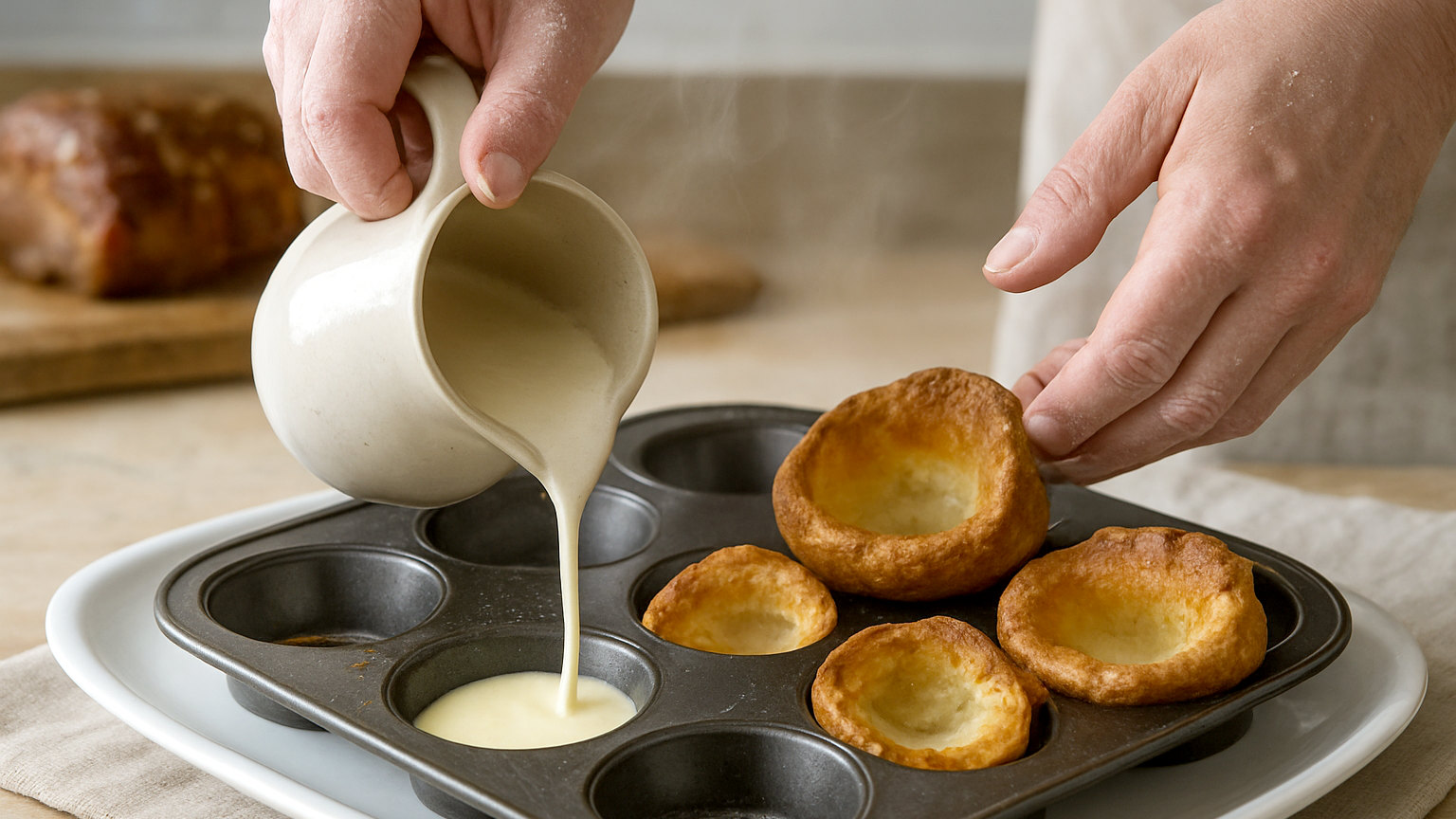
Most Yorkshire pudding recipes call for milk, some call for water, and a number of experienced cooks use half of each without ever explaining why. The two liquids genuinely do different things, and the choice is a trade between flavour and height. Neither is wrong, and knowing what each contributes lets you aim at the pudding you actually want.
What does milk do?
It brings fat, protein and lactose, all of which contribute flavour and help the puddings brown. The result is richer, softer and a deeper golden colour.
Milk also makes the batter slightly heavier, so the rise is a little less dramatic than with water.
What does water do?
Water is pure steam once it hits the heat, with nothing weighing it down. A water based batter rises higher and produces thinner, crisper walls and a hollower middle.
What it loses is flavour and colour. Water puddings can taste flat and look pale, which is why very few recipes use water alone.
Is half and half the answer?
For many cooks, yes. Replacing a third to a half of the milk with water gives most of the extra height while keeping enough of the richness and browning.
Start by replacing a third and adjust from there depending on whether you want taller or tastier.
Does the fat content of the milk matter?
Whole milk gives the richest flavour and best colour. Semi skimmed produces a marginally lighter pudding and is what most households have.
Skimmed works but browns less and tastes thinner, which is effectively a step towards the water version.
What about dairy free milks?
Oat milk is the best substitute, since it browns well and has enough body. Soya works and can taste slightly beany.
Almond and rice milks are thin and produce pale puddings, closer to a water batter in behaviour. Choose unsweetened versions in every case.
Should the liquid be cold?
Yes. The rise depends on the contrast between cold batter and smoking fat, so batter straight from the fridge starts from the best possible position.
This applies whether you are using milk, water or a mixture.
Does sparkling water help?
It is often suggested and the effect is small. The bubbles largely escape during whisking and resting, and the rise still comes overwhelmingly from steam.
If you use it, add it at the last moment rather than before resting, so at least some of the carbonation survives.
Can you use stock instead?
You can, and it makes a savoury pudding that suits being served with a stew. Use it in place of the water portion rather than all the liquid.
Keep it unsalted or reduce the salt in the batter, since stock is usually seasoned already.
Does the liquid affect how they keep?
Milk based puddings stay softer for longer, while water based ones crisp harder and go stale slightly faster once cooled.
If you are batch cooking for the freezer, a milk batter holds up marginally better on reheating.
Does the ratio change?
No. Equal parts egg, flour and liquid by volume holds whether the liquid is milk, water or a mixture of the two.
The consistency you are aiming for is single cream in every version.
Does it change the cooking time?
Barely. A water heavy batter may set a minute or two faster because there is less fat and protein to cook through, but the difference is within normal oven variation.
Judge by colour rather than the clock in either case, and look for deep gold on the sides rather than just the top.
Which should you choose?
Milk for puddings served with a roast, where flavour matters and they will be eaten with gravy. A milk and water mix for maximum height, or for giant puddings where you want dramatic walls.
Try both across two Sundays with the same tin and oven, which is the only comparison that means anything in your own kitchen.
For something along the same lines, see Can You Make Yorkshire Pudding Batter Ahead?, or browse all our Roasts recipes.


