
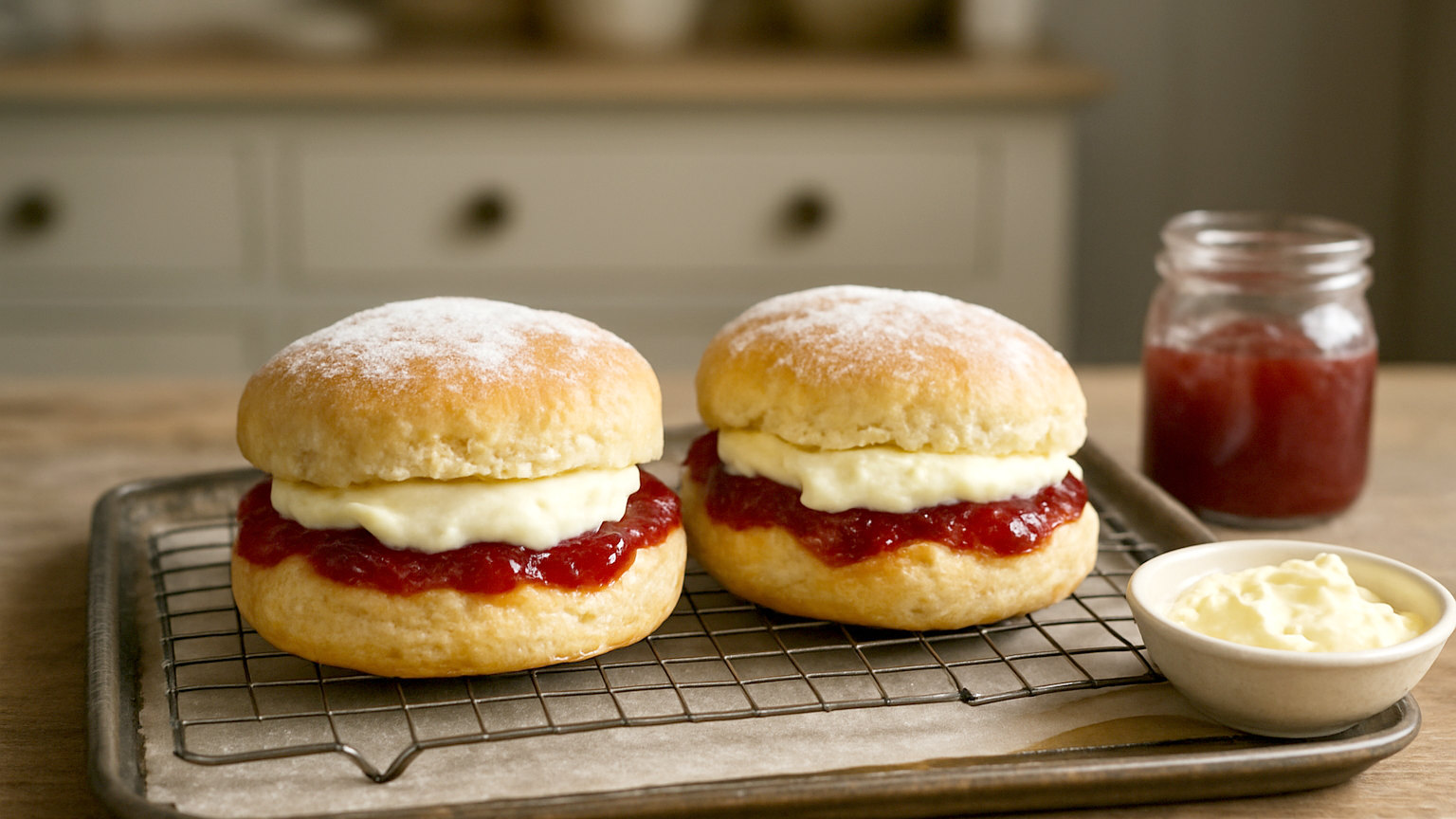
Devon splits, also called Cornish splits or Chudleighs, are soft sweet yeasted buns that were the original base of the West Country cream tea before scones displaced them. They are split, filled with jam and clotted cream and dusted with icing sugar. Filled with golden syrup and cream instead, they are called thunder and lightning.
What do you need for 12 splits?
- 500g strong white bread flour
- 7g fast action yeast and 1 teaspoon salt
- 50g caster sugar
- 50g butter, softened
- About 300ml warm whole milk
- Icing sugar to dust
- Jam and clotted cream to fill
How do you make them?
- Combine the flour, yeast, salt and sugar, keeping salt and yeast apart initially.
- Rub in the butter, then add the warm milk to make a soft dough.
- Knead for 10 minutes until smooth and elastic.
- Prove for 1 hour 30 minutes until doubled.
- Divide into 12 and shape into smooth rounds.
- Space on trays and prove for 45 minutes.
- Bake at 190C fan for 12 to 15 minutes until pale gold.
- Cool under a cloth to keep the crust soft, then split and fill.
Cool them under a clean tea towel. Trapped steam softens the crust, which is what a split should have. Cooled uncovered on a rack they develop a firm crust and become ordinary bread rolls.
How are they different from scones?
A split is a yeasted bread bun, soft and slightly chewy. A scone is raised chemically and is crumbly and short.
Splits are also less rich and take considerably longer to make.
Should they be glazed?
No. They are baked plain and pale, then dusted with icing sugar once filled.
An egg glaze gives a shine and a firmer crust, both of which are wrong here.
Why did scones replace them?
Scones are quicker, needing no proving, which suited commercial tea rooms serving large numbers of Victorian tourists.
Splits survive in traditional Cornish and Devon bakeries.
What is thunder and lightning?
A split filled with clotted cream and golden syrup or treacle instead of jam. The name describes the pale cream and the dark syrup.
It is a Cornish speciality worth trying.
Are they served warm?
Warm or at room temperature. Hot from the oven the clotted cream melts, which defeats the purpose.
Twenty minutes out of the oven is about right.
What is a Chudleigh?
The Devon name for the same bun, after the town of Chudleigh.
Devon split, Cornish split and Chudleigh all describe the same thing.
Should they be split all the way?
Traditionally they are cut at an angle rather than straight across, which is where the name comes from.
Can they be made in a mixer?
Easily, with a dough hook for 8 minutes. The dough is soft but not unmanageable by hand.
How should the dough feel?
Soft and slightly tacky. A firm dough gives a dense bun rather than the light soft crumb wanted here.
Why do they need two proves?
The first develops flavour and structure and the second gives the shaped buns their lightness. Skipping the second gives dense splits.
Forty five minutes for the second is enough.
Can they be made savoury?
Reduce the sugar to 25g and they work well as soft rolls for ham or cheese.
How should they be filled?
Jam first, then clotted cream, dusted with icing sugar. The Cornwall and Devon argument applies here as much as to scones.
Fill them shortly before eating, since the bread softens.
How large should they be?
About 70g of dough each, which gives twelve from this quantity and a bun that sits comfortably in the hand.
They are smaller than a Sally Lunn and larger than a dinner roll.
Why should they stay pale?
A split should be soft rather than crusty, so twelve to fifteen minutes at a moderate heat is enough. A deep brown crust is wrong for them.
How long do they keep?
A day, since they stale quickly. They freeze for a month and refresh at 160C fan for 5 minutes.
If that was useful, Cream Tea: Devon or Cornwall covers related ground, and there is plenty more in Regional recipes.


