
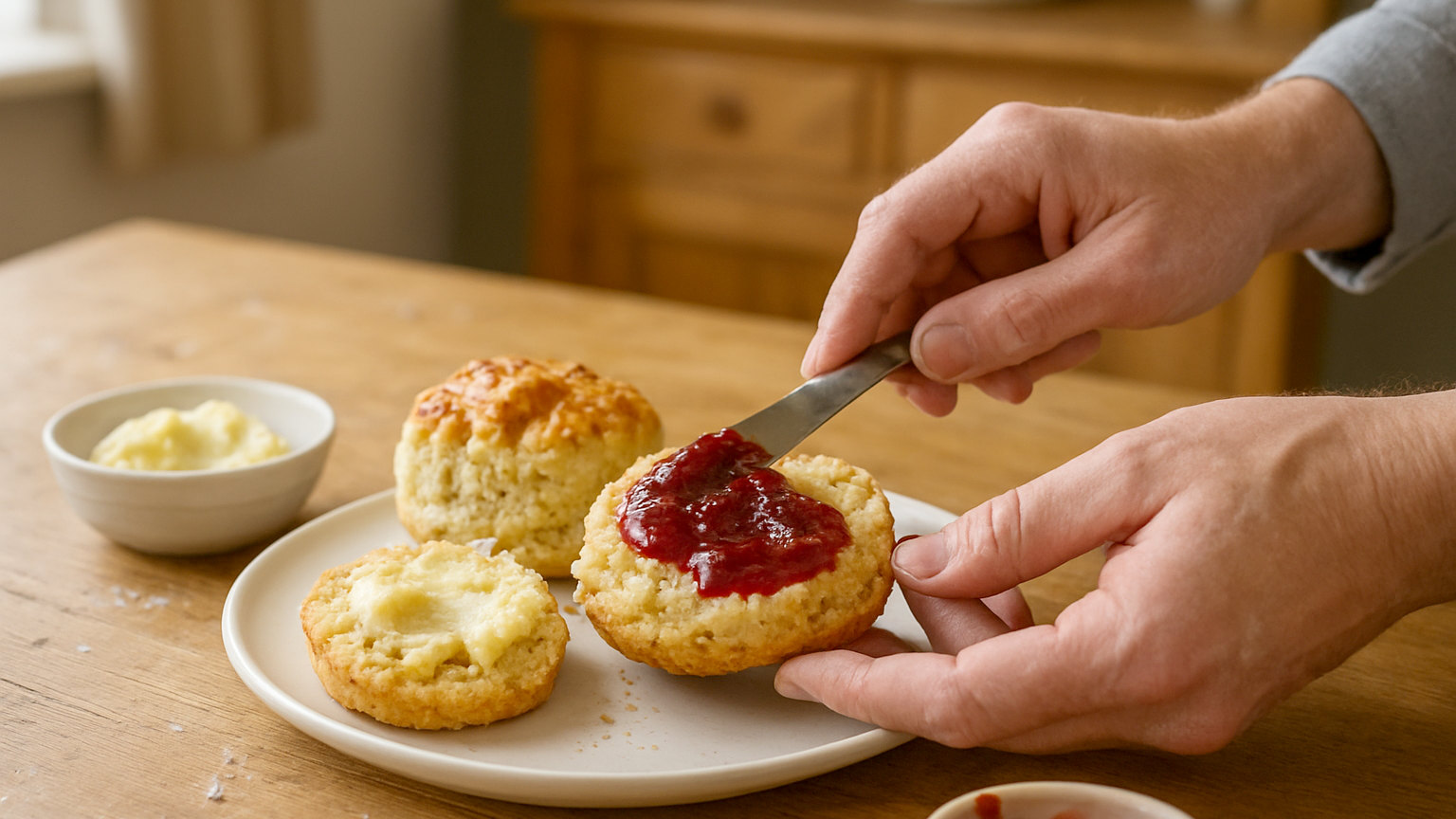
A cream tea is scones, clotted cream, strawberry jam and a pot of tea. That much is agreed. The order in which the jam and cream go on the scone is not agreed, and the disagreement runs along the Devon and Cornwall border with genuine feeling on both sides.
What is the Devon method?
Cream first, spread onto the scone like butter, then jam on top of it.
Devon has the older documented association with clotted cream, with references going back to the eleventh century at Tavistock Abbey.
What is the Cornish method?
Jam first, spread onto the scone, then a spoonful of clotted cream on top.
The cream sits proud like a topping rather than being spread flat.
Which one works better?
There is a practical argument for jam first. Clotted cream is thick enough to spread on top of jam without disturbing it, while jam spread onto cream tends to drag it about.
That said, spreading cold cream onto a warm scone is easier than spreading jam onto one. Neither side is going to concede.
What should a cream tea include?
- Two scones per person, warm
- Clotted cream, not whipped or squirty
- Strawberry jam, traditionally
- A pot of tea
Is it eaten instead of lunch?
It is substantial enough to replace one, and traditionally it sits in the afternoon between meals.
Should the scones be plain or fruit?
Plain is traditional, since the jam supplies the fruit. Fruit scones are common and not incorrect.
They should be warm rather than hot, or the cream melts.
Does it have to be a scone?
In Cornwall a split, a soft sweet yeasted bun, is the older base and is still used in some tea rooms.
Scones took over through the twentieth century.
How much cream per scone?
A generous spoonful, around 25g. A cream tea is not the moment for restraint.
Should scones be cut or broken?
Split horizontally, either with a knife or by pulling apart with the thumbs, which gives a rougher surface that holds more cream.
Should scones be warm or cold?
Warm, but not hot. A hot scone melts the clotted cream into a puddle, and a cold one is dull.
Fifteen minutes out of the oven is about right.
Can you use squirty cream?
Not in a cream tea. Clotted cream is the defining ingredient and whipped or aerosol cream makes it something else.
Is it the same as afternoon tea?
No. Afternoon tea includes sandwiches and cakes as well. A cream tea is scones, cream, jam and tea and nothing else.
It is a smaller and considerably older tradition.
Should the cream be spreadable?
Take it out of the fridge twenty minutes before serving. Fridge cold clotted cream is hard and tears the scone.
It should be thick enough to hold a shape but soft enough to spoon.
Where did it come from?
Clotted cream has been made in the West Country for centuries, and the cream tea as a commercial offering grew with Victorian tourism to Devon and Cornwall.
Is there an official ruling?
None that either county accepts. Both methods have been defended at various times by tourist boards, chefs and the National Trust, and the argument continues.
It is a matter of local loyalty rather than fact.
Should butter go on as well?
No. Clotted cream is rich enough that butter is redundant, and adding it is generally considered wrong on both sides of the border.
A warm scone needs nothing else.
What tea should be served?
A strong black tea, brewed in a pot. It needs to stand up to the cream and jam.
Milk in a jug, served separately.
How many scones per person?
Two is standard, which with cream and jam is a substantial afternoon.
Does the jam have to be strawberry?
Traditionally yes. Raspberry is the common alternative and anything sharp works well against the cream.
Refrigerate clotted cream and use it within the date on the pack, in line with Food Standards Agency guidance.
See also Clotted Cream, or browse more Regional recipes.


