
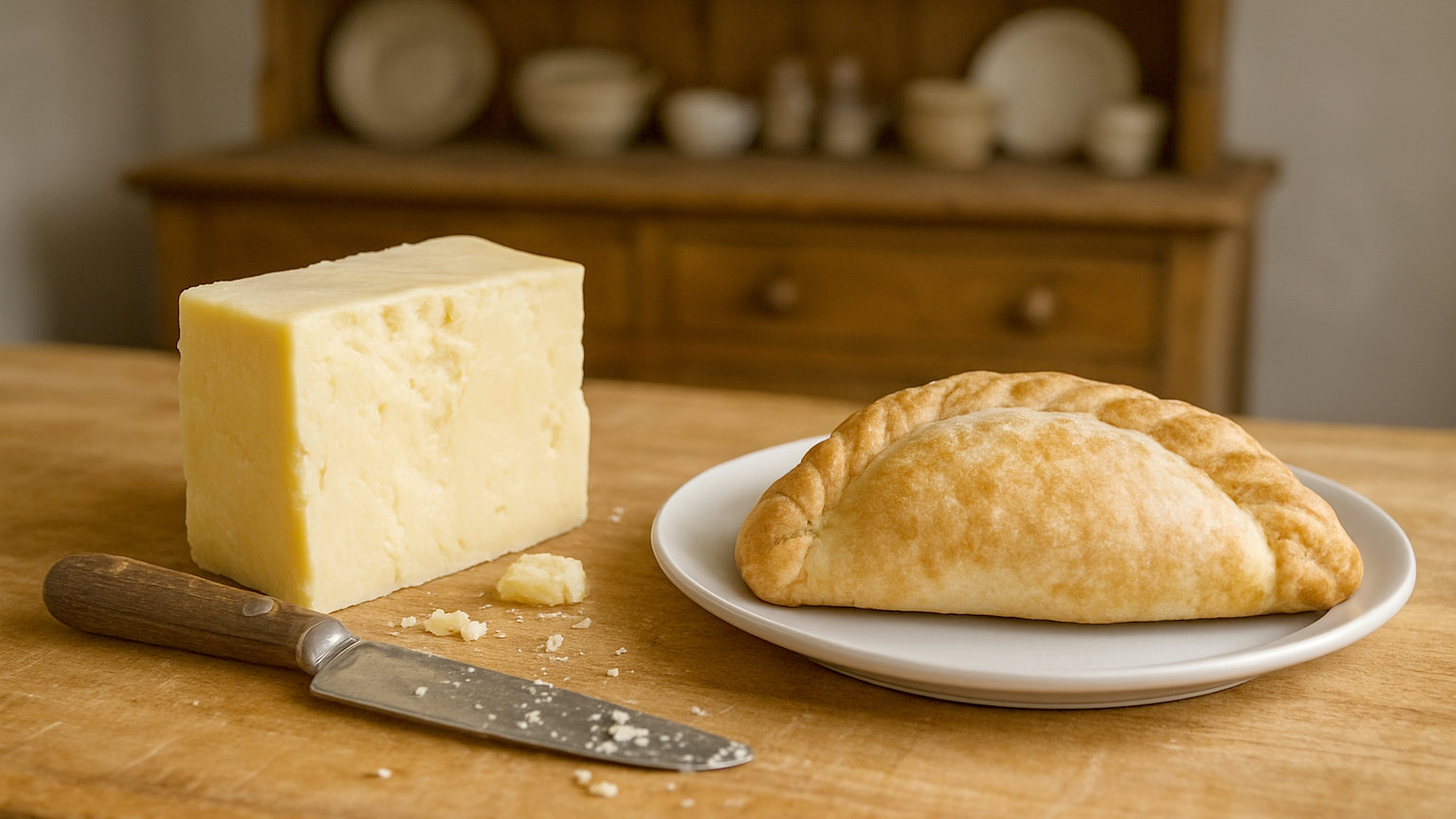
Cheddar is the most eaten cheese in Britain and the most copied in the world, and the reason it could never be protected is that its name describes a process rather than a place. Cheddaring is a specific step in the making, and any dairy anywhere can do it. Only West Country Farmhouse Cheddar holds protected status.
What is cheddaring?
Cutting the drained curd into slabs and stacking, turning and restacking them repeatedly. The weight presses out more whey and the curd develops a fibrous, layered texture.
That step is what makes a cheese a cheddar rather than something else, and it happens before the curd is milled and pressed.
What happens after cheddaring?
The slabs are milled into small pieces, salted, packed into moulds and pressed hard, then matured for anything from three months to several years.
Traditional cheddar is bound in cloth and larded, which lets it breathe as it matures.
What does protected status cover?
West Country Farmhouse Cheddar must be made on a farm in Somerset, Devon, Dorset or Cornwall, using milk from that region and traditional methods.
Plain cheddar has no protection at all and is made worldwide.
Is all cheddar made the same way?
No. Block cheddar is made at scale in sealed plastic and matured quickly, while traditional cloth bound cheddar is made in truckles and matured slowly.
Both are legally cheddar and they taste noticeably different.
Why Cheddar Gorge?
The caves in the gorge provided a naturally cool, humid environment for maturing cheese, and the village gave the cheese its name.
Some cheese is still matured in the caves today.
What is the difference between mild and mature?
Maturing time. Mild is around three months, mature nine to twelve, extra mature eighteen months or more.
Longer maturing concentrates the flavour and produces crunchy calcium lactate crystals.
How long does cheddar mature?
Anything from three months to five years. Most farmhouse cheddar is sold between twelve and twenty four months.
Beyond about three years it becomes very dry and intensely savoury.
What are the white crystals?
Calcium lactate, which forms naturally in well aged cheese. They are a sign of good maturing rather than a fault.
What size are traditional truckles?
A full cloth bound cheddar truckle weighs around 27kg and matures for a year or more, which is why farmhouse cheddar is expensive to produce.
Smaller truckles are sold for the retail market.
Why is some cheddar orange?
Annatto, a natural plant dye. It was originally added to imitate the colour of rich summer milk and tells you nothing about the strength.
Can you make it at home?
It is possible with a press and a curing space, and the difficulty is holding a steady temperature and humidity for months rather than the making.
What is cloth bound cheddar?
Cheese wrapped in muslin and coated in lard or butter, which allows slow moisture loss and produces a more complex flavour than block cheddar sealed in plastic.
It also develops a natural rind.
Does cheddar melt well?
Very well, and mature cheddar can go oily if overheated. Grate it and add it off the heat for sauces.
Younger cheddar melts more smoothly and tastes of less.
How do you choose a good one?
Look for farmhouse, cloth bound and unpasteurised if you want depth. Check the maturing time rather than trusting the word mature alone.
What happened to farmhouse cheddar?
Wartime rationing required creameries to make a single standard cheese, and by 1945 only a handful of farms still made traditional cheddar.
Fewer than a dozen producers now hold the West Country Farmhouse protected designation.
Does unpasteurised matter?
Raw milk cheese generally has more complexity, since the natural bacteria survive. Pasteurised cheddar is milder and more consistent.
Both are widely sold and hard raw milk cheese carries a low risk.
How should it be stored?
Wrapped in waxed paper in the fridge rather than cling film, which makes it sweat, and brought to room temperature an hour before eating.
Follow the dates on the pack, in line with Food Standards Agency guidance.
Worth reading next: Hevva Cake. There is more in our Regional recipes.


