
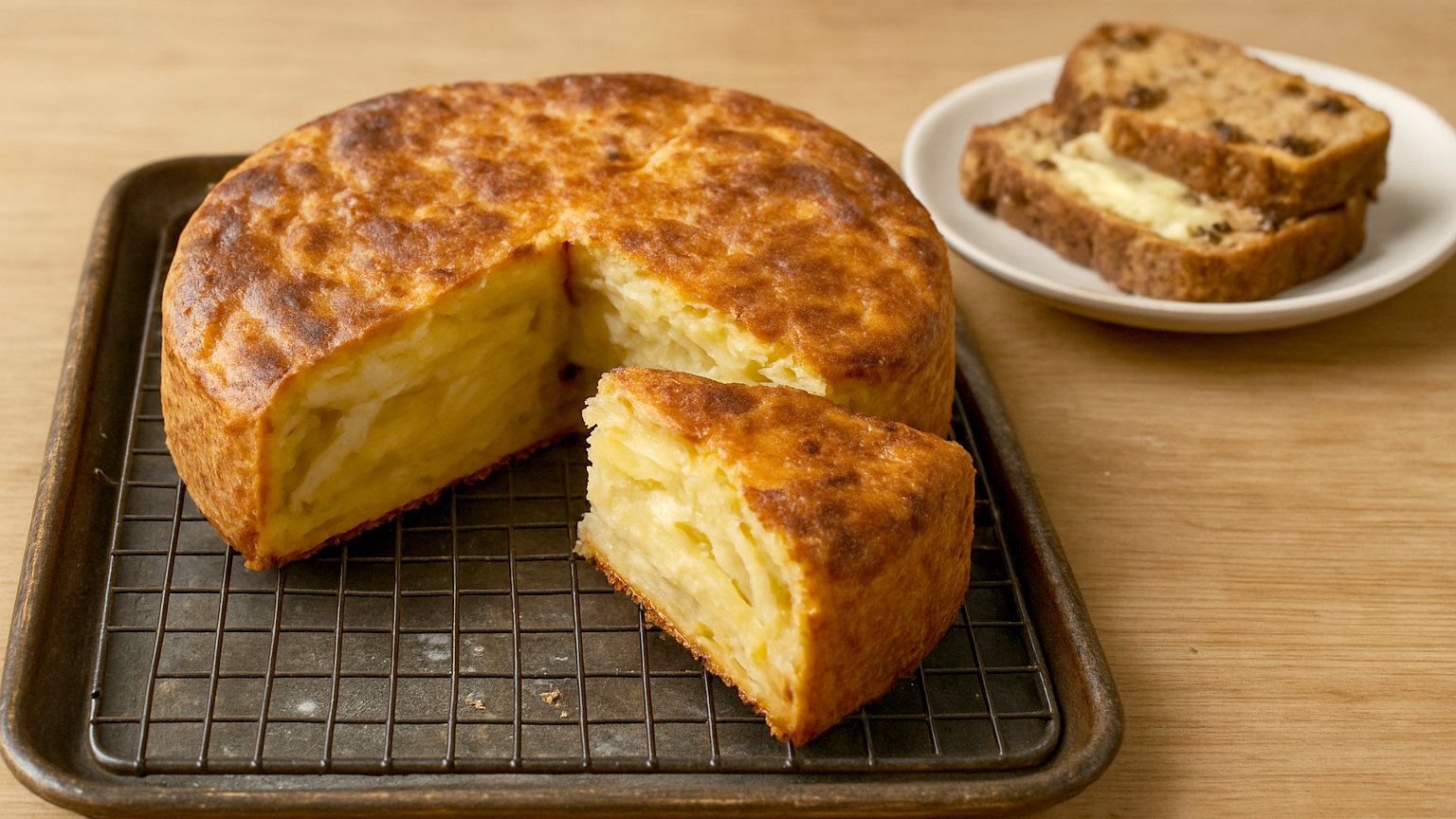
Welsh onion cake, teisen nionod, is nothing more than thinly sliced potatoes and onions layered with butter and baked slowly until the whole thing sets into a cake that can be turned out and cut into wedges. It is a side dish that comfortably becomes a main with cheese and a salad, and it costs almost nothing.
What do you need for 6 people?
- 1.2kg floury potatoes, peeled
- 3 large onions, very thinly sliced
- 125g butter, melted
- Salt and plenty of black pepper
- A few sprigs of thyme, optional
- 100ml stock or milk, optional
How do you make it?
- Heat the oven to 170C fan, 190C conventional, gas mark 5.
- Butter a deep 20cm cake tin or ovenproof dish generously.
- Slice the potatoes very thinly, about 2mm, ideally on a mandoline.
- Lay a layer of potato in the base, overlapping the slices.
- Scatter with onion, season and brush with melted butter.
- Repeat until everything is used, finishing with potato and butter.
- Press down firmly, cover with foil and bake for 1 hour.
- Uncover and bake for a further 30 minutes until browned, then rest 10 minutes and turn out.
Press the layers down firmly before it goes in the oven. Compacting them is what makes the finished dish hold together as a cake rather than falling apart into loose slices when cut.
How thin should the potatoes be?
About 2mm. Thick slices stay separate and never bind into a single mass.
A mandoline is far quicker and more even than a knife. Use the guard.
Can it be made in a frying pan?
An ovenproof frying pan works well and gives a better crust on the base, which becomes the top when turned out.
Start it on the hob for five minutes before it goes in the oven.
Should the potatoes be rinsed?
No. The starch on the surface is what glues the layers together, so rinsing works against you here.
This is the opposite of what you would do for chips.
Can other vegetables go in?
Thinly sliced leek in place of some of the onion is common in Wales, and a little grated cheese between the layers is a modern addition.
Keep anything wet out, since moisture stops the layers binding.
Why cover it for the first hour?
It steams the potatoes through so they are fully soft before the top is allowed to brown.
Uncovered throughout, the top burns before the middle is cooked.
Is stock necessary?
The traditional version uses butter alone and relies on the moisture in the potatoes. A little stock makes it more reliable and slightly less crisp.
Should the butter be melted?
Yes, so it can be brushed evenly over each layer. Dotting cold butter leaves dry patches where the potato does not soften properly.
How do you turn it out?
Rest for ten minutes, run a knife round the edge, put a plate over the tin and invert firmly.
Resting lets it settle so it holds together.
How long does it take?
Ninety minutes in total, an hour covered and half an hour uncovered. It cannot be rushed, since the potato has to soften completely before browning.
Most of that time is unattended.
What is it served with?
Roast lamb above all, or with cheese and pickle as a supper in its own right.
How is it different from a dauphinoise?
Dauphinoise is cooked in cream and garlic and stays soft. Onion cake uses butter alone, contains onions, and is firmer and browner.
Which potatoes should you use?
Floury varieties such as Maris Piper or King Edward, which release starch and bind the layers.
Waxy potatoes stay in separate slices and the cake will not hold.
How thinly should the onions be sliced?
As thinly as the potatoes, so they soften completely and disappear into the layers rather than staying as distinct rings.
Three large onions for 1.2kg of potato is the right proportion.
How long does it keep?
Two days refrigerated and it reheats well in a hot oven for 20 minutes.
Cool it quickly and refrigerate within two hours, in line with Food Standards Agency guidance.
Next, try Caerphilly and Welsh Cheeses, or see the rest of our Regional recipes.


