
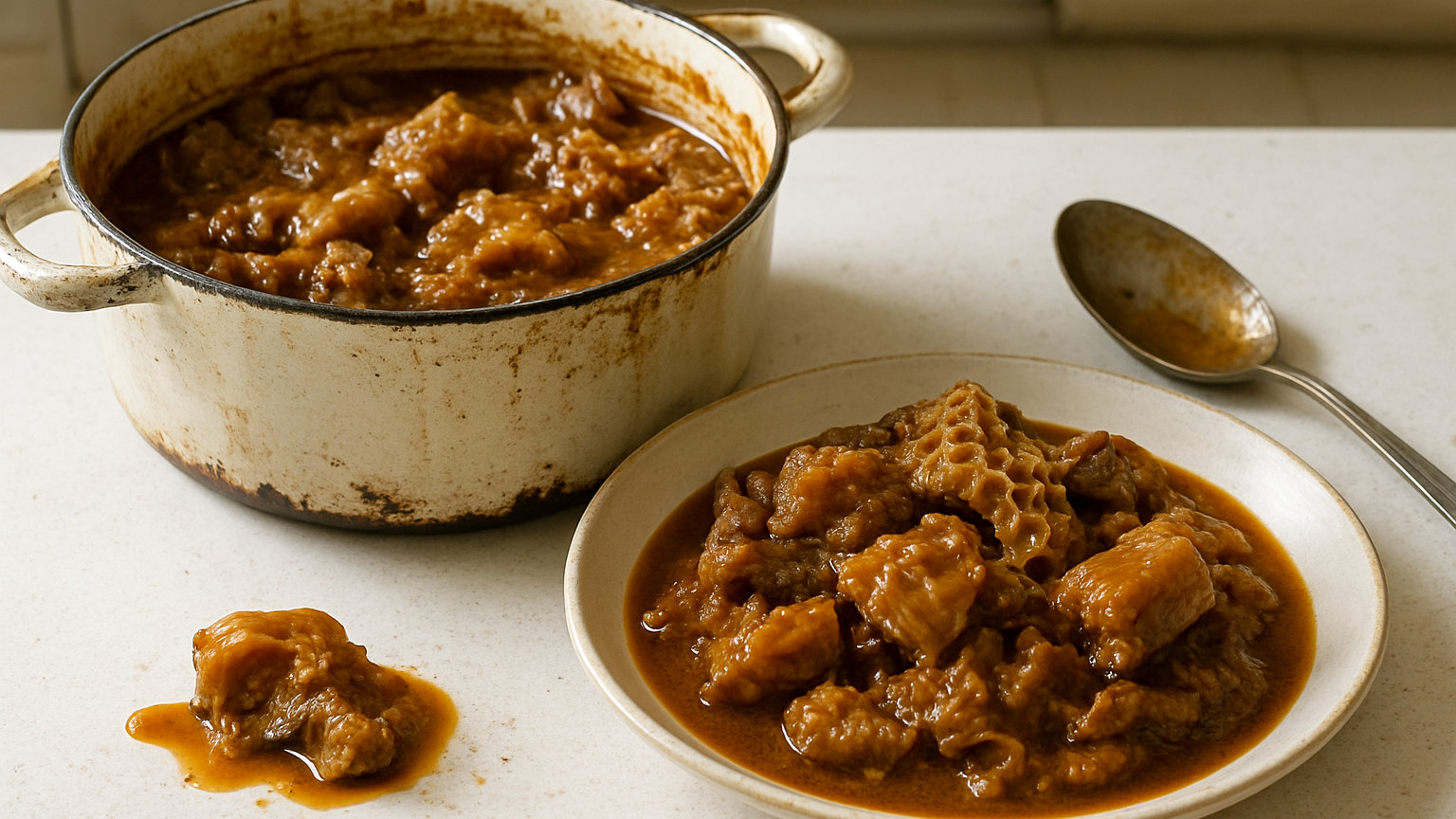
Tripe shops were a fixture of Lancashire and Yorkshire high streets well into the twentieth century, with one chain running well over a hundred of them. Tripe, cow heel and elder were cheap, nourishing and eaten weekly by industrial households. Almost all of that has gone, and understanding why explains a good deal about how northern food changed.
What is tripe?
The stomach lining of a cow. Cattle have four stomach chambers and different chambers give different types of tripe.
It is sold dressed, meaning cleaned and part cooked, which is essential.
What are the different kinds?
- Blanket or flat tripe, smooth and from the first chamber
- Honeycomb tripe, patterned and generally considered the best
- Book or bible tripe, layered like pages
- Reed tripe, from the fourth chamber
How was it eaten?
Cold with vinegar, pepper and raw onion, straight from the tripe shop. That was the standard Lancashire way and it required no cooking at all.
It was also stewed slowly in milk with onions, which is the other classic preparation.
What is cow heel?
The foot of a cow, extremely high in collagen, used to give body and gelatine to stews and pies.
It appears in Lancashire hotpot variations and in cow heel and tripe stews.
Was it eaten hot or cold?
Usually cold, straight from the shop, which is why it needed no cooking at home. Stewing it in milk was the hot version.
What is elder?
Cooked cow udder, sliced and eaten cold with salt and vinegar. It is now almost impossible to buy.
It was a tripe shop staple within living memory.
Why was it eaten so widely?
It was cheap, filling and high in protein at a time when industrial wages did not stretch to prime cuts.
It was also sold ready to eat, which mattered for households with little fuel and less time.
What was a UCP shop?
United Cattle Products ran a large chain of tripe shops and restaurants across the north west, at its height numbering well over a hundred premises.
Its decline through the second half of the twentieth century tracks the decline of the food itself.
Why did the tripe shops close?
Rising incomes, changing tastes and the availability of cheap meat after rationing ended. A generation grew up associating it with hardship.
Very few remain, mostly in Lancashire market towns.
Where can you still buy it?
A small number of Lancashire market stalls and traditional butchers, and it can usually be ordered in advance from any butcher who deals with a full carcass.
Supermarkets stopped stocking it decades ago.
Is it still eaten?
Rarely in Britain and widely abroad, in France, Italy, Spain, Mexico and across Asia, where it is often a restaurant dish rather than a poverty food.
How should tripe be cooked?
Dressed tripe still needs long slow simmering, typically two hours in milk with onion and bay, then thickened.
Buy it dressed from a butcher and never attempt to clean raw tripe at home.
What did a tripe shop sell?
Dressed tripe by weight, cow heel, elder, black pudding and sometimes savoury ducks, which is another name for faggots.
Most sold it ready to eat, wrapped in paper, to be taken home and eaten cold.
What does tripe taste like?
Very mild, faintly milky, with the texture doing most of the work. It takes on whatever it is cooked with.
The texture is what divides people rather than the flavour.
Is it worth trying?
As a piece of northern food history it is, and honeycomb tripe stewed slowly in milk with onions is a genuinely good dish.
Order it from a butcher in advance, since few keep it in stock.
Is offal safe?
Buy from a reputable butcher, keep it refrigerated on the bottom shelf and cook it thoroughly, in line with Food Standards Agency guidance.
Offal is highly perishable and should be used within a day or two of purchase.
If that was useful, Pan Haggerty covers related ground, and there is plenty more in Regional recipes.


