
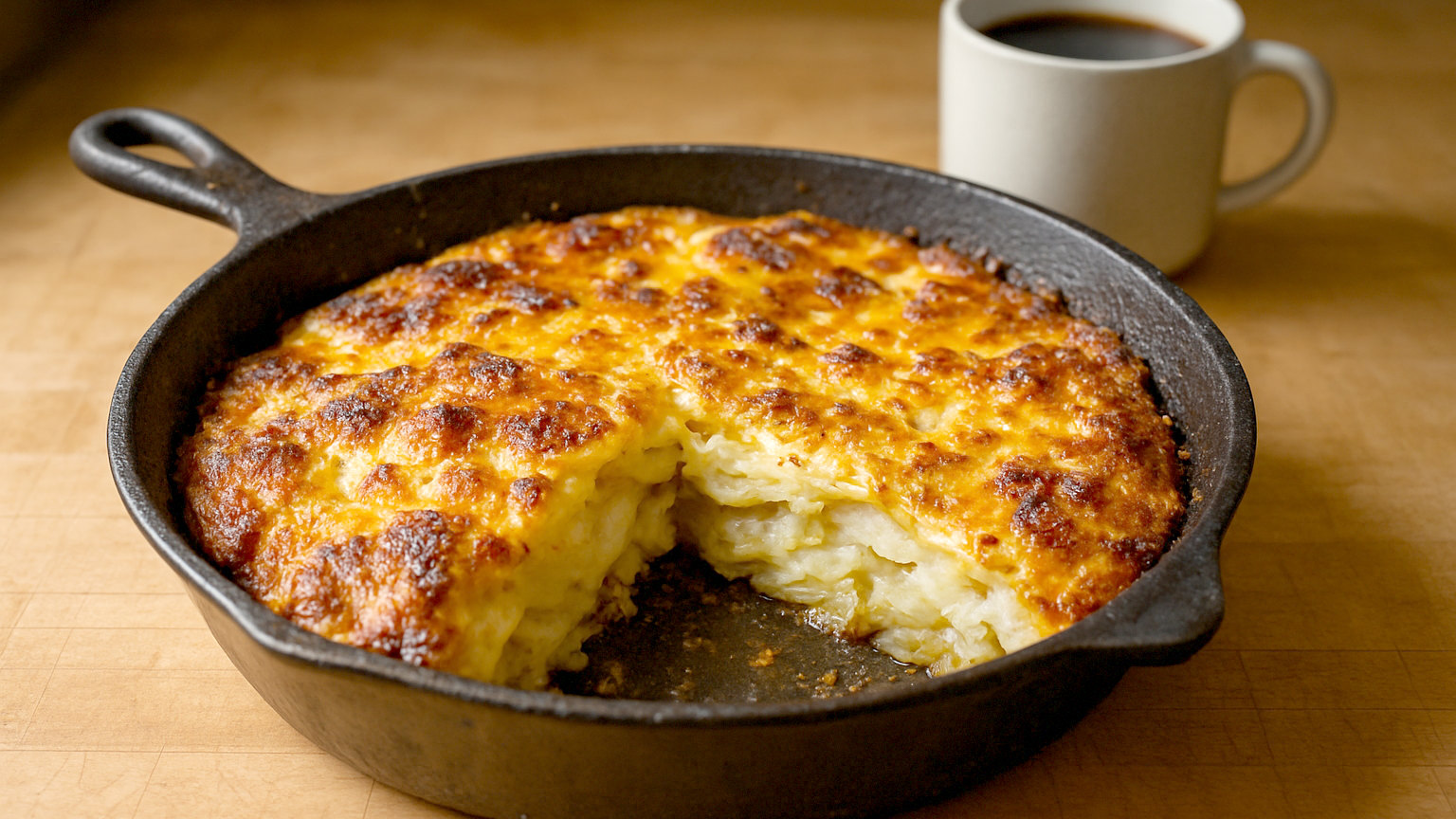
Pan haggerty is sliced potato, onion and cheese layered in a frying pan, cooked slowly on the hob and browned under the grill. It comes from Northumberland and it is a dish built entirely on cheapness: three ingredients, one pan and no oven needed for most of it. It is considerably better than that description suggests.
What do you need for 4 people?
- 800g floury potatoes, peeled and thinly sliced
- 2 large onions, thinly sliced
- 200g mature cheddar or Northumberland cheese, grated
- 50g butter and 1 tablespoon oil
- Salt and plenty of black pepper
- Chopped parsley to finish
How do you make it?
- Slice the potatoes about 3mm thick and pat them dry.
- Heat the butter and oil in a heavy 24cm frying pan.
- Lay in a layer of potato, overlapping the slices.
- Add a layer of onion, season, then a layer of cheese.
- Repeat, finishing with potato and then cheese on top.
- Cover and cook on the lowest heat for 30 minutes.
- Check the base is not catching and that the potato is tender.
- Finish under a hot grill for 5 minutes until browned and bubbling.
Keep the heat as low as it will go and use a lid. The potatoes cook in their own steam, and any real heat under a heavy pan burns the base long before the middle is tender.
Why not rinse the potatoes?
The surface starch helps the layers bind together, so rinsing works against you here.
Pat them dry instead, which removes surface water without the starch.
Which cheese should you use?
A strong mature cheddar. Northumberland and Cheshire both work, and anything mild disappears entirely.
Grate it coarsely so it melts into distinct layers.
How thin should the potatoes be?
About 3mm. Thicker slices will not cook through in half an hour and thinner ones collapse into a mash.
A mandoline is quicker and more even than a knife.
Should it be turned out?
It is usually served straight from the pan in wedges. Some cooks flip it halfway to brown both sides, which is harder and looks impressive.
Where does the name come from?
The origin is uncertain. It may relate to an old word for chopping or hacking, referring to the roughly sliced vegetables.
It has been made in Northumberland and Tyneside for well over a century.
Is it the same as a dauphinoise?
No. Dauphinoise uses cream and garlic and no cheese between the layers, and it is baked in the oven. Pan haggerty is cooked on the hob with cheese throughout.
It is closer to a Welsh onion cake with cheese added.
Can it be baked instead?
Yes, covered at 180C fan for 45 minutes then uncovered for 15. The hob method is traditional and needs no oven.
How many does it serve?
Four as a main with something green, or six as a side. A 24cm pan is the right size for that quantity.
What can you add?
Bacon or black pudding between the layers, or a little thyme. It is a frugal dish and additions go against the spirit of it.
How long does it take?
About 35 minutes in total, half an hour covered on the hob and five minutes under the grill.
Most of that is unattended.
What is it served with?
A green vegetable and a sharp pickle, or on its own as a supper.
How many layers should there be?
Three or four of each, in a 24cm pan. More layers give a better distribution of cheese and onion through the dish.
Season every layer, not just the top.
Why does it stick to the pan?
Too little fat at the start or too much heat. Use butter and oil together and keep the heat at the lowest setting.
A slightly caught base is considered by many to be the best part.
How long does it keep?
Two days refrigerated and it reheats well in a hot oven.
Cool it quickly and refrigerate within two hours, in line with Food Standards Agency guidance.
If that was useful, Potted Shrimps covers related ground, and there is plenty more in Regional recipes.


