
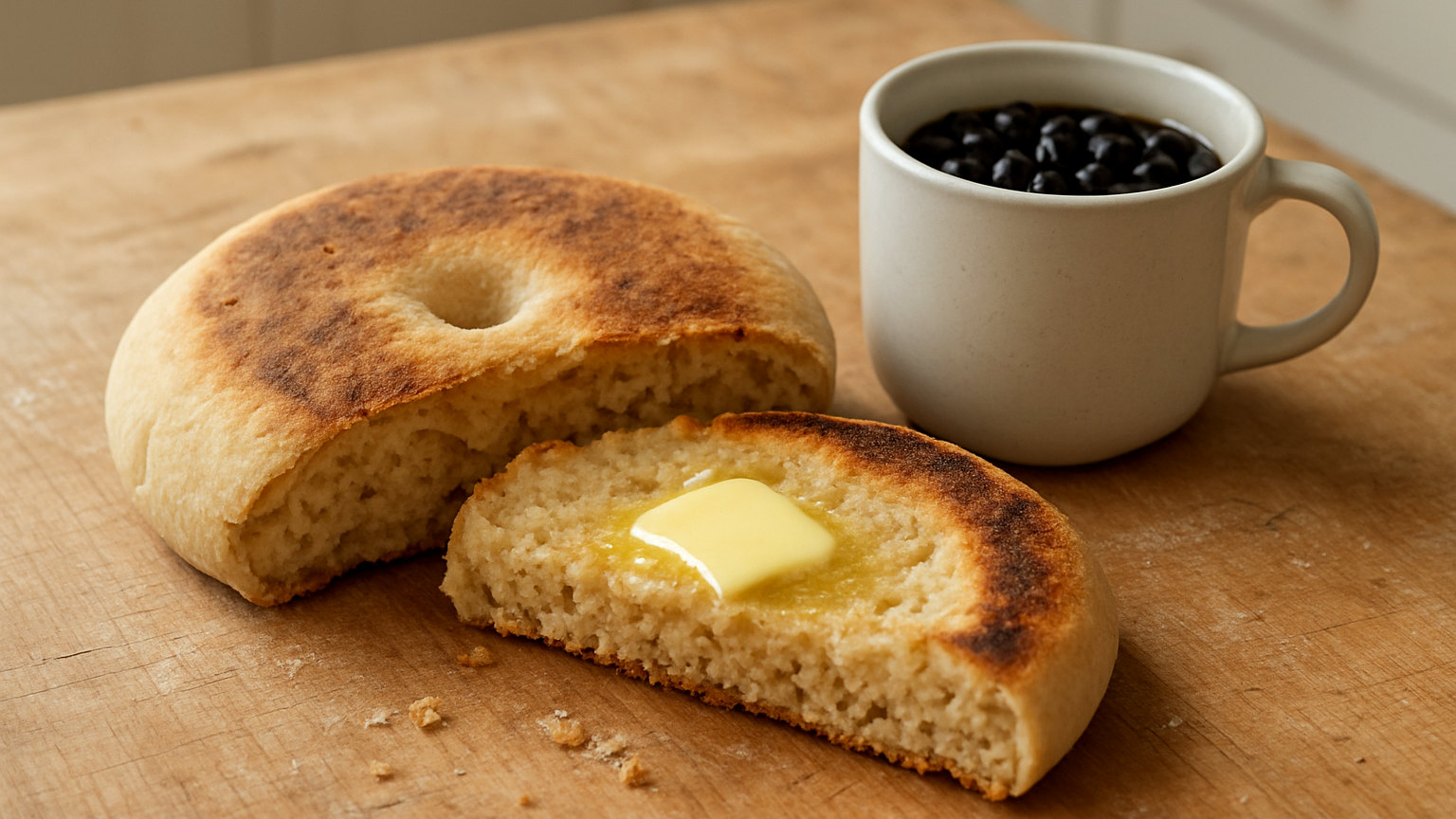
A stottie is a flat, dense, chewy round loaf from Tyneside, about 30cm across and 4cm deep, with a dimple pressed into the middle. It is baked at the bottom of the oven, traditionally using the space left after the main baking, and turned partway through so both sides colour. Split and filled with ham and pease pudding, it is the classic Newcastle sandwich.
What do you need for 1 large stottie?
- 500g strong white bread flour
- 7g fast action yeast and 2 teaspoons salt
- 25g lard or butter
- About 300ml warm water
- Extra flour for dusting
How do you make it?
- Rub the lard into the flour, then add the yeast and salt separately.
- Add the warm water and mix to a firm dough.
- Knead for 10 minutes until smooth.
- Prove for 1 hour until doubled.
- Knock back and roll into a flat round about 30cm across and 3cm thick.
- Prove for 30 minutes only, which is deliberately short.
- Press a deep dimple in the centre and dust with flour.
- Bake at 200C fan on the lowest shelf for 12 minutes, turn it over, and bake 10 minutes more.
Turn the loaf over halfway through baking. That is what gives a stottie its flat, pale, evenly coloured surfaces on both sides rather than a domed top and a soft base.
Why is it so dense?
The second prove is short and the loaf is baked flat, so it has neither the time nor the room to rise much.
That density is the point: it holds a heavy filling without collapsing.
What does the dimple do?
It stops the middle doming up and keeps the loaf flat. It is also the traditional mark of a stottie.
Press it firmly, since a shallow dimple disappears in the oven.
Where does the name come from?
From the Geordie word stott, meaning to bounce. The story is that a properly made stottie would bounce if dropped on the floor.
It is a joke about the density rather than an instruction.
What is pease pudding?
Dried yellow split peas boiled to a thick savoury puree, traditionally cooked with a ham hock. It is the standard stottie filling alongside the ham.
It is sold in tubs across the north east.
Should it be floured on top?
Yes, generously, which gives the pale matt surface a stottie should have rather than a glazed shine.
Why bake it at the bottom of the oven?
Historically it used the falling heat at the end of a bake, which is why it is a cheap, practical loaf.
The lowest shelf gives good bottom heat, which suits it.
How big should it be?
About 30cm across and 3cm thick before baking, which gives a loaf that quarters neatly into four large sandwiches.
Smaller versions are sold as individual stotties.
How is it eaten?
Cut into quarters and split, filled with ham and pease pudding, or with bacon and egg for breakfast.
Why lard in the dough?
It softens the crumb and helps the loaf keep. It was also cheap and available, which mattered for a working loaf.
Butter works and gives a slightly richer result.
Can it be made smaller?
Individual stotties of about 12cm work well and bake in about 14 minutes with a turn halfway.
Why is the second prove short?
A full second prove would give a light, airy loaf, which is the opposite of what a stottie should be. Thirty minutes gives enough lift and keeps the density.
It is one of the few breads deliberately underproved.
What is a ham and pease pudding stottie?
A quarter of a stottie split and filled with sliced boiled ham and a thick layer of pease pudding, sometimes with mustard.
It is the standard sandwich of Newcastle and Gateshead.
How long does it keep?
Two days wrapped, which is better than most bread because of the dense crumb. It freezes for a month.
Next, try Fat Rascals, or see the rest of our Regional recipes.


