
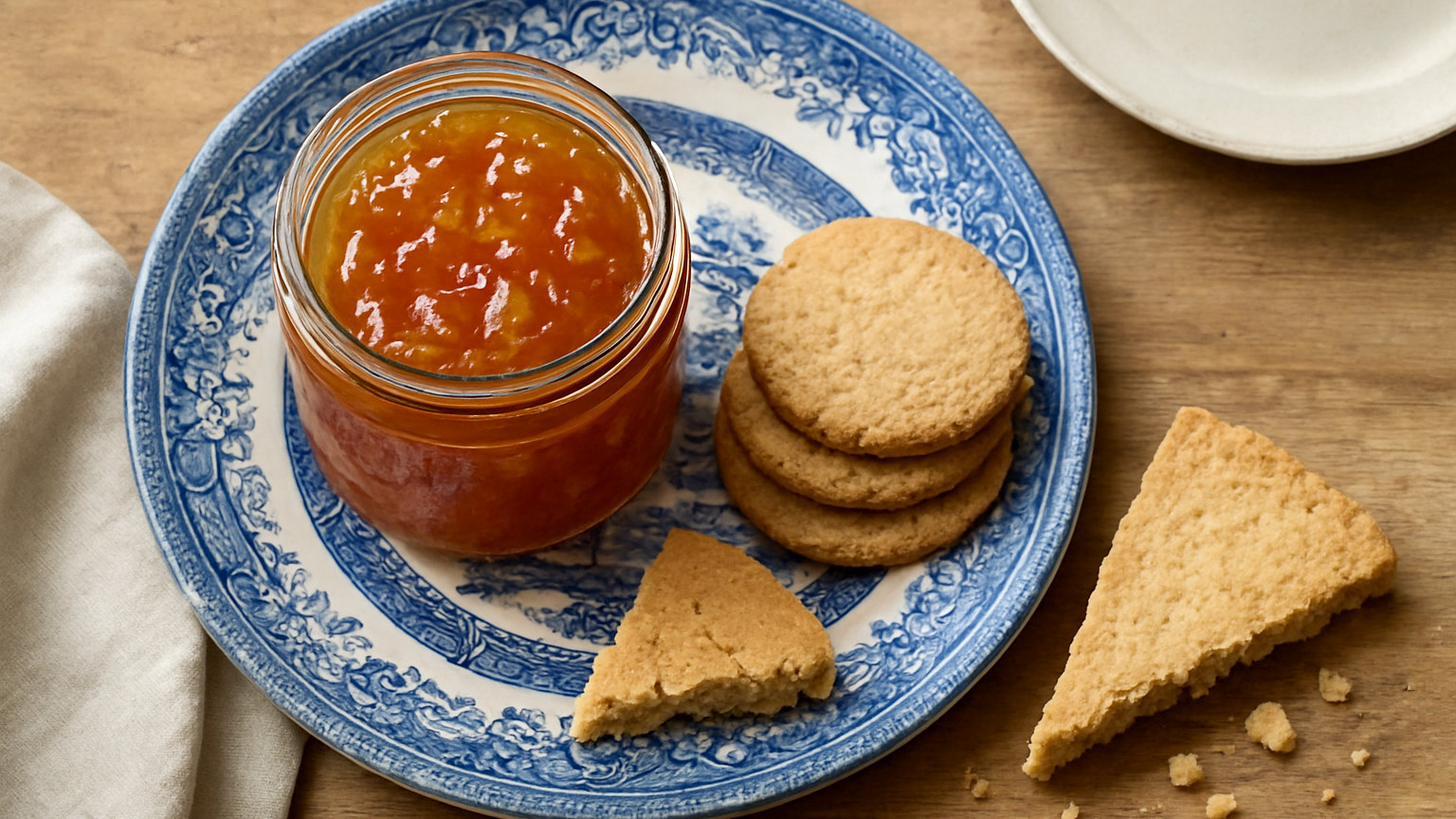
Marmalade made with Seville oranges is a January job, since the fruit has a season of about six weeks and is almost inedible raw. Dundee built a substantial industry on it from the eighteenth century. The whole thing turns on pectin, which comes from the pips and pith rather than from anything you add.
What do you need for about 6 jars?
- 1kg Seville oranges
- 2 litres water
- 2kg granulated sugar
- Juice of 1 lemon
- A square of muslin and string
How do you make it?
- Scrub the oranges and halve them, squeezing the juice into a large pan.
- Scoop the pips and loose pith into a muslin square and tie it into a bag.
- Shred the peel as finely or coarsely as you like.
- Add the peel, juice, water and the muslin bag to the pan.
- Simmer gently for 2 hours until the peel is completely soft.
- Lift out the bag, cool it and squeeze it hard back into the pan.
- Add the sugar and lemon juice and stir until fully dissolved.
- Boil hard for 15 to 25 minutes until setting point is reached.
Squeeze the muslin bag hard. The thick sticky liquid that comes out is almost pure pectin, and it is what sets the marmalade. Discarding the bag unsqueezed is the commonest reason a batch stays runny.
How do you test for setting point?
Put a saucer in the freezer beforehand. Drop a teaspoon of marmalade onto it, wait a minute, and push it with a finger. If it wrinkles, it is ready.
On a thermometer it is 105C.
Why must the peel soften first?
Sugar sets the peel and stops it softening further. Peel that is still tough when the sugar goes in will stay tough in the jar.
Test it by pressing a piece between your fingers before adding the sugar.
Why Seville oranges?
They are sour, high in pectin and thick skinned, which is exactly what marmalade needs. Sweet oranges make a poor, loose preserve.
They are in the shops from late December to early February only.
Can you freeze the oranges?
Yes, whole, for up to a year, which is how to make marmalade out of season. Add an extra orange, since freezing slightly reduces the pectin.
How do you shred the peel?
Scrape out the remaining pith with a spoon, then slice the peel into strips with a sharp knife. It takes about forty minutes for a kilo.
A food processor gives an uneven, mushy result and is not worth it.
What is the Dundee connection?
Janet Keiller is credited with the first commercial marmalade in Dundee in the 1700s, and the firm exported it worldwide.
Dundee marmalade is traditionally thick cut with a dark colour.
How should the jars be prepared?
Wash them in hot soapy water and dry them in a 140C oven for 15 minutes. Fill them while both jars and marmalade are hot.
How much sugar do you need?
Roughly twice the weight of fruit, so 2kg of sugar to 1kg of oranges. That ratio is what preserves it as well as sweetening it.
Reducing it substantially gives a preserve that will not keep.
Why let it stand before potting?
Ten minutes off the heat lets it thicken slightly so the peel distributes evenly instead of floating to the top of every jar.
Why did it not set?
Either the pips were not squeezed out properly, or it did not reach 105C, or the peel was undercooked before the sugar went in.
It can be reboiled with the juice of another lemon to correct it.
Thick cut or fine cut?
Entirely a matter of preference. Thick cut is the Dundee style and fine cut takes considerably longer to prepare.
The cutting is the slow part of the whole recipe.
How long does it keep?
A year in a cool dark cupboard unopened, and a month refrigerated once opened.
Discard any jar showing mould, in line with Food Standards Agency guidance.
For something along the same lines, see Cooking With Whisky, or browse all our Regional recipes.


