
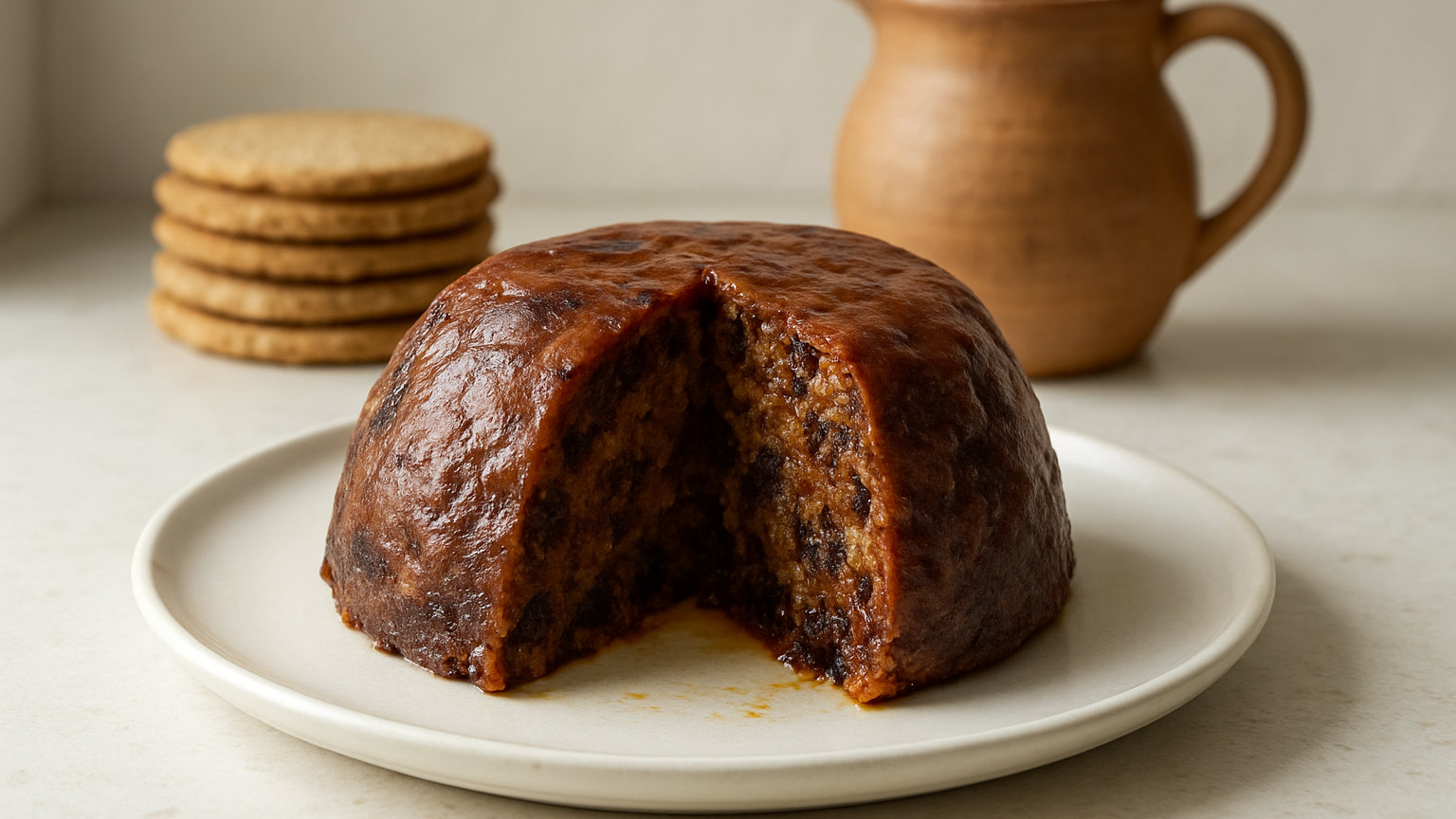
A clootie dumpling is a spiced suet and fruit pudding boiled in a cloth, or cloot, for three or four hours. What distinguishes it from a basin steamed pudding is the skin: a slightly leathery, darkened surface that forms where the floured cloth meets the pudding, and which is dried in the oven at the end. It is traditional at Hogmanay and birthdays.
What do you need for 8 people?
- 250g self raising flour
- 125g shredded suet
- 125g fresh white breadcrumbs
- 150g caster sugar
- 200g sultanas and 200g currants
- 2 teaspoons mixed spice, 1 teaspoon cinnamon, 1 teaspoon ground ginger
- 1 tablespoon black treacle and 1 egg
- About 150ml milk
- A large square of cotton cloth and extra flour
How do you make it?
- Scald the cloth in boiling water, then wring it out carefully.
- Lay it flat and dust it generously and evenly with flour.
- Mix all the dry ingredients, then add the treacle, egg and enough milk for a soft dough.
- Sit the dough in the centre of the cloth.
- Gather the cloth up and tie with string, leaving room for expansion.
- Lower into a large pan of boiling water with a plate in the base.
- Boil steadily for 3 hours 30 minutes, topping up with boiling water.
- Lift out, unwrap, and dry in a 180C fan oven for 15 minutes to set the skin.
The flour on the cloth is what makes the skin. It combines with the wet dough to form a seal that darkens and firms during boiling. An unfloured cloth sticks to the pudding and there is no skin at all.
Why scald the cloth?
It sterilises it, removes any residue and makes the flour adhere evenly.
Use plain cotton with no fabric conditioner. An old pillowcase or a large tea towel works.
How tightly should it be tied?
Firmly at the neck but leaving a couple of centimetres of slack, since the pudding expands considerably.
Tied too tight it splits, and too loose it takes in water.
How much water should the pan hold?
Enough to cover the pudding completely and keep it covered for three and a half hours, topping up with boiling water as it evaporates.
A pudding that becomes exposed cooks unevenly.
Why a plate in the pan?
It keeps the pudding off the base so it does not scorch, and lets water circulate underneath.
Why dry it in the oven?
The skin is wet and pale when it comes out of the water. Fifteen minutes in a hot oven dries and darkens it into the characteristic surface.
How is it different from a Christmas pudding?
It is lighter, less rich, contains no alcohol traditionally, and includes breadcrumbs as well as flour.
The cloth and the skin are the main difference.
How do you know it is cooked?
A skewer through the cloth into the centre should come out clean. Three and a half hours is reliable for this size.
It is very forgiving and an extra half hour does no harm.
When is it eaten?
Hogmanay, birthdays and Christmas. Silver coins wrapped in paper were traditionally hidden in it for children.
Should coins really go in it?
It was traditional to wrap silver coins in greaseproof paper and hide them in the mixture for children to find.
It is a choking hazard and most people now leave them out or hide them under the plate instead.
How should it be served?
Hot with custard, or cold in slices fried in butter the next day, which many people prefer.
Can it be steamed in a basin instead?
Yes, and it is easier, though you lose the skin entirely, which is the defining feature. Steam for the same length of time.
At that point it is a spiced steamed pudding rather than a clootie dumpling.
What is a cloot?
The Scots word for a cloth. The pudding is named after the thing it is boiled in rather than anything it contains.
How long does it keep?
A week wrapped in the fridge and it freezes for three months.
Reheat by steaming for 45 minutes or frying slices, in line with Food Standards Agency guidance.
If that was useful, Stovies covers related ground, and there is plenty more in Regional recipes.


