
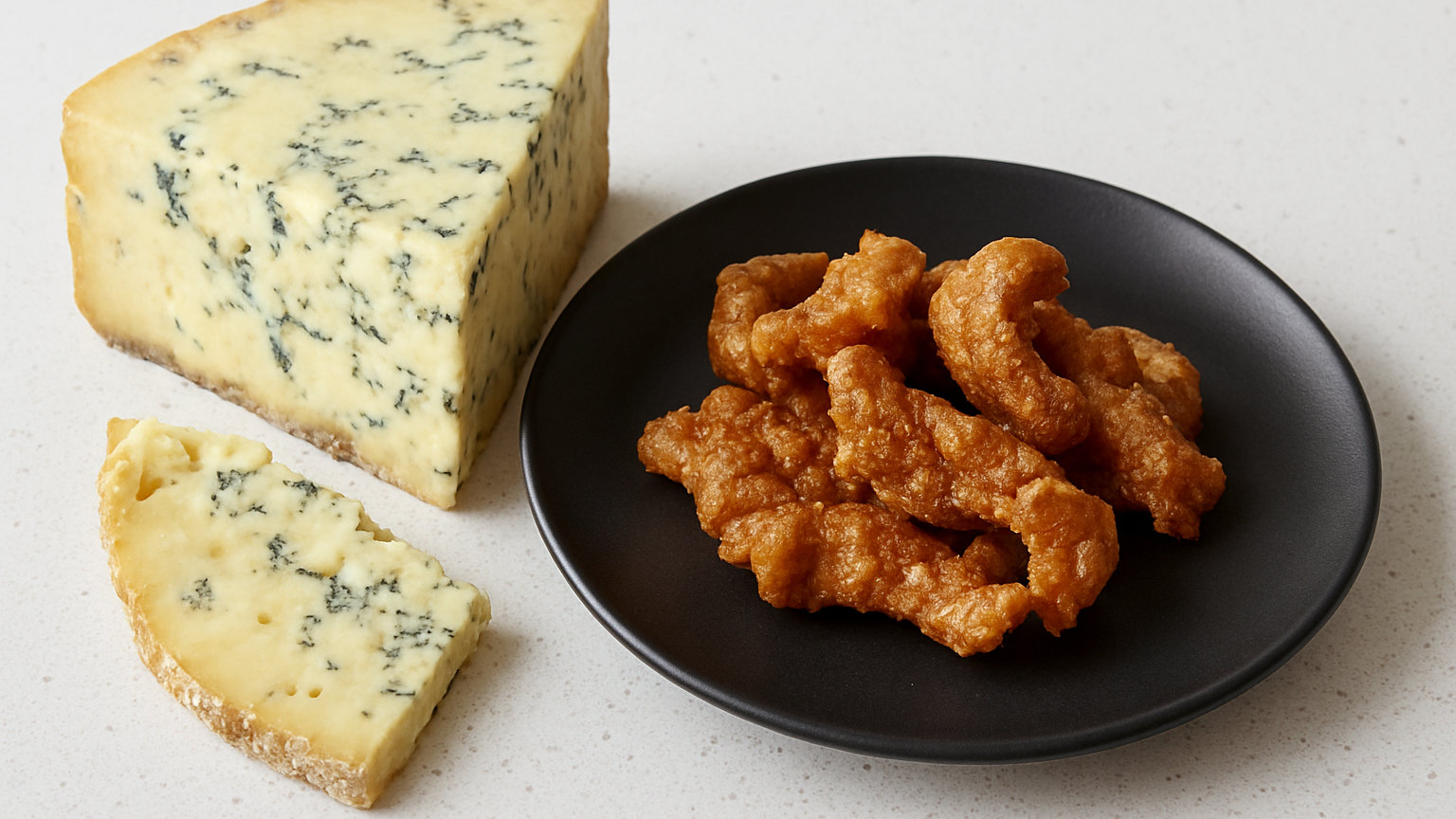
Stilton is the best known British blue cheese and its rules are unusually strict. It holds protected status, and that status limits production to Derbyshire, Leicestershire and Nottinghamshire. The village of Stilton itself is in Cambridgeshire, which means the cheese cannot legally be made in the place it is named after.
Why can it not be made in Stilton?
The protected designation names three counties, and Cambridgeshire is not one of them. The village was where the cheese was sold rather than made, from a coaching inn on the Great North Road.
A cheese made in the village today has to be sold under a different name.
What is Blue Stilton like?
Rich, salty and creamy with blue veining running through it and a crusty natural rind.
It is matured for around nine to twelve weeks and becomes stronger with age.
What is White Stilton?
The same cheese without the blue mould, sold young. It is mild, crumbly and slightly acidic.
It is often sold with added fruit such as apricot or cranberry, which is a modern product rather than a traditional one.
How is the blue made?
Penicillium roqueforti is added to the milk, and the cheese is pierced with stainless steel needles after several weeks to admit air.
The mould grows along the air channels, which is why the veining follows the needle lines.
How should it be served?
At room temperature, taken out of the fridge an hour beforehand, cut into wedges so everyone gets rind and centre.
Cold Stilton tastes of very little.
Should you scoop it out with a spoon?
The Victorian habit of scooping the middle from a whole truckle and pouring port in is now generally discouraged, since it dries the rest of the cheese.
Cutting wedges keeps it in better condition.
Is White Stilton the same cheese?
The same make without the blue mould, sold young at around four weeks. It holds its own protected status separately.
It is mild and crumbly rather than rich and salty.
Does it go with port?
Traditionally yes, and the sweetness balances the salt well. Sauternes, sweet sherry and a good ale all work equally well.
What can you cook with it?
Soups with celery or broccoli, a sauce for steak, stirred into mashed potato, or melted over a burger.
It is strong, so a little goes a long way.
Can you cut the rind off first?
Better to cut wedges through the whole piece so the rind protects the cut face between servings.
Is it made with pasteurised milk?
All Stilton sold under the protected name is pasteurised. A raw milk version is made under a different name.
Can it be frozen?
It freezes for three months and the texture becomes crumblier on defrosting, so frozen Stilton is better used in cooking than on a board.
Wrap it well, since it takes on other flavours readily.
What is the rind for?
It forms naturally as the cheese matures and protects it. It is edible, though many people leave it.
How many dairies make it?
Only a handful hold the licence, all within the three permitted counties.
What is the Great North Road connection?
The Bell Inn at Stilton sat on the main coaching route between London and the north, and cheese sold to travellers there took the village name with it.
The cheese itself came from farms in Leicestershire.
How long is it matured?
Around nine weeks minimum and often twelve or more. Longer maturing gives a stronger, more crumbly cheese with heavier veining.
Very young Stilton is mild and slightly chalky.
What should go with it on a board?
Celery, oatcakes, walnuts, pears and a fruit chutney. It is strong enough to dominate anything milder beside it.
How should it be stored?
Wrapped in waxed paper in the fridge, not cling film, and kept away from other cheeses since it flavours them.
Follow the date on the pack, in line with Food Standards Agency guidance.
See also Melton Mowbray Pork Pie, or browse more Regional recipes.


