
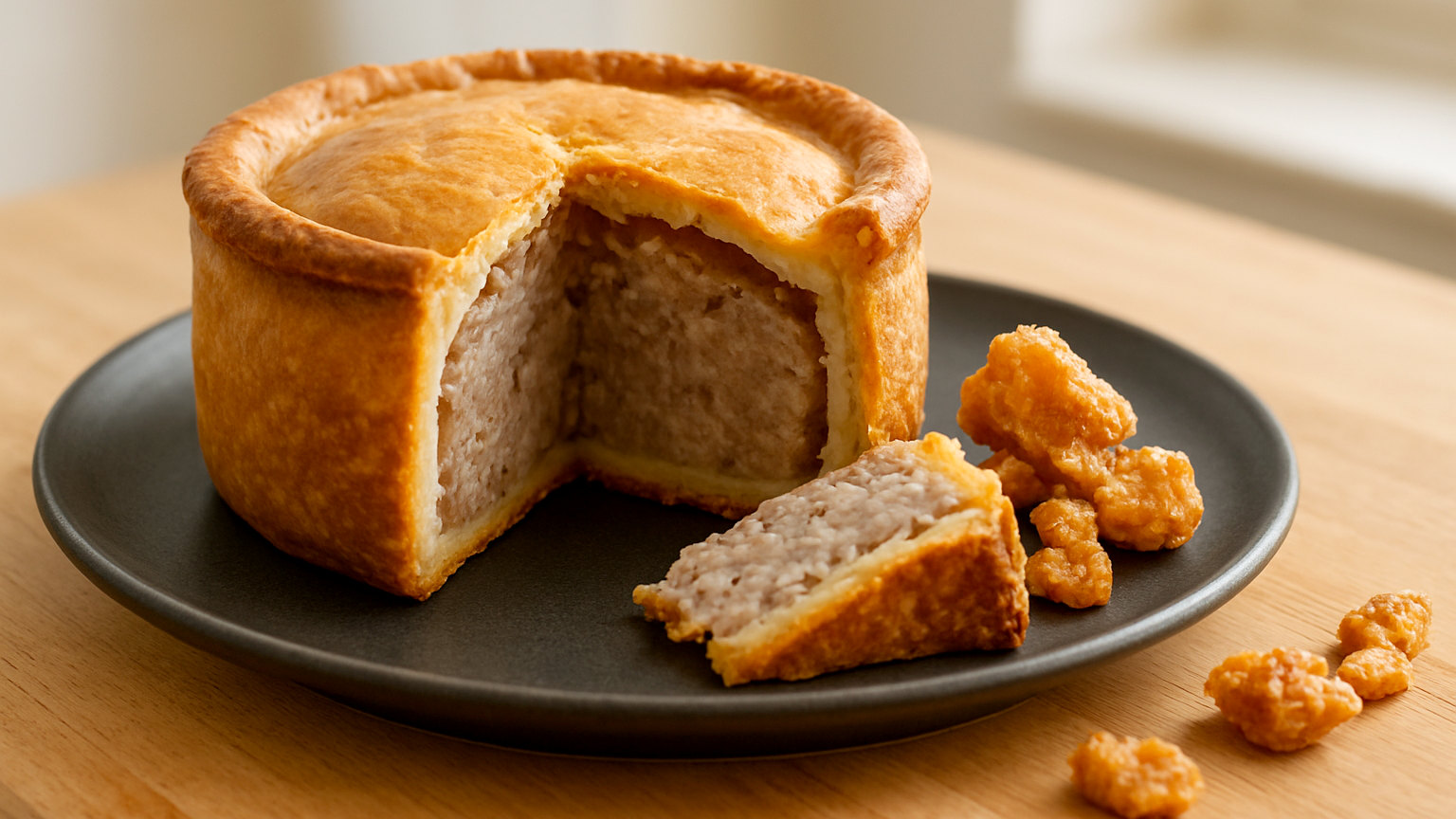
A Melton Mowbray pork pie is hand raised rather than made in a tin, which is why the sides bow outwards. The meat is uncured, so it cooks to a grey brown rather than the pink of a supermarket pie, and a rich pork jelly is poured in through the top after baking. It holds protected status and must be made in a defined area around the Leicestershire town.
What do you need for 6 pies?
- For the pastry: 500g plain flour, 125g lard, 125ml water, 1 teaspoon salt
- 750g pork shoulder, coarsely chopped
- 150g pork belly, chopped
- 1 teaspoon ground white pepper and half a teaspoon of ground mace
- 1 teaspoon salt and a pinch of ground nutmeg
- For the jelly: 500ml strong pork stock and 3 gelatine leaves if needed
- 1 beaten egg to glaze
How do you make them?
- Mix the pork, belly and seasonings and chill.
- Bring the lard, water and salt to the boil and pour into the flour.
- Mix quickly to a dough and knead briefly while hot.
- Take two thirds and mould it around a floured jam jar to raise the cases.
- Ease the pastry off the jar and fill with the pork mixture.
- Add pastry lids, crimp firmly and cut a hole in each top.
- Glaze and bake at 180C fan for 30 minutes, then 160C fan for 1 hour.
- Cool, then pour warm jelly through the hole and refrigerate overnight.
Work the hot water crust while it is warm. It is pliable and mouldable at that stage and becomes brittle and unworkable once it cools, which is why raising a pie has to be done quickly.
Why is the meat grey?
Because it is uncured. Supermarket pork pies use cured meat containing nitrites, which keeps it pink.
Grey is correct for a Melton Mowbray pie and is the quickest visual test of authenticity.
Why are the sides bowed?
Hand raised pies are baked without a hoop or tin, so the sides slump slightly outwards as the pastry softens.
A straight sided pie was made in a tin.
What is hot water crust?
Pastry made by pouring boiling water and melted lard into flour, which gelatinises some of the starch and makes it mouldable rather than short.
It sets firm and strong enough to stand alone.
Why add jelly after baking?
The meat shrinks during cooking and leaves a gap under the lid. Jelly fills it, excludes air and keeps the pie moist.
Pour it in warm and slowly through the steam hole once the pie has cooled.
How do you make the jelly?
Simmer pork bones and trotters for four hours and reduce the stock until it sets when chilled. Gelatine leaves are the shortcut.
Season it well, since a bland jelly is noticeable.
What does protected status require?
The pie must be made within a defined area around Melton Mowbray, hand raised, uncured and bow sided.
Pies made elsewhere cannot use the name however they are made.
How coarsely should the pork be chopped?
Coarsely, by hand or through a large mincer plate, so there are distinct pieces of meat in the finished slice.
Why mace and white pepper?
They are the traditional seasonings and give the characteristic flavour. Be generous, since cold food needs more seasoning than hot.
Do you need a pie dolly?
A wooden pie dolly is the traditional tool, and a straight sided jam jar dusted with flour does the same job perfectly well.
How should it be served?
Cold, with mustard or pickle and a pint. Never warm.
Why is it eaten cold?
The jelly sets as it cools and holds everything together. Warmed through, the jelly melts and the pie falls apart.
It was made as portable food for hunting and for workers, which is another reason it is a cold item.
How long does it keep?
Three days refrigerated. Pork must reach 75C during baking, and the pies should be kept chilled throughout, in line with Food Standards Agency guidance.
If that was useful, Pork Scratchings covers related ground, and there is plenty more in Regional recipes.


