
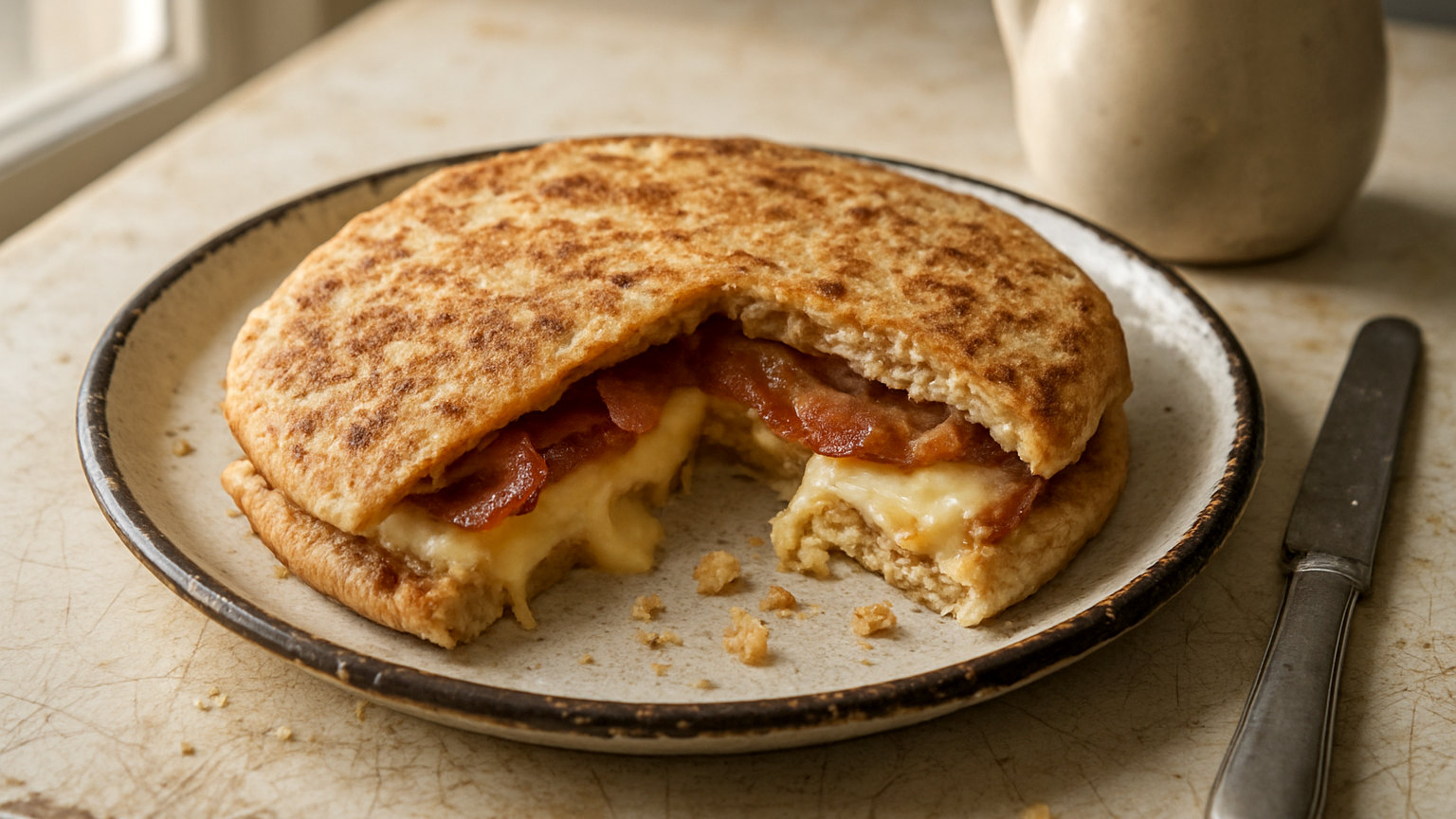
A Staffordshire oatcake is a large soft savoury pancake made from a yeasted batter of oatmeal and flour, cooked on a griddle. It is nothing whatever like a Scottish oatcake, which is a crisp biscuit. It belongs to the Potteries, where oatcake shops served the pottery workers, and it is filled with cheese and bacon and folded.
What do you need for 8 oatcakes?
- 200g fine oatmeal
- 100g plain flour and 100g wholemeal flour
- 7g fast action yeast
- 1 teaspoon salt and 1 teaspoon sugar
- 400ml warm milk
- 400ml warm water
- A little oil or lard for the pan
How do you make them?
- Combine the oatmeal, both flours, yeast, salt and sugar.
- Whisk in the warm milk and water to make a thin batter.
- Cover and leave in a warm place for 1 hour until frothy.
- Stir it down gently.
- Heat a large flat pan and wipe with a little oil.
- Pour in a ladleful and swirl to about 20cm across.
- Cook for 2 to 3 minutes until the surface sets and holes appear.
- Turn and cook for 1 minute more, then stack under a cloth.
The batter should be thin, closer to a crepe batter than a pancake one. A thick batter gives a heavy, doughy oatcake, and the characteristic texture depends on it spreading easily in the pan.
How are they different from Scottish oatcakes?
Entirely. Scottish oatcakes are crisp, dry biscuits made from a stiff dough. Staffordshire oatcakes are soft yeasted pancakes.
The two share only the oats.
Why does the batter need yeast?
It gives the slightly sour flavour and produces the holes that appear as they cook, which is what makes them recognisable.
An unyeasted batter makes a plain oat pancake.
Can the batter rest overnight?
It can, and it develops a deeper, tangier flavour that way. Leave it covered in a cool place and stir it down before use.
Should they be eaten hot?
Warm, filled and folded, straight from the pan. Cold they are soft and dull, though they reheat perfectly well.
What size should they be?
Large, about 20cm across, so they can be filled and folded in half or rolled.
How thick should they be?
Thin, about 3mm, so they fold without cracking. They should be flexible rather than substantial.
What goes in them?
Cheese and bacon is the standard. Also sausage, egg, mushrooms, black pudding or baked beans.
Sweet versions with syrup or jam exist and are less common.
Can they be made without a griddle?
Any large flat frying pan works. A crepe pan is ideal, since the batter needs to spread to about 20cm.
A non stick surface makes turning them considerably easier.
How are they served?
Filled and folded, then returned to the pan or put under a grill until the cheese melts.
Why do holes appear as they cook?
The yeast produces carbon dioxide, which rises through the thin batter and breaks the surface, in the same way a crumpet does.
Wait until the holes have set before turning.
What is the Potteries connection?
Stoke on Trent and the surrounding pottery towns had dedicated oatcake shops, several selling through a front window directly onto the street.
A few still trade.
Can they be frozen?
Yes, layered with paper, for three months. They defrost in minutes and reheat in a dry pan.
What oatmeal should you use?
Fine oatmeal, which blends smoothly into a thin batter. Pinhead or medium oatmeal stays gritty and will not pour properly.
Some recipes use oat flour, which works equally well.
Why is the mix half oats and half flour?
Oats alone have no gluten and the pancake falls apart. The flour gives enough structure to lift and fold it.
A mixture of plain and wholemeal flour gives the traditional colour.
How long do they keep?
Three days refrigerated, wrapped, and they reheat well.
Cool them quickly and refrigerate within two hours if filled, in line with Food Standards Agency guidance.
Next, try Stilton, or see the rest of our Regional recipes.


