
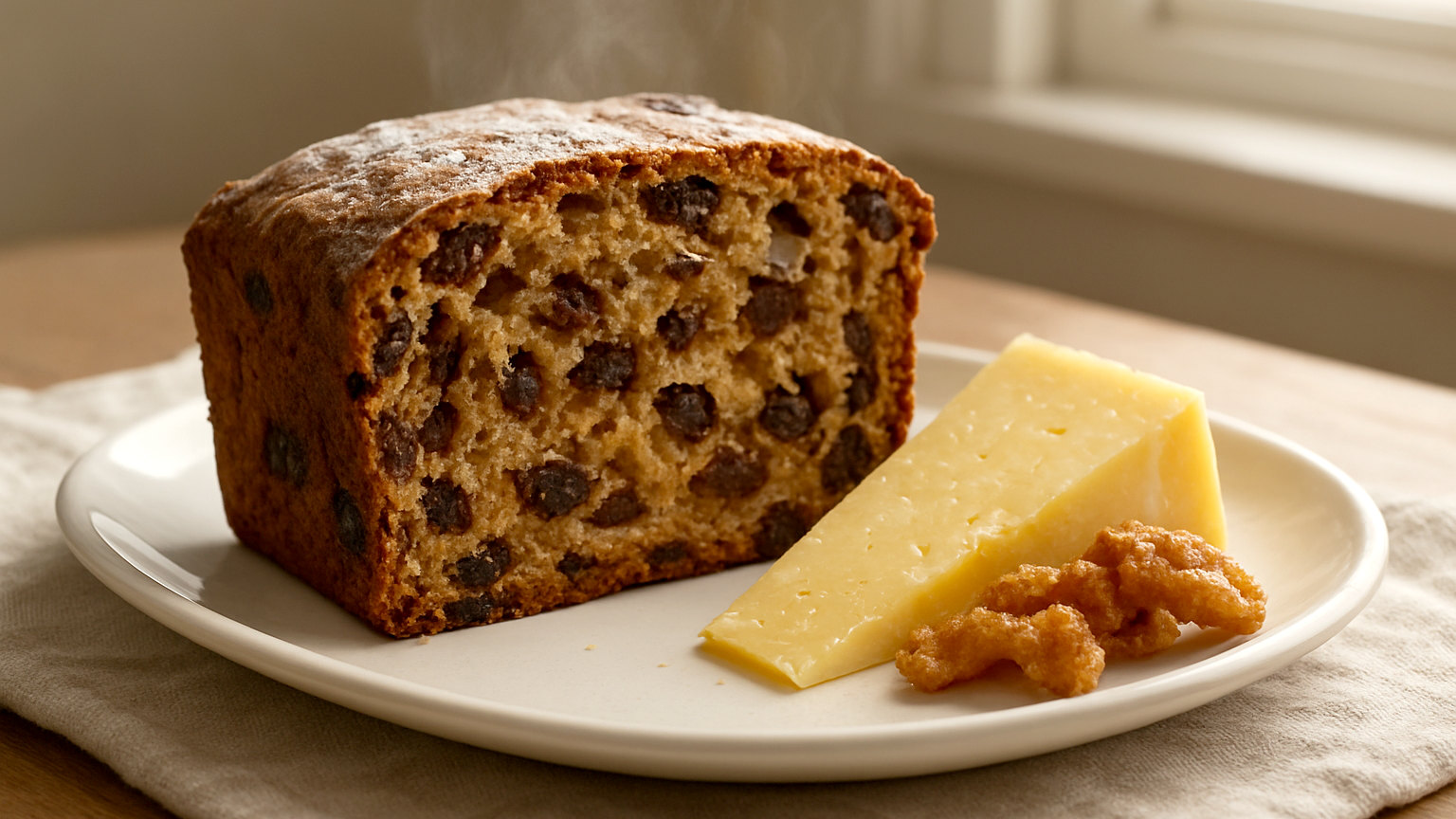
Lincolnshire plum bread contains no plums. Plum was an old English word for any dried fruit, which is why Christmas pudding was once plum pudding. It is a yeasted fruit loaf, less sweet than most, and the local habit of eating it with a slice of strong cheese is what makes it distinctive.
What do you need for a 900g loaf?
- 300g mixed dried fruit, mostly currants and sultanas
- 150ml hot strong black tea
- 450g strong white bread flour
- 7g fast action yeast and 1 teaspoon salt
- 75g caster sugar and 1 teaspoon mixed spice
- 100g butter, softened
- 2 eggs, beaten
- About 100ml warm milk
How do you make it?
- Soak the dried fruit in the hot tea overnight, then drain well.
- Combine the flour, yeast, salt, sugar and mixed spice.
- Rub in the butter, then add the eggs and enough warm milk for a soft dough.
- Knead for 10 minutes until smooth.
- Prove for 2 hours until doubled.
- Knock back and work in the drained fruit.
- Shape into a greased 900g loaf tin and prove for 1 hour.
- Bake at 160C fan for 50 to 60 minutes, covering with foil if it browns too fast.
Drain the soaked fruit properly here, unlike in bara brith. This is a yeasted dough rather than a batter, and excess liquid makes it too wet to knead or shape.
Why is it called plum bread?
Plum was a general term for dried fruit in older English, particularly raisins and currants. The same usage gives us plum pudding.
There have never been plums in it.
Why eat it with cheese?
It is the Lincolnshire habit, usually with Lincolnshire Poacher, a strong hard cheese made in the county.
The salt and acidity cut the sweetness in the same way cheese works with Eccles cakes and fruit cake in Yorkshire.
Should it be glazed?
A brush of warmed honey or sugar syrup while hot gives a shine. Many Lincolnshire bakers leave it plain.
How is it different from bara brith?
Plum bread is yeasted and less sweet, closer to a bread. Modern bara brith is a loaf cake with no yeast.
Both soak their fruit in tea.
Does it need mixed spice?
A teaspoon is traditional and it should be subtle. This is a bread rather than a spiced cake.
Why such a low oven?
Sugar and fruit both brown quickly, so a moderate oven for an hour is safer than a hot one.
Cover it with foil if the top colours before the centre is done.
Can it be made in a bread machine?
The dough can, on a sweet dough setting, adding the fruit at the raisin beep. Bake it in the oven for a better crust.
Why add the fruit after the first prove?
Dried fruit tears the gluten during kneading and its sugars slow the yeast.
How long should the fruit soak?
Overnight in hot tea, then drained thoroughly. A few hours will do at a push and overnight gives plumper fruit.
Keep the drained tea for another use or discard it.
Should it contain peel?
Some versions include mixed peel and cherries. Currants and sultanas are the traditional base.
How sweet is it?
Considerably less sweet than most fruit loaves, which is deliberate. It has to work against a strong salty cheese.
How is it served?
Sliced and buttered, with cheese, or toasted the following day.
What is Lincolnshire Poacher?
A hard unpasteurised cheese made in the county, somewhere between a cheddar and a continental alpine cheese, and strong enough to stand up to the fruit.
Any mature hard cheese works in its place.
How do you know it is baked?
It should sound hollow when tapped underneath and a skewer should come out clean. Around 55 minutes is usual.
Fruited loaves take longer than plain ones.
How long does it keep?
Five days wrapped and it freezes for three months, whole or sliced.
It toasts very well after the second day.
For something along the same lines, see Lincolnshire Sausages, or browse all our Regional recipes.


