
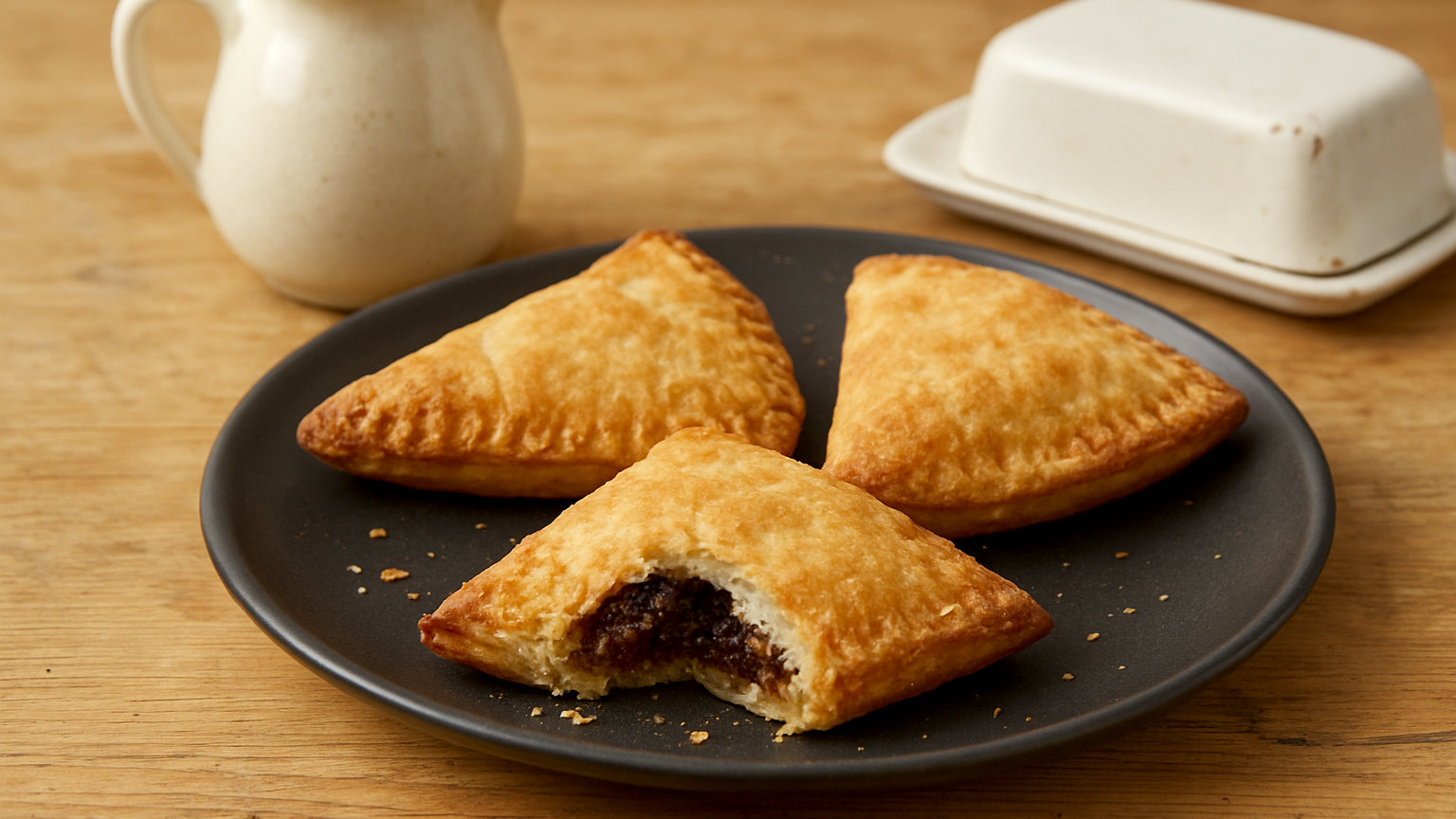
Coventry God cakes are small triangular puff pastry turnovers filled with mincemeat, traditionally given by godparents to their godchildren at New Year. The triangle represents the Trinity, and three slashes are cut in the top for the same reason. They were sold by Coventry bakers in three sizes according to what the godparent could afford.
What do you need for 12 cakes?
- 500g all butter puff pastry
- 300g mincemeat
- 1 tablespoon brandy, optional
- Zest of 1 lemon
- 1 egg white, beaten
- Caster sugar for the tops
How do you make them?
- Heat the oven to 200C fan, 220C conventional, gas mark 7.
- Stir the brandy and lemon zest into the mincemeat.
- Roll the pastry thinly and cut into 12cm squares.
- Put a spoonful of mincemeat on one half of each square.
- Fold over diagonally to make a triangle and seal the edges firmly.
- Cut three short slashes in the top of each.
- Brush with egg white and dust with caster sugar.
- Bake for 15 to 18 minutes until puffed and golden.
Seal the edges properly with a fork or your fingers. Mincemeat becomes liquid in the oven and any weak seam will leak, which burns onto the tray and empties the pastry.
Why triangular?
The three corners represent the Holy Trinity, as do the three slashes cut into the top.
It is a deliberate religious symbolism rather than a practical shape.
What is the godparent tradition?
Godparents gave them to godchildren at New Year as a blessing for the year ahead, a custom recorded in Coventry from at least the eighteenth century.
They were sold in three sizes to suit different budgets.
Why egg white rather than whole egg?
It gives a crisp frosted finish with the sugar rather than a golden glaze, which is the traditional appearance.
How much filling per cake?
About a heaped teaspoon, roughly 25g. Overfilled cakes burst as the mincemeat boils.
Keep it well away from the edges.
Should they be filled cold?
Yes. Warm mincemeat softens the pastry before it reaches the oven and the layers will not rise properly.
Chill the assembled triangles for ten minutes if the kitchen is warm.
Can you use homemade mincemeat?
Yes, and it is better. Drain off any excess liquid, since a wet filling makes the pastry soggy underneath.
Do they freeze well?
Better raw than baked. Freeze them shaped on a tray, then bag them, and bake from frozen with five extra minutes.
How thin should the pastry be?
About 3mm. Puff pastry rises considerably, so thick pastry gives a doughy cake with little filling.
Why puff pastry?
It gives the light layered texture and the dramatic rise. Shortcrust works and produces something much closer to a mince pie.
All butter puff is worth the extra cost here.
Are they eaten only at New Year?
Traditionally yes, and they are made at Coventry bakeries at other times. They suit the whole Christmas period.
How do you cut clean triangles?
Cut 12cm squares with a sharp knife rather than a cutter, then fold corner to corner. A ruler is not excessive here.
Even squares give even triangles that bake at the same rate.
How should they be served?
Warm from the oven or cold, with tea. They need no cream.
What were the three sizes?
Coventry bakers sold them small, medium and large, so a godparent could give one appropriate to their means.
All three were the same triangular shape.
How is it different from a mince pie?
Same filling, different construction. A mince pie is a round tart in a tin, and a God cake is a folded triangular turnover.
God cakes also use puff pastry rather than shortcrust.
Are they still made?
A small number of Coventry bakers still make them, particularly around New Year, and the tradition has been revived locally.
How long do they keep?
Three days in a tin and they freeze raw for three months, baked from frozen with 5 extra minutes.
They are best on the day they are baked.
See also Grantham Gingerbreads, or browse more Regional recipes.


