
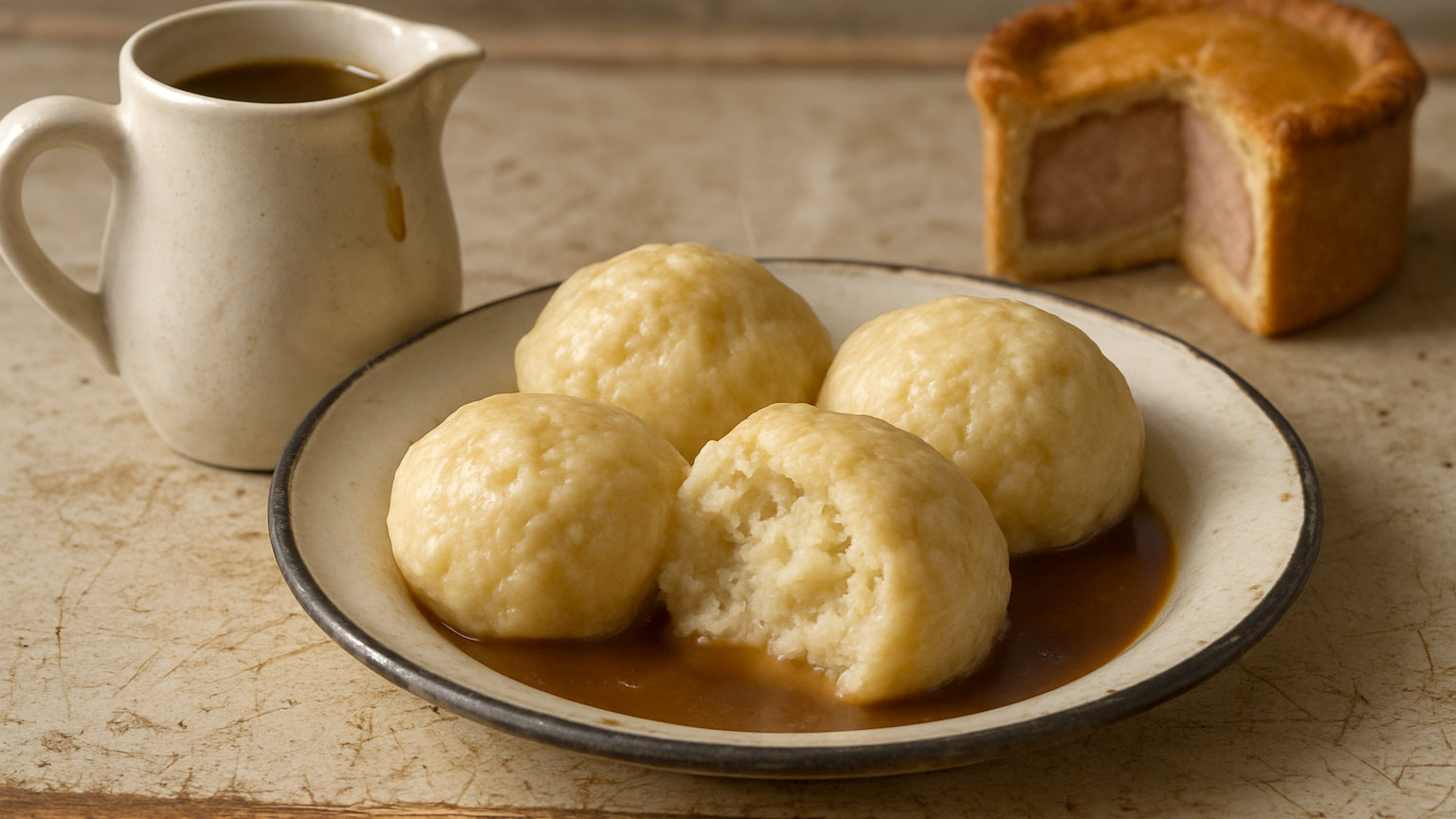
Norfolk dumplings are quite different from the suet dumplings that go into a stew. They contain no fat at all, being simply flour, yeast, water and salt, and they are boiled in water rather than cooked in a stew. The result is light and slightly chewy, and they were traditionally eaten with gravy before the meat course to take the edge off appetites.
What do you need for 8 dumplings?
- 450g strong white bread flour
- 7g fast action yeast
- 1 teaspoon salt
- About 300ml warm water
- Gravy to serve
How do you make them?
- Combine the flour, yeast and salt.
- Add the warm water gradually and mix to a soft dough.
- Knead for 8 minutes until smooth.
- Prove in a covered bowl for 45 minutes until doubled.
- Knock back and divide into 8 pieces, shaping each into a ball.
- Prove for a further 15 minutes on a floured tray.
- Bring a large pan of salted water to a rolling boil.
- Drop them in, cover, and boil for 20 minutes without lifting the lid.
Do not lift the lid during the twenty minutes. The dumplings rise on trapped steam as much as on the boiling water, and letting it out mid way gives heavy, dense dumplings that will not recover.
Why is there no suet?
These are a bread dough rather than a pastry. The lift comes entirely from yeast, which is why they are lighter and chewier than a suet dumpling.
Suet dumplings are a different dish and belong in a stew.
Why are they called floaters?
They float to the surface of the boiling water as they cook, which is the traditional Norfolk name for them.
Sinkers, by contrast, are the heavier suet kind.
How were they eaten?
With gravy, as a first course before the meat, which was expensive. Filling up on dumplings meant less meat was needed.
The same logic gave Yorkshire pudding its traditional place at the start of a meal.
What gravy suits them?
A dark onion gravy or the gravy from a roast. It should be plentiful and well seasoned, since the dumplings themselves are plain.
Allow about 150ml per person.
How do you serve them?
Tear them open with two forks rather than cutting them, which keeps them light, and pour gravy over.
Cutting with a knife compresses them.
How much water do they need?
A large pan with plenty of room, since they swell and need to move freely. Crowded dumplings stick together and cook unevenly.
Can they be cooked in a stew?
They can be steamed on top of a stew for 20 minutes with the lid on, which is closer to how suet dumplings are done.
Boiling separately is the traditional Norfolk method.
Why do they collapse?
Either the lid came off during boiling or they were overproved before going in. Both leave them dense and flat.
Fifteen minutes for the second prove is enough.
Are they eaten sweet?
Sometimes, with sugar and butter or with fruit and syrup, as a pudding.
The dough is unsweetened either way.
Can they be made without yeast?
A version with self raising flour and no proving exists and is quicker, though it is closer to a scone dumpling than the traditional article.
The yeasted dough is what gives the characteristic chew.
Why East Anglia?
Norfolk was a wheat growing county with plentiful flour and comparatively little fat, which suited a dumpling made without suet.
How big should they be?
About the size of a small apple before boiling, since they swell considerably. Eight from this quantity of dough is right.
Larger ones stay doughy in the middle.
Does the water need salting?
Yes, generously, in the same way as pasta water. It is the only chance to season the dumplings from the outside.
How long do they keep?
They are best eaten immediately and go dense within an hour. Any left over can be sliced and fried in butter the next day.
Cool quickly and refrigerate within two hours, in line with Food Standards Agency guidance.
Worth reading next: Chelsea Buns. There is more in our Regional recipes.


