
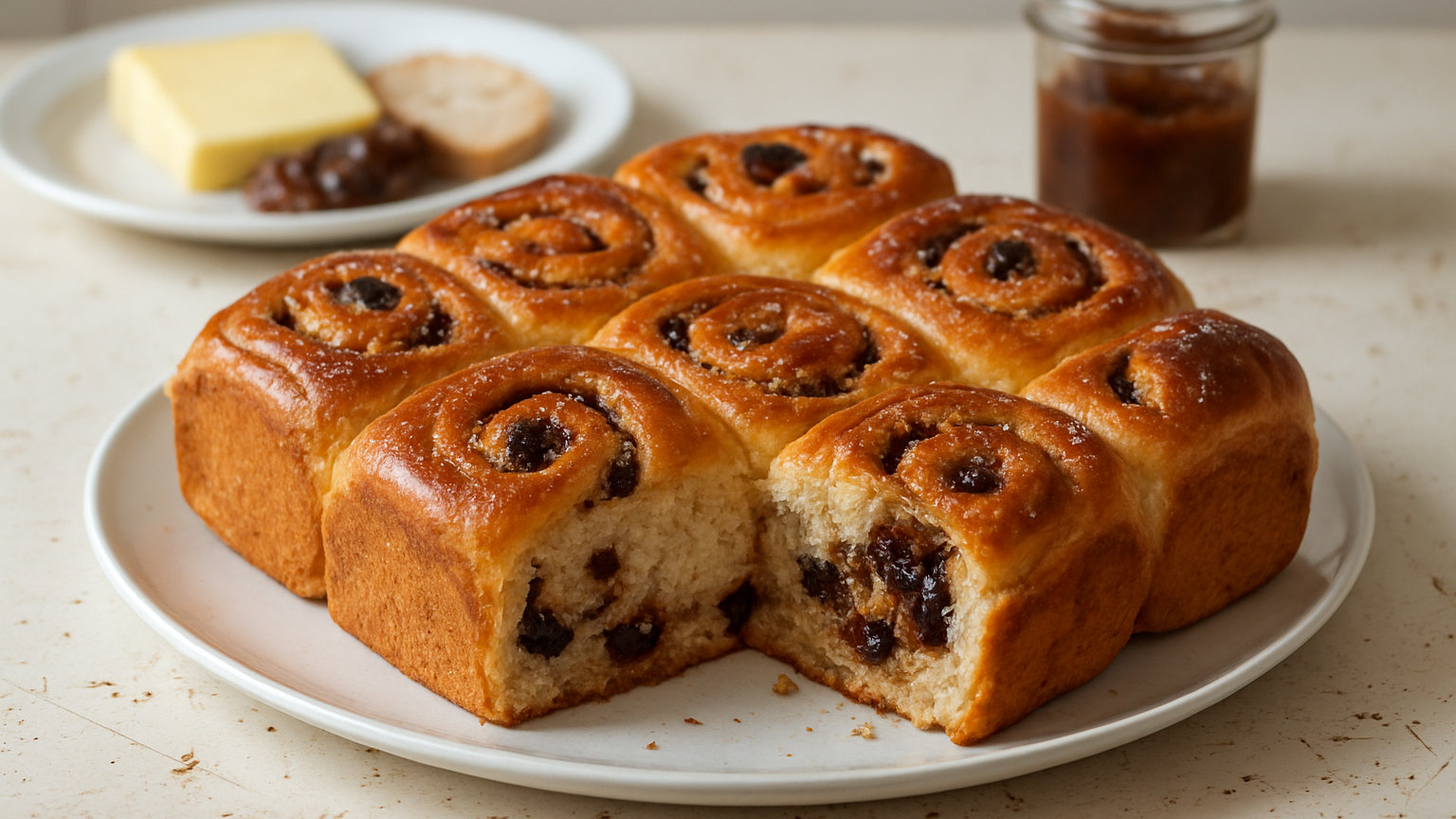
Chelsea buns are an enriched yeast dough rolled up with butter, sugar and dried fruit, cut into spirals and baked packed tightly together so they rise into one another and stay soft at the sides. They take their name from the Chelsea Bun House, an eighteenth century London bakery that attracted royal custom and enormous crowds.
What do you need for 9 buns?
- 500g strong white bread flour
- 7g fast action yeast and 1 teaspoon salt
- 50g caster sugar
- 250ml warm whole milk
- 50g melted butter and 1 egg
- For the filling: 75g softened butter, 100g light brown sugar, 2 teaspoons mixed spice, 200g mixed dried fruit
- For the glaze: 3 tablespoons caster sugar and 3 tablespoons milk
How do you make them?
- Combine the flour, yeast, salt and sugar, keeping the salt and yeast apart initially.
- Add the milk, melted butter and egg and mix to a soft dough.
- Knead for 10 minutes until smooth and elastic.
- Prove for 1 hour until doubled.
- Roll into a rectangle about 40cm by 30cm.
- Spread with the softened butter, scatter with sugar, spice and fruit.
- Roll up tightly from the long side and cut into 9 pieces.
- Pack cut side up into a lined 23cm square tin, prove for 45 minutes and bake at 180C fan for 25 minutes.
Pack them tightly with the sides almost touching. As they prove and bake they press into each other, which keeps the sides soft and pale while only the tops brown. Spaced apart they dry out and become ordinary buns.
How do you get a tight spiral?
Roll firmly from the long edge, keeping tension in the roll as you go, and pinch the final seam to seal it.
A loose roll unwinds during baking and the fruit falls out.
How do you cut them cleanly?
With a sharp knife in one downward stroke, or with a length of dental floss slid under the roll and pulled up through it.
Sawing squashes the spiral flat.
What is the glaze?
Sugar dissolved in milk, boiled for a minute and brushed over the buns while they are still hot from the oven.
It sets to a sticky sheen as they cool.
How is it different from a Bath bun?
A Bath bun is a rounded, craggy bun with sugar nibs on top rather than a rolled spiral, and it is a different dough.
Chelsea buns are square, flat and rolled.
How do you know the dough has proved?
It should have roughly doubled and a finger pressed into it should leave a dent that fills back slowly rather than springing straight out.
What fruit is traditional?
Currants and sultanas with mixed peel. Soaking them in hot tea for twenty minutes first stops them drying the dough.
Why does the dough need enriching?
Butter, egg and sugar give a soft, tender crumb quite unlike a plain bread dough, and they also slow the yeast, which is why proving takes longer.
Can the dough be made overnight?
Yes, and it improves the flavour. Do the first prove in the fridge overnight, then roll, fill and shape in the morning.
Let the shaped buns come to room temperature before the final prove.
What was the Chelsea Bun House?
A bakery near Sloane Square that traded from the early eighteenth century and drew crowds of thousands at Easter. It closed in 1839.
Why does the dough need two proves?
The first develops the flavour and structure, and the second lets the shaped buns expand into each other in the tin.
Skipping the second gives dense buns with gaps between them.
What tin should you use?
A 23cm square tin for nine buns, which packs them in three rows of three with just enough room to expand.
A round tin works and the corner buns lose their square shape.
How long do they keep?
Two days in a tin and they are far better on the day. They freeze for a month and refresh at 160C fan for 5 minutes.
For something along the same lines, see Maids of Honour, or browse all our Regional recipes.


