
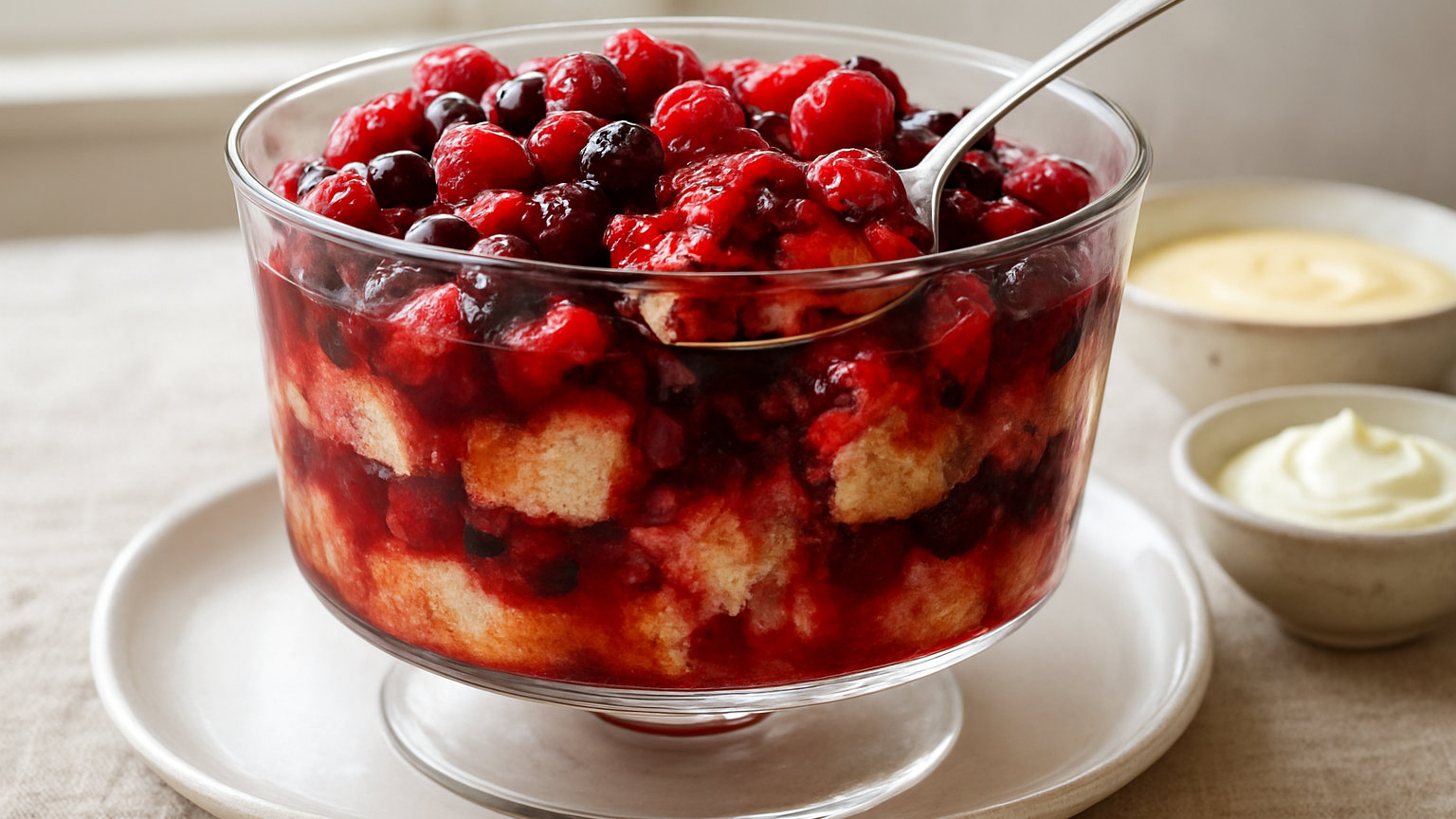
Summer pudding is berries and their juice pressed into a basin lined with bread and left overnight under a weight. The bread absorbs the juice completely and turns a deep purple, and when it is turned out it holds its shape as a solid dome. It requires no cooking beyond a few minutes softening the fruit.
What do you need for 6 people?
- 800g mixed summer berries: raspberries, redcurrants, blackcurrants and strawberries
- 125g caster sugar
- 2 tablespoons water
- 7 to 8 slices of good white bread, slightly stale, crusts removed
- Cream to serve
How do you make it?
- Put the currants and sugar in a pan with the water and heat gently for 3 minutes until the juices run.
- Take off the heat and stir in the raspberries and strawberries.
- Cool completely.
- Cut a disc of bread for the base of a 1 litre basin and strips for the sides.
- Dip each piece in the fruit juice and line the basin with no gaps.
- Spoon in the fruit with most of the juice, keeping some back.
- Cover with more bread and trim.
- Cover with a plate that fits inside, weight it down and refrigerate overnight.
Weight it properly and leave it overnight. Tins of beans on a saucer are ideal. Without real weight the bread does not compress into a solid mass and the pudding collapses when turned out.
Why does the bread need to be stale?
Fresh bread is soft and turns to mush when it absorbs juice. A day or two old it is firmer and holds together.
Use a plain white tin loaf. Sourdough and seeded breads are too strongly flavoured.
Which berries should you use?
Redcurrants and blackcurrants for sharpness and colour, raspberries for flavour, and strawberries for bulk.
Blackcurrants give the deepest colour. A pudding of raspberries alone is good but paler.
Why cook only the currants?
Currants need heat to release their juice and soften. Raspberries and strawberries collapse readily and would turn to pulp.
Three minutes is enough for the currants.
How do you avoid gaps in the lining?
Cut the strips slightly wider than you need and overlap them, pressing the joins together firmly.
Any gap will leak juice and show as a white patch when turned out.
Why keep some juice back?
To patch any pale spots after turning out. There are almost always one or two.
Spoon it over and it soaks in within a minute.
How do you turn it out?
Run a knife around the edge, put a deep plate over the basin and invert firmly in one movement.
Lift the basin away slowly, since the pudding settles as it releases.
Why must the fruit be cold before lining?
Hot juice turns the bread to paste immediately rather than soaking into it gradually.
Cool it completely, which takes about an hour.
What should you serve with it?
Plenty of cold pouring cream, and nothing else. Clotted cream is good if the occasion warrants it.
The pudding is intensely fruity and sharp, so the cream is doing real work.
Can you use frozen fruit?
Yes, and frozen mixed summer fruit is convenient and cheap. Cook it from frozen and expect slightly more juice.
What size basin do you need?
A 1 litre basin for six people, which uses about 800g of fruit. A pudding basin with sloping sides turns out more easily than a straight sided bowl.
Line it with cling film first if you are nervous about it releasing.
Can it be made in individual portions?
Yes, in ramekins or teacups, which need only four hours under a weight rather than overnight.
They also turn out more reliably than one large pudding.
How long does it keep?
Three days refrigerated, and it is at its best after one night. It freezes for three months in the basin.
Serve with plenty of pouring cream, in line with Food Standards Agency guidance on storing dairy.
Next, try Syllabub, or see the rest of our Puddings recipes.

