
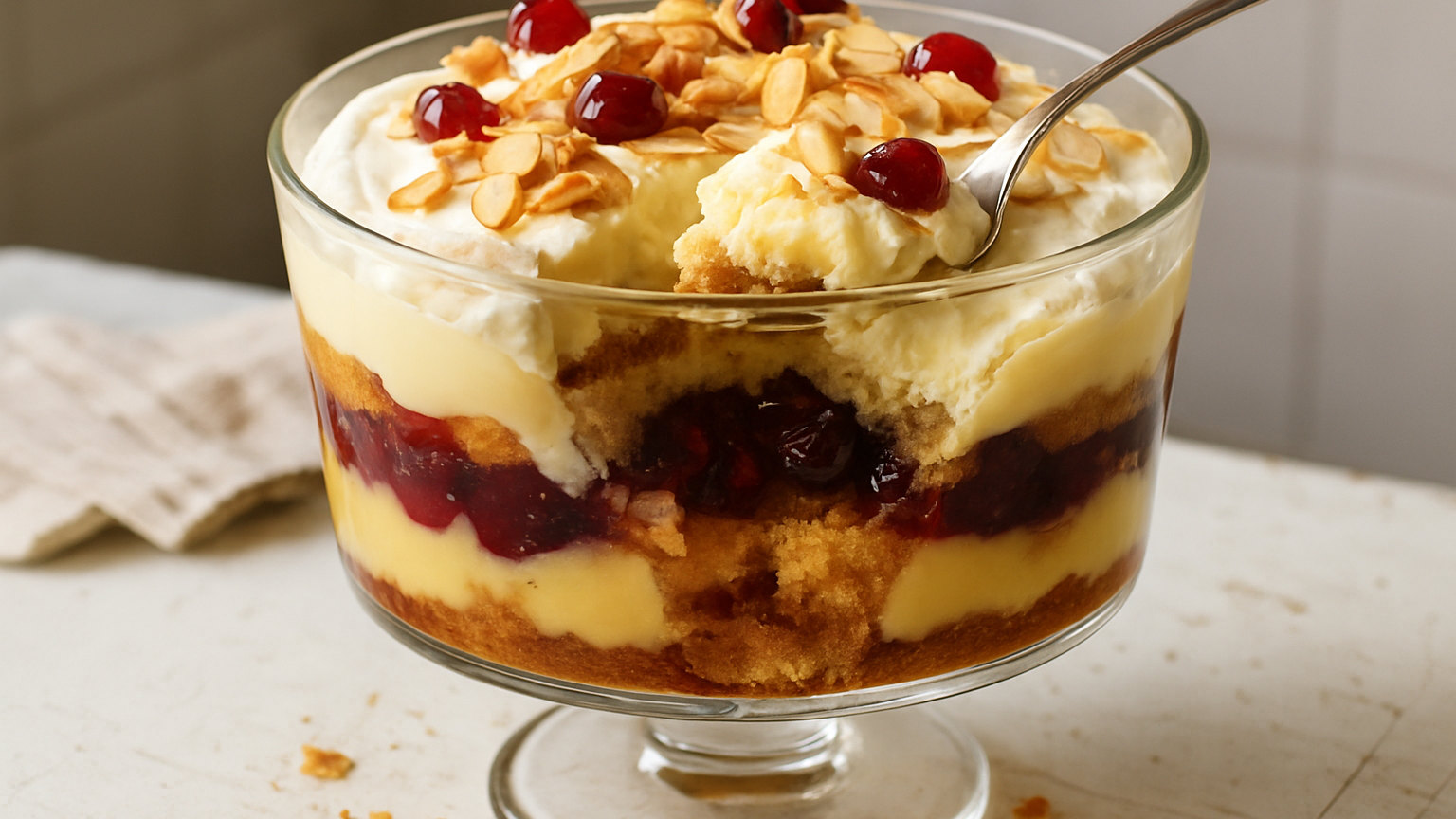
A proper trifle is four layers built in order, and the discipline is entirely in the temperature. Warm custard poured onto sponge will soak straight through it, and cream spread onto custard that has not set will slide off and marble into it. Each layer has to be completely cold before the next goes on, which means starting the day before.
What do you need for 8 people?
- 1 shop bought or homemade Madeira cake, or 8 trifle sponges
- 6 tablespoons raspberry jam
- 150ml medium or sweet sherry
- 400g raspberries, fresh or frozen
- For the custard: 600ml whole milk, 200ml double cream, 6 egg yolks, 75g caster sugar, 2 teaspoons cornflour, 1 vanilla pod
- 500ml double cream for the top
- Toasted flaked almonds to finish
How do you make it?
- Slice the cake, spread with jam, sandwich and cut into cubes.
- Pack into the base of a glass bowl and spoon over the sherry.
- Scatter the raspberries over and press down lightly.
- For the custard, heat the milk and cream with the vanilla to just below a simmer.
- Whisk the yolks, sugar and cornflour, pour on the hot milk and return to a low heat.
- Stir constantly for 8 to 10 minutes until it coats the back of a spoon.
- Cool completely with cling film on the surface, then pour over the fruit.
- Chill for 4 hours, then top with whipped cream and almonds.
The custard must be cold before it goes on the sponge. Poured warm it soaks through into the base and the trifle has no distinct layers, which is the commonest reason a homemade one looks like a bowl of pale mush.
Why cornflour in the custard?
It stabilises the egg yolks so the custard is far less likely to curdle, and it gives a firmer set that holds the cream layer above it.
A pure egg custard is finer but too soft to build on.
How thick should the custard be?
Thick enough to coat the back of a spoon and hold a line drawn through it with a finger.
It firms considerably as it cools, so stop while it still pours.
Which sherry should you use?
A medium amontillado or a sweet oloroso. Dry fino is too austere against the sweet layers.
Marsala, Madeira or a sweet dessert wine all work.
How much should the sponge be soaked?
Damp rather than sodden. About 150ml for a trifle this size, which will be absorbed within twenty minutes.
The fruit juices soak in further, so allow for that.
Can you make it without alcohol?
Use orange juice, or the syrup from tinned fruit. The sponge needs moistening with something.
Label it clearly if you are making both versions, since the two look identical.
How much does this serve?
Eight generously in a 2.5 litre bowl. Trifle is rich, so a small serving with a spoonful of each layer is enough.
Scale the custard first, since it is the layer that runs short.
Why a glass bowl?
The layers are half the point of a trifle, and a straight sided glass bowl shows them. A ceramic dish hides everything.
How far ahead can it be made?
Build it up to the custard layer a day ahead. Add the cream on the day, since whipped cream weeps after about twelve hours.
Should there be jelly in it?
Not in the classic version. Jelly is a Victorian and twentieth century addition and it divides households sharply.
If you want it, set it over the fruit and let it firm completely before the custard goes on.
Why does the custard curdle?
The heat was too high or it was left unstirred. Egg yolks scramble above about 85C, so keep it low and keep the spoon moving.
The cornflour makes this much less likely, and a curdled custard can sometimes be saved by blitzing it.
How should it be stored?
Covered in the fridge, and eaten within two days. It contains cream and lightly set custard, so keep it chilled until serving, in line with Food Standards Agency guidance.
See also What Belongs in a Trifle?, or browse more Puddings recipes.

