
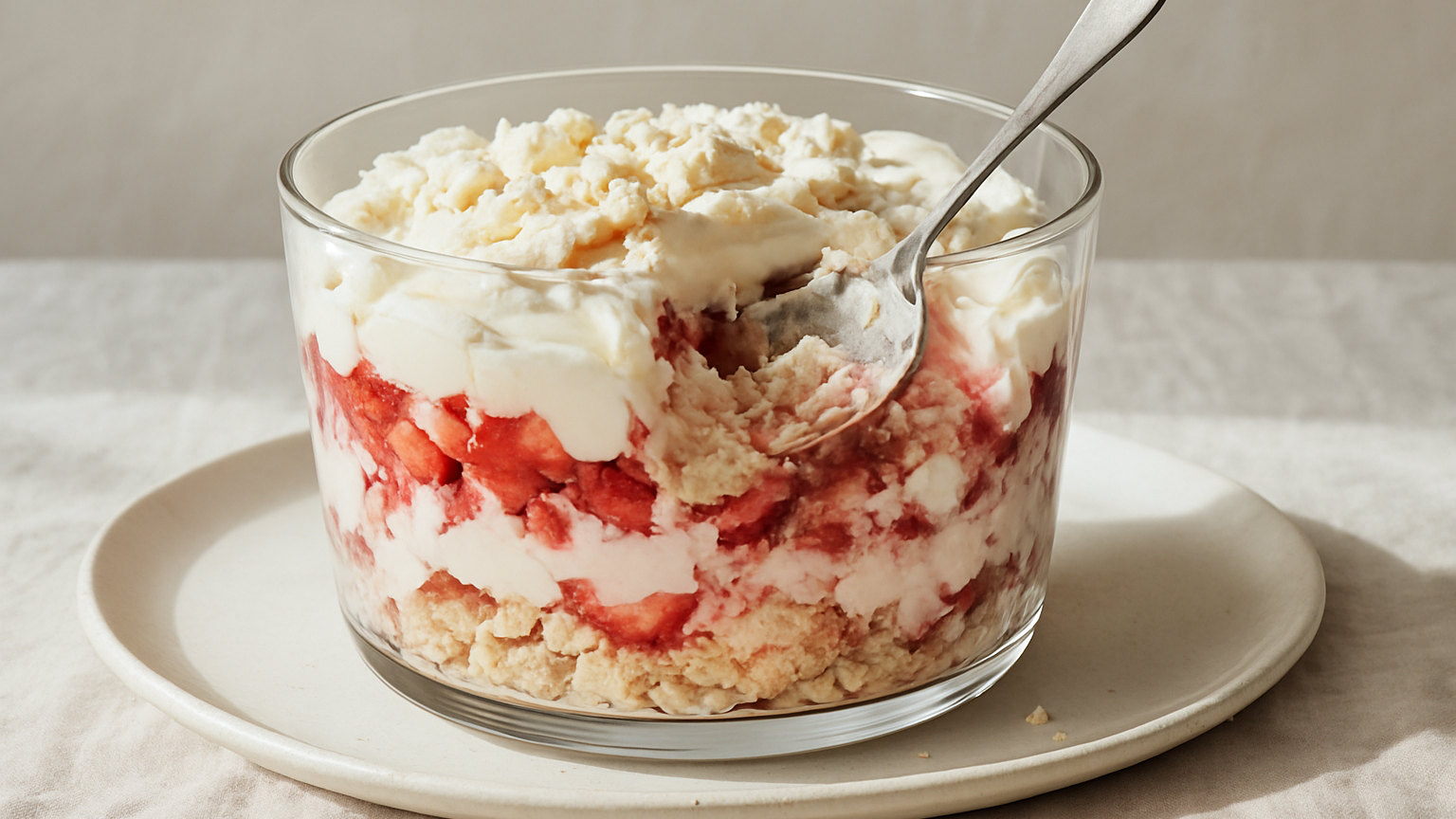
Eton mess is three things thrown together and it depends entirely on timing. Meringue dissolves the moment it meets cream and fruit juice, so a mess assembled half an hour early is a bowl of sweet pink slop. Made at the table it has crisp shards, soft cream and sharp fruit all at once, which is the whole point of it.
What do you need for 6 people?
- 800g strawberries, hulled
- 3 tablespoons icing sugar
- 1 tablespoon balsamic vinegar or lemon juice
- 600ml double cream
- 1 teaspoon vanilla extract
- 6 shop bought or homemade meringue nests
How do you make it?
- Halve or quarter two thirds of the strawberries and put them in a bowl.
- Sprinkle with 2 tablespoons of the icing sugar and the vinegar and leave for 30 minutes.
- Blitz or mash the remaining third to a puree with the last of the sugar.
- Whip the cream with the vanilla to soft peaks.
- Break the meringues into rough pieces of varying size.
- Fold the cream, meringue and macerated fruit together with two or three strokes.
- Ripple the puree through.
- Serve immediately.
Combine it at the very last moment. Ten minutes is acceptable and thirty is not. If you need to work ahead, prepare all three components separately and fold them together as people sit down.
Why macerate the strawberries?
Sugar draws out the juice and concentrates the flavour, and half an hour turns even mediocre supermarket strawberries into something worth eating.
A splash of balsamic sharpens them further and is not detectable as vinegar.
Why puree some of the fruit?
It gives the ripple through the cream and spreads the flavour, while the whole pieces give texture.
Using only whole fruit makes it look plain and taste patchy.
Should the meringue be crushed finely?
No. Break it into pieces of different sizes, some as large as a walnut. Fine crumbs dissolve instantly and add nothing.
Is it worth making the meringue?
If you have spare egg whites, yes. Whisk four whites with 200g of caster sugar and bake at 100C fan for 90 minutes.
Homemade meringue holds its crispness a little longer in the cream.
Can you use shop bought meringue?
Entirely, and most people do. Homemade meringue is crisper and a little better, and it uses up egg whites.
Should the cream be sweetened?
Barely. The meringue is almost pure sugar and the fruit is macerated, so the cream is the only unsweetened element and should stay that way.
A teaspoon of vanilla is enough.
What other fruit works?
Raspberries, blackberries, poached rhubarb or a mixture of summer berries. Rhubarb and ginger is a good winter version.
Anything very juicy needs draining first.
What if the strawberries are poor?
Macerating rescues most of them, and a spoonful of strawberry jam stirred into the puree adds depth to underripe fruit.
Out of season, frozen berries make a better mess than pale fresh ones.
Where does the name come from?
It is associated with Eton College and the annual cricket match against Harrow, where it has been served since at least the nineteenth century.
Early versions used banana and sometimes ice cream rather than meringue.
Can any of it be done ahead?
All of it, separately. Macerate the fruit up to four hours ahead, whip the cream up to two, and break the meringue whenever you like.
Only the folding has to happen at the last minute.
How much cream per person?
About 100ml of double cream and 130g of fruit each, which is generous. It is very rich and small bowls are better than large ones.
This quantity comfortably serves six and stretches to eight.
Can it be made in individual glasses?
Yes, and layering rather than folding gives a neater result for serving to guests. Build fruit, cream and meringue in three or four layers.
Assemble them no more than ten minutes before serving.
How should leftovers be treated?
It does not keep, since the meringue has already dissolved. Refrigerate and eat within a day, in line with Food Standards Agency guidance.
For something along the same lines, see Fruit Fool, or browse all our Puddings recipes.

