
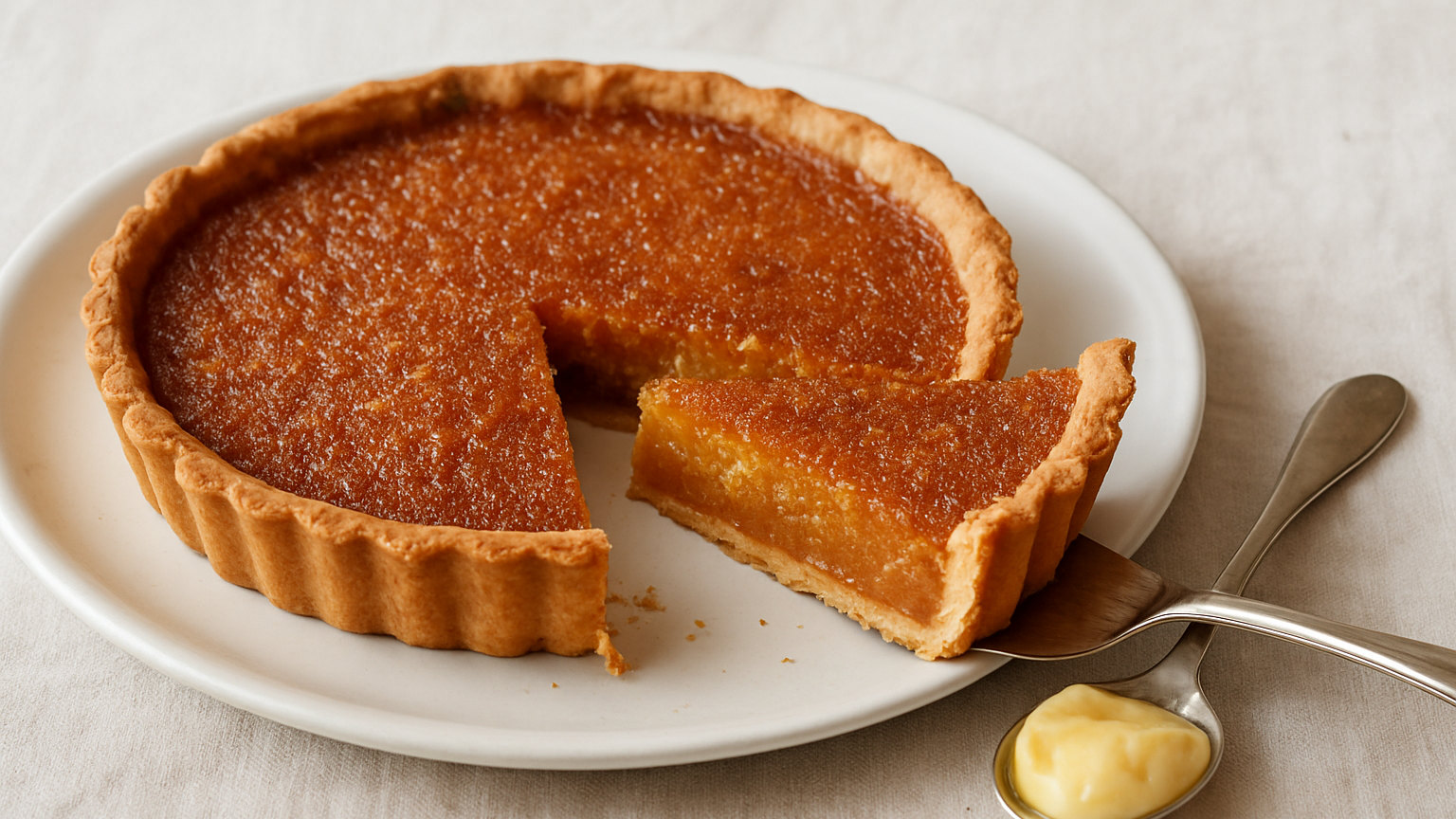
Treacle tart is golden syrup held together with breadcrumbs in a pastry case, and it is one of the few British puddings built almost entirely from store cupboard ingredients. The breadcrumbs are doing the structural work, absorbing the syrup so it sets into something sliceable rather than running out of the case the moment it is cut.
What do you need for 8 people?
- 1 blind baked 23cm sweet shortcrust case
- 400g golden syrup
- 150g fresh white breadcrumbs
- Zest of 2 lemons and juice of 1
- 1 egg, beaten
- 75ml double cream
- A pinch of salt
- A little ground ginger, optional
How do you make it?
- Blind bake the pastry case and leave it in the tin.
- Warm the golden syrup gently in a pan until runny, but do not let it boil.
- Take it off the heat and stir in the breadcrumbs, lemon zest and juice.
- Leave for 10 minutes so the crumbs absorb the syrup.
- Beat in the egg, cream, salt and ginger if using.
- Pour into the case and level the surface.
- Bake at 170C fan for 35 to 40 minutes until set with a slight wobble in the centre.
- Cool for at least 30 minutes before slicing.
The lemon is not optional. Golden syrup on its own is overwhelmingly sweet, and the zest and juice of two lemons is what makes a slice of this edible rather than cloying.
Is there any actual treacle in it?
Usually none. Golden syrup was originally sold as a light treacle, which is where the name comes from, and black treacle would make the tart bitter.
A tablespoon of black treacle added to the golden syrup deepens the flavour if you want it darker.
What kind of breadcrumbs?
Fresh white breadcrumbs from slightly stale bread, blitzed in a processor. Dried packet crumbs are too fine and give a pasty texture.
Brown bread works and makes a nuttier, darker tart.
What is the ratio?
Roughly 400g of syrup to 150g of breadcrumbs. Less crumb gives a looser, more liquid filling and more gives a dense, cakey one.
The egg and cream are optional in traditional recipes and give a softer, more custardy set.
Why warm the syrup?
Cold golden syrup is too thick to mix evenly with breadcrumbs. Warming it makes it pourable and lets the crumbs absorb it properly.
Do not boil it, which starts to caramelise it and makes the tart darker and harder.
How do you know when it is set?
The surface should be firm around the edges with a slight wobble in the middle, which firms up as it cools.
Baked until completely firm it will be dry and chewy once cold.
How sweet is it?
Very. This is among the sweetest things in British baking, so portions should be modest and the accompaniment unsweetened.
Where does it come from?
Golden syrup was first produced commercially in the 1880s, and treacle tart follows shortly afterwards, which makes it a late Victorian invention rather than an ancient one.
It became a school and nursery pudding in the twentieth century, which is where most of its associations come from.
Should it be served hot or cold?
Warm is best, about half an hour out of the oven. Straight from the oven it is molten and will not slice.
It is also perfectly good cold and keeps three days.
Can it be made ahead or frozen?
It keeps three days at room temperature in a tin and freezes for three months, whole or in slices.
Reheat slices at 150C fan for 10 minutes rather than in a microwave, which makes the pastry soft.
Why blind bake the case?
The filling is wet and bakes for only forty minutes, which is not long enough to cook raw pastry underneath it.
Seal the baked case with beaten egg and return it for two minutes, which stops the syrup soaking in.
Can you make it with a lattice?
Strips of pastry laid over the filling are traditional and look good, though they add nothing to the taste. Roll them thinly and lay them on before baking.
Keep some pastry back when lining the tin if you want to do this.
What should you serve with it?
Custard, cream or clotted cream. Something unsweetened is essential given how sweet the tart is.
See also Bakewell Tart, or browse more Puddings recipes.

