
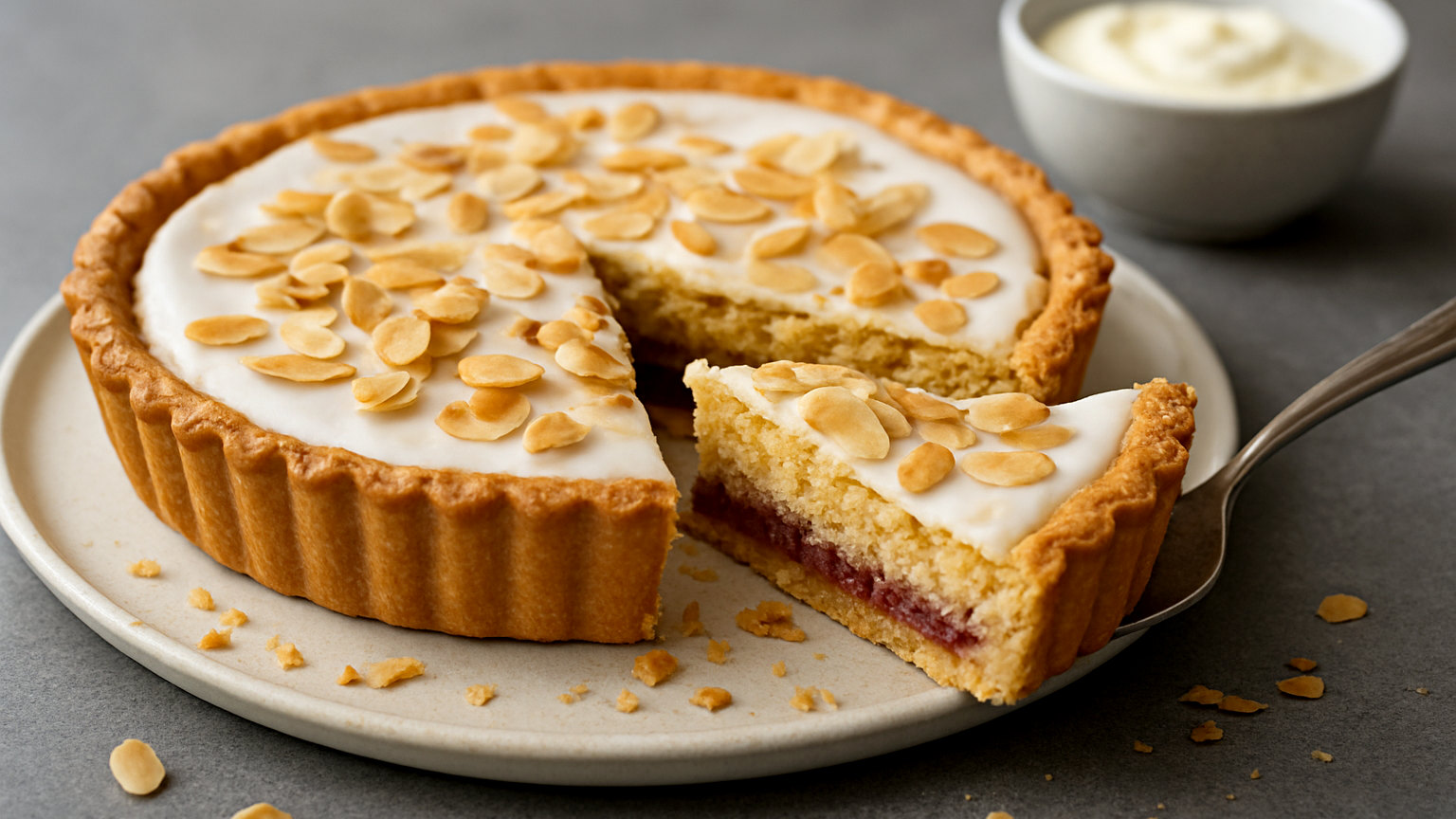
A Bakewell tart is jam spread thinly in a pastry case, covered with frangipane and baked until golden. It is often confused with the Bakewell pudding, which is an older and quite different thing, and with the iced cherry Bakewell sold in packets. The version below is the tart most people picture, and the frangipane is the part worth getting right.
What do you need for 8 people?
- 1 blind baked 23cm sweet shortcrust case
- 5 tablespoons raspberry jam
- 150g softened butter
- 150g caster sugar
- 3 eggs
- 150g ground almonds
- 50g plain flour
- 1 teaspoon almond extract
- 50g flaked almonds
How do you make it?
- Blind bake the case and leave it in the tin.
- Spread the jam thinly and evenly over the base.
- Beat the butter and sugar until pale and light.
- Add the eggs one at a time, with a spoonful of the ground almonds if it curdles.
- Fold in the ground almonds, flour and almond extract.
- Spoon over the jam and spread carefully to the edges.
- Scatter with flaked almonds.
- Bake at 160C fan for 35 to 40 minutes until golden and firm.
Spread the frangipane rather than pouring it. Dropping it on in a lump pushes the jam to the sides, and it should be dotted over in spoonfuls and then joined up gently.
How much jam should you use?
A thin layer, about 5 tablespoons for a 23cm tart. Too much and it boils up through the frangipane and burns at the edges.
Raspberry is traditional. A sharp jam balances the sweetness of the almond filling better than a sweet one.
What is frangipane?
A creamed mixture of butter, sugar, eggs and ground almonds, used as a filling in tarts across Europe. It puffs slightly as it bakes and sets to a soft, moist sponge.
The small amount of flour helps it hold together without making it cakey.
Does it need almond extract?
Ground almonds alone are mild, and a teaspoon of extract gives the pronounced almond flavour most people expect from a Bakewell.
Use it sparingly, since too much tastes synthetic.
Why does the jam sink or rise?
A warm or runny jam moves as the frangipane bakes and can bubble up through it. Use a thick set jam straight from the fridge.
Spreading it on a fully cooled pastry base also helps it stay where it is put.
How do you know it is cooked?
The frangipane should be golden, firm to a light touch and a skewer should come out clean. It sets further as it cools.
How full should the case be?
About two thirds, since the frangipane rises. Overfilling means it spills over the pastry edge and sticks to the tin.
Why does the top crack?
Usually the oven was too hot, so the surface set before the middle had finished rising. 160C fan is the right temperature.
Cracks are cosmetic and the flaked almonds hide most of them.
Why does the jam sink or rise?
A thin even layer stays put. A thick one boils, bubbles up through the frangipane and burns where it reaches the surface.
Warming the jam slightly makes it easier to spread thinly without dragging the pastry.
How do you know it is baked?
The frangipane should be golden, risen and firm to a light press, and a skewer in the centre should come out clean.
Around 40 minutes at 160C fan is reliable for a 23cm tart.
Should it be iced?
The classic tart is not iced. The iced version with a glace cherry on top is a Cherry Bakewell, which is a different and more recent commercial product.
Both are legitimate and the argument about which is correct is long running.
Can you use other jams?
Damson, blackcurrant and apricot all work and each changes the character. Cherry jam makes something close to the commercial cherry version.
Choose a sharp jam rather than a very sweet one, since the frangipane brings plenty of sugar.
Can it be made ahead or frozen?
It keeps three days in a tin and freezes for three months. It is arguably better on the second day, once the flavours have settled.
Serve warm or at room temperature with cream or custard.
Next, try Bakewell Pudding or Bakewell Tart?, or see the rest of our Puddings recipes.

