
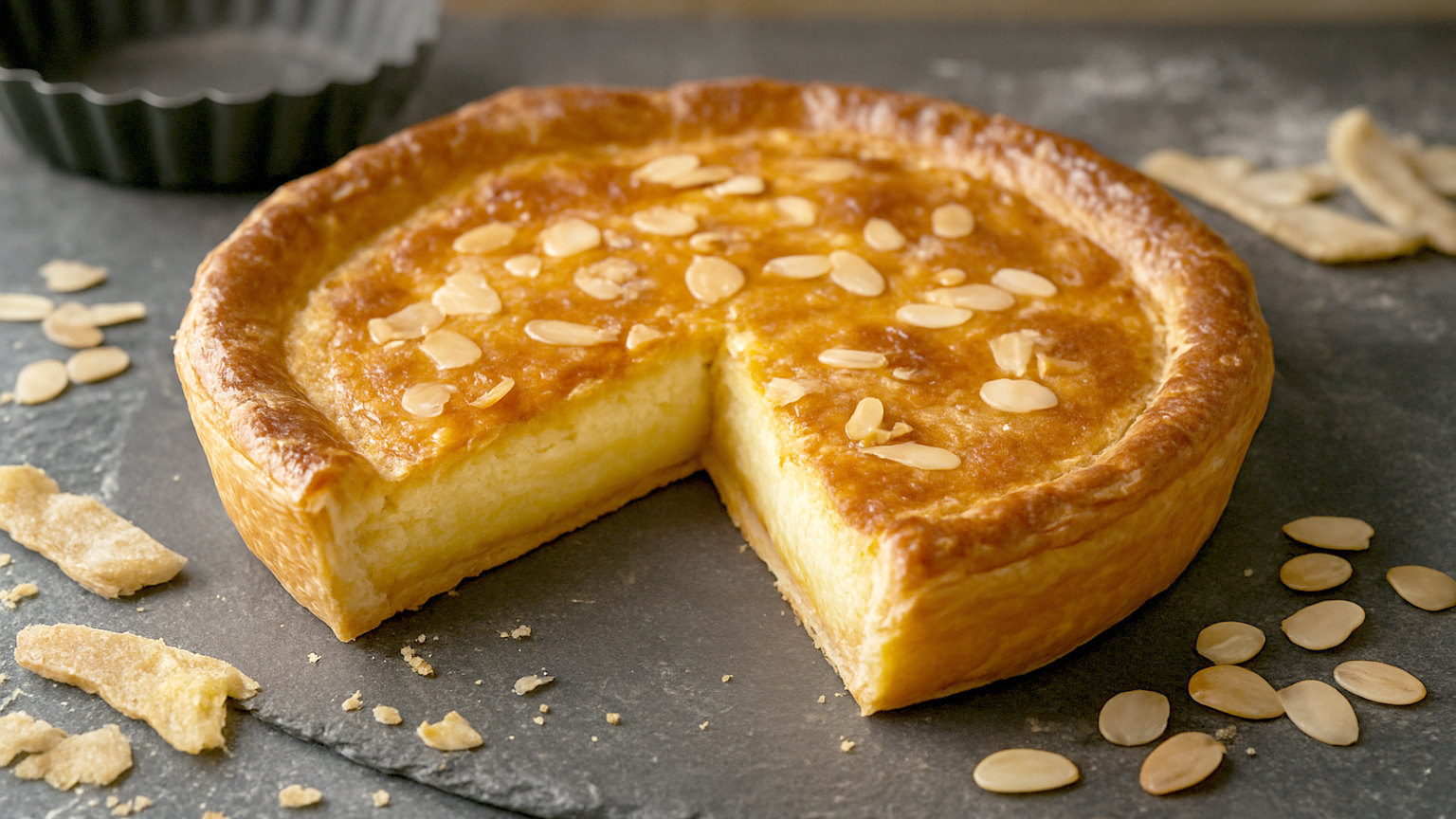
Bakewell pudding and Bakewell tart are frequently treated as the same thing and they are not. The pudding is older, comes from the Derbyshire town of Bakewell, and is made with puff pastry and a loose, set egg and almond filling. The tart is a later adaptation with shortcrust and frangipane. Both are good and the town is firm about the distinction.
What is a Bakewell pudding?
Puff pastry spread with jam and filled with a mixture of eggs, sugar, butter and ground almonds that sets into a soft, slightly wobbly layer.
The filling is closer to a custard than a sponge. It is loose when poured and sets to something rich and almost translucent rather than cakey.
What is a Bakewell tart?
Shortcrust pastry with jam and frangipane, which is a creamed mixture of butter, sugar, eggs and ground almonds that rises slightly and sets to a soft sponge.
It is firmer, sweeter and easier to slice than the pudding.
What is the origin story?
The traditional account has a cook at the White Horse Inn in Bakewell misunderstanding instructions in the 1820s, spreading jam on the pastry and pouring the egg mixture over the top instead of stirring it into the pastry.
It is a good story and, like most such stories, hard to verify.
Which pastry does each use?
The pudding uses puff pastry, which gives crisp flaky edges around a soft filling. The tart uses sweet shortcrust.
This is the clearest visual difference between the two.
How do the fillings differ?
The pudding filling is poured and sets like a baked custard. The tart filling is spooned and behaves like a sponge batter.
The pudding contains proportionally more egg and butter and less flour, which is what makes it looser.
How do you tell them apart on sight?
Look at the pastry edge. Puff pastry rises into visible flaky layers, while shortcrust stays as a smooth firm rim.
The pudding filling also looks glossier and less risen than frangipane, which puffs and browns.
Where does the cherry version come from?
The Cherry Bakewell is a twentieth century commercial product: a small shortcrust tart with frangipane, topped with white glace icing and a single glace cherry.
It is a descendant of the tart rather than the pudding and it is a legitimate thing in its own right.
Is either protected?
Neither has protected status, unlike the Cornish pasty or Melton Mowbray pork pie, so anyone can make and sell either under those names.
Several shops in Bakewell claim the original recipe, and their claims are mutually incompatible.
Are the fillings interchangeable?
Not really. The pudding filling is too loose for a shortcrust case with a high rim, and frangipane in puff pastry weighs the layers down.
Each filling was developed for its own pastry.
Which should you make?
The tart is easier, slices more neatly and travels better. The pudding is richer and more interesting and is worth making once to see the difference.
The pudding is best eaten warm on the day, which limits it somewhat.
Which is older?
The pudding, by a considerable margin. It is recorded from the early nineteenth century, while the frangipane tart is a later Victorian and twentieth century development.
The tart largely displaced the pudding outside Derbyshire.
Do they use the same jam?
Both traditionally use raspberry or strawberry, spread thinly. Some Bakewell pudding recipes use a thicker layer than the tart does.
Does the pudding contain flour?
Very little or none, which is why the filling stays loose. The tart filling contains flour, which is part of what makes it firmer.
Some pudding recipes use a few breadcrumbs instead.
What shape are they?
The pudding is traditionally oval, made in a shallow dish, and the tart is round in a fluted tin.
Shops in Bakewell still sell the puddings in their traditional oval shape.
Does the distinction matter?
To anyone from Bakewell, considerably. To everyone else it matters mainly because ordering one and expecting the other leads to disappointment.
They are different enough that it is worth knowing which you are making.
Next, try Bakewell Tart, or see the rest of our Puddings recipes.

