
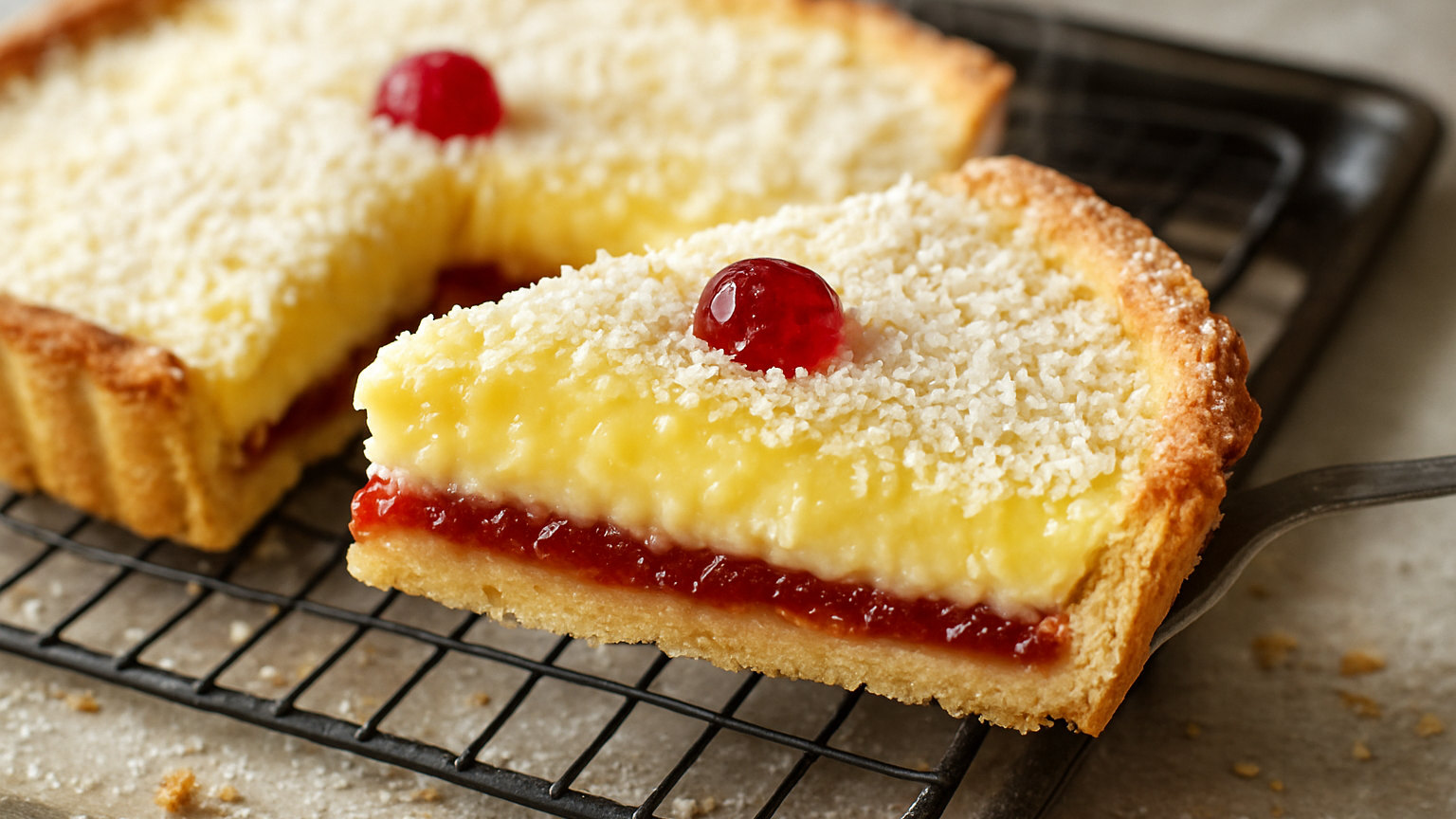
Manchester tart is a shortcrust case spread with raspberry jam, filled with thick set custard and covered in desiccated coconut with a glace cherry in the middle. It is firmly a school dinner pudding and it is genuinely good when made properly, which mostly means making a custard thick enough to slice rather than one that runs across the plate.
What do you need for 8 people?
- 1 blind baked 23cm sweet shortcrust case
- 5 tablespoons raspberry jam
- 600ml whole milk
- 4 egg yolks
- 75g caster sugar
- 50g cornflour
- 1 teaspoon vanilla extract
- 25g butter
- 40g desiccated coconut and a glace cherry
How do you make it?
- Spread the jam over the base of the cooled pastry case.
- Whisk the yolks, sugar and cornflour together with a splash of the milk.
- Heat the remaining milk to just below a simmer.
- Pour it over the yolk mixture, whisking, then return it all to the pan.
- Cook over a medium heat, whisking constantly, until it thickens and boils.
- Simmer for 1 minute, then beat in the vanilla and butter.
- Pour over the jam and level the surface.
- Cool completely, then scatter with coconut and top with the cherry.
The custard must be boiled properly. Cornflour only reaches full thickening power once it has come to the boil, and a custard taken off just before that point will never set firm enough to slice.
Why cornflour rather than a pouring custard?
This is a pastry cream rather than a pouring custard, and the cornflour is what allows it to be cut into wedges.
An egg only custard would be far too soft for a tart.
How do you stop lumps forming?
Whisk constantly and get into the corners of the pan. If lumps do form, push the custard through a sieve while it is still hot.
A balloon whisk works better than a spoon here.
How do you stop a skin forming?
Press cling film directly onto the surface while it cools, or add the coconut as soon as it has cooled slightly.
A skin is not a disaster and can be stirred back in while warm.
How thick should the jam layer be?
Thin, about five tablespoons across a 23cm case. The custard is the main event and too much jam makes the tart sickly.
Warm the jam slightly so it spreads without tearing the pastry.
Is there banana in it?
Some versions include a layer of sliced banana under the custard, and opinion on this is divided. It was common in school kitchens.
Bananas discolour and go slippery within a day, so leave them out if you are making it ahead.
Why did the custard split?
Too much heat too fast, or it was left unwhisked and caught on the base of the pan. Cornflour custards are fairly robust but not immune.
A medium heat and constant whisking prevents it.
Should the coconut be toasted?
Traditionally it is not, and plain desiccated coconut is what most people remember. Toasting it gives a better flavour if you are not chasing nostalgia.
How long does it take to set?
At least three hours at room temperature, or two in the fridge. It will not slice cleanly before then.
Add the coconut once it is cool but before it is fully cold, so it sticks.
Can you use custard powder?
Yes, and it is closer to the original school version. Make it much thicker than the packet says, using about 75g to 600ml of milk.
It gives the yellow colour people remember, which egg yolks alone do not.
Where does it come from?
It is descended from the Victorian Manchester pudding, which used breadcrumbs and was baked. The custard version became a staple of northern school dinners in the twentieth century.
Can it be made ahead?
It needs several hours to set, so making it the day before is sensible. Keep it refrigerated.
Use within two days and do not freeze, since the custard separates, in line with Food Standards Agency guidance.
If that was useful, Why Does My Tart Pastry Shrink or Crack? covers related ground, and there is plenty more in Puddings recipes.

