
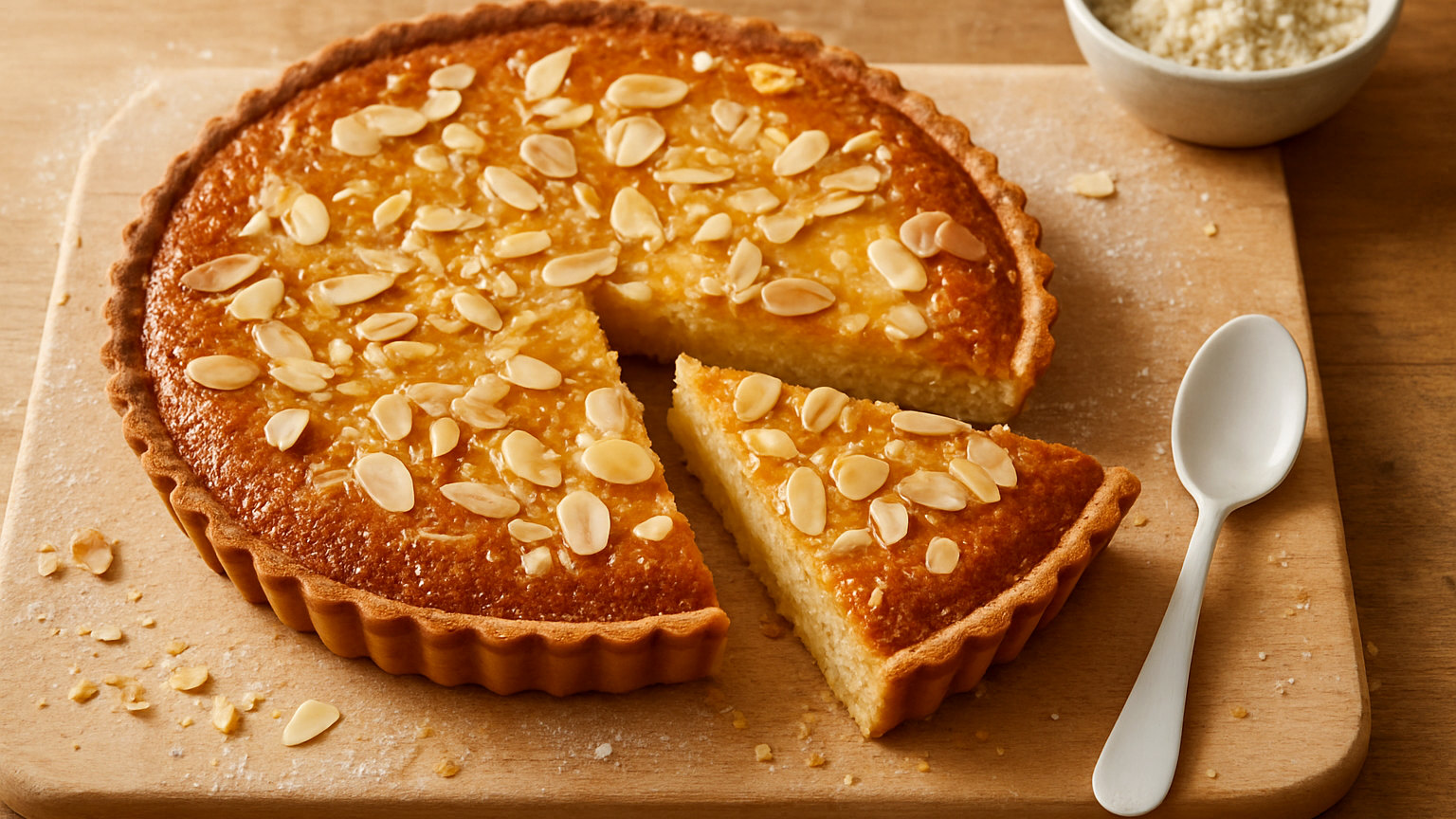
Frangipane is the most useful thing in this section, because it is one mixture that turns whatever fruit you have into a proper tart. It is a creamed almond filling that puffs slightly in the oven and sets into a moist, dense sponge, and it holds fruit in place while absorbing the juice that fruit releases. The ratio is easy to remember.
What is the ratio?
Equal weights of butter, sugar, eggs and ground almonds. Three eggs weigh roughly 150g without shells, so 150g of each of the other three is the standard quantity for a 23cm tart.
A tablespoon or two of plain flour is usually added to help it hold together, though it is not essential.
What do you need?
- 150g softened butter
- 150g caster sugar
- 3 eggs, about 150g
- 150g ground almonds
- 2 tablespoons plain flour
- 1 teaspoon almond extract or the zest of a lemon
How do you make it?
- Beat the butter and sugar until pale and light, about 3 minutes.
- Add the eggs one at a time, beating well between each.
- If it curdles, add a spoonful of the ground almonds.
- Fold in the ground almonds, flour and flavouring.
- Use immediately, or chill for up to three days.
Why does it curdle?
Cold eggs added too quickly to creamed butter split the emulsion. Have the eggs at room temperature and add them one at a time.
A spoonful of the ground almonds brings it back immediately and does no harm to the finished tart.
Which fruit works with it?
Pears above all, then plums, apricots, cherries, raspberries and apples. Rhubarb works if it is drained first.
Press the fruit gently into the surface rather than burying it, so it is visible when baked.
Should the fruit be cooked first?
Poached pears and roasted plums both give a better result than raw fruit, since they release less liquid into the filling.
Tinned pears drained thoroughly are a perfectly respectable shortcut and are what many bakeries use.
How deep should it be?
Fill the case about two thirds, since frangipane rises. It settles slightly as it cools.
Too deep and the middle stays wet while the edges overbake.
What temperature does it need?
160C fan for 35 to 45 minutes depending on depth. A hotter oven browns the surface before the centre has set.
It is done when golden, risen and firm to a light press.
Can it be made in a processor?
Yes, and it is quicker. Blitz the butter and sugar, add the eggs, then pulse in the almonds until just combined.
Stop as soon as it comes together, since over processing makes it dense.
How much does this quantity fill?
A 23cm tart case two thirds full, or about twelve individual tartlets.
What else can you use it for?
Bakewell tart, pear and almond tart, mince pies with a frangipane top, individual tartlets, or spread into a puff pastry galette with fruit on top.
It also works as a filling for croissants that have gone stale.
Can you use other nuts?
Ground hazelnuts, pistachios and walnuts all work in place of almonds and suit different fruit. Hazelnut frangipane with pear is excellent.
Grind them yourself in a processor, stopping before they turn oily.
Does it need to be blind baked underneath?
Yes. Frangipane bakes for around forty minutes at a low temperature, which is not enough to cook raw pastry beneath a wet filling.
Seal the baked case with beaten egg before filling it.
Why does it sink in the middle?
Usually underbaking, or too much air beaten in at the creaming stage. It rises on the trapped air and collapses when that escapes.
Cream the butter and sugar until light but stop there rather than beating for five minutes.
Can it be made ahead or frozen?
It keeps three days in the fridge and freezes for three months. Defrost it in the fridge and beat briefly before using.
Bring it back to room temperature so it is soft enough to spread without tearing the pastry.
See also Sweet Shortcrust Pastry for Tarts, or browse more Puddings recipes.

