
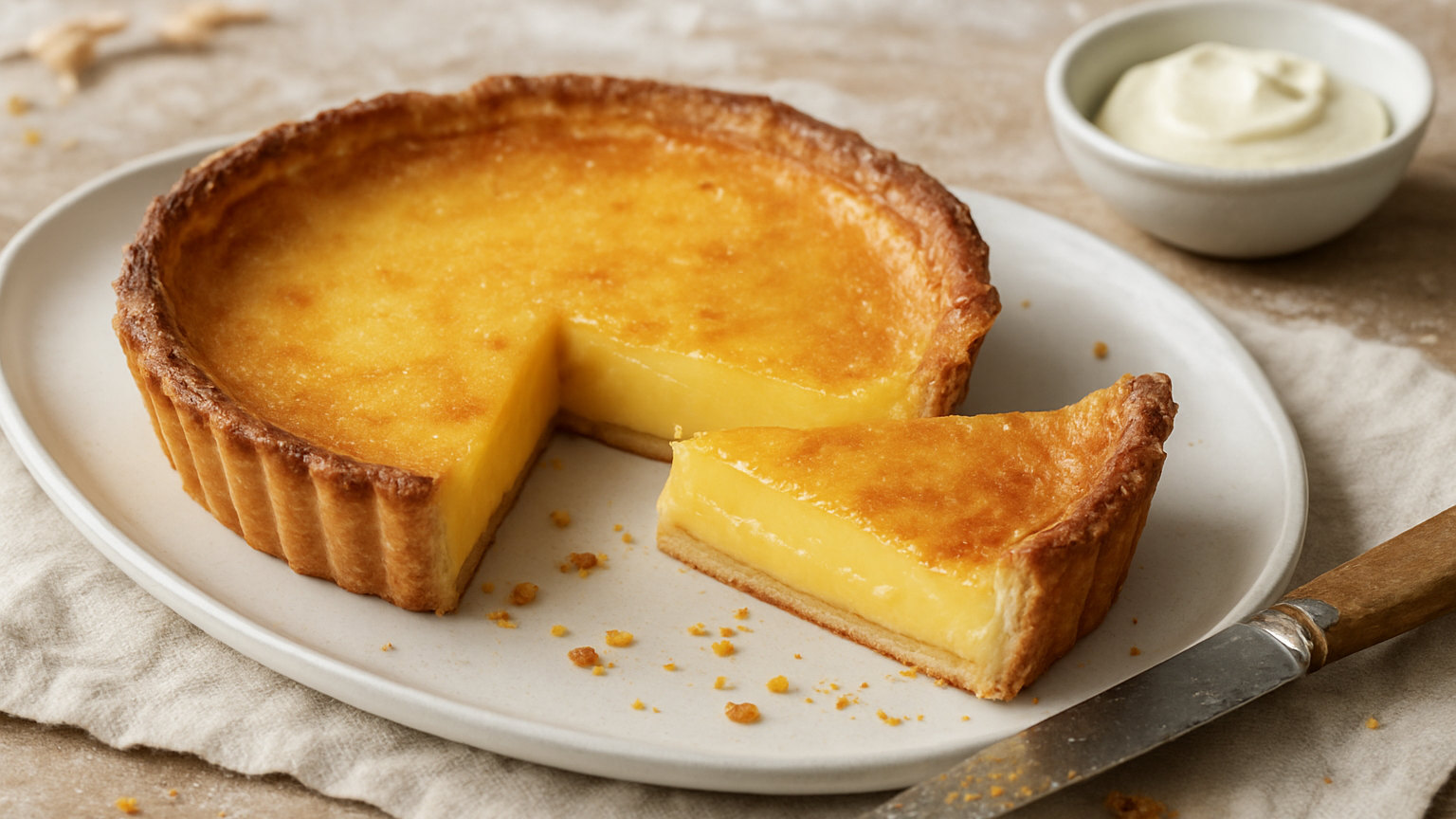
A baked custard tart is one of the simplest things in British baking and one of the least forgiving. It is eggs, cream, sugar and nutmeg in a pastry case, and the only real skill is knowing when to take it out. A few minutes too long and the custard curdles, releasing water and turning grainy, which cannot be undone.
What do you need for 8 people?
- 1 blind baked 23cm sweet shortcrust case, rolled thinly
- 500ml double cream or half cream and half whole milk
- 1 vanilla pod, split, or 1 teaspoon vanilla extract
- 6 egg yolks
- 75g caster sugar
- A whole nutmeg for grating
How do you make it?
- Heat the oven to 130C fan, 150C conventional, gas mark 2.
- Warm the cream with the vanilla to just below a simmer, then take off the heat and leave for 20 minutes.
- Whisk the yolks and sugar together without incorporating air.
- Pour the warm cream over, whisking gently, then strain through a fine sieve.
- Skim off any foam from the surface.
- Sit the pastry case on a shelf pulled halfway out and pour in the custard.
- Grate nutmeg generously over the surface.
- Bake for 35 to 45 minutes until set at the edges with a distinct wobble in the middle.
Take it out while the centre still wobbles like a jelly. It carries on setting as it cools, and a custard that looks fully firm in the oven will be overcooked and grainy by the time it is served.
Why such a low oven?
Egg custard curdles above about 85C. A low oven brings it up to temperature slowly and gives you a much wider margin before it splits.
At 180C the edges are overcooked long before the middle has set.
Why strain the mixture?
It removes any strands of egg white and the chalazae, which would set into rubbery threads in the finished tart.
Skimming the foam gives a smooth, unblemished surface for the nutmeg.
Why fill it at the oven?
A tart filled to the brim is impossible to carry without slopping custard over the pastry rim, which then bakes on and makes it hard to remove from the tin.
Pull the shelf out, sit the tart on it and pour from a jug.
How thin should the pastry be?
About 3mm, thinner than for most tarts. A thick case overwhelms a delicate filling.
Seal the blind baked case with beaten egg and return it to the oven for two minutes, which stops the custard soaking in.
Should the nutmeg be fresh?
Always. Ready ground nutmeg has lost most of its aroma, and a whole nutmeg grated over the surface is one of the defining flavours of the tart.
Be generous, since it mellows in the oven.
What size eggs should you use?
Large eggs, and six yolks to 500ml of cream gives a set that is firm enough to slice but still soft. Fewer yolks give a looser custard.
Keep the whites for meringue, which freezes for three months.
Can you use whole eggs?
Yolks alone give the silkiest custard. Whole eggs set firmer and are more prone to a rubbery texture, since the whites tighten at a lower temperature.
Six yolks to 500ml of cream is the classic proportion for a tart.
How long does it take to set?
Between 35 and 45 minutes at 130C fan, and ovens vary considerably at low temperatures. Start checking at 30 minutes.
Should it be served warm or cold?
At room temperature, which is when the texture is best. Straight from the fridge it is firm and the flavour is muted.
Why did it curdle?
The oven was too hot or it was baked too long. Curdled custard has released its water and the texture cannot be recovered.
A low oven and taking it out early are the only reliable defences.
Should it be baked in a water bath?
Not for a tart, since it would make the pastry soggy. The low oven does the same job of moderating the heat.
A water bath is for custards baked in ramekins without pastry.
Can it be made ahead?
Make it on the day, or the day before at the latest. Cool it quickly, refrigerate within two hours and use within two days, in line with Food Standards Agency guidance.
It does not freeze, since the custard separates on thawing.
Worth reading next: Treacle Tart. There is more in our Puddings recipes.

