
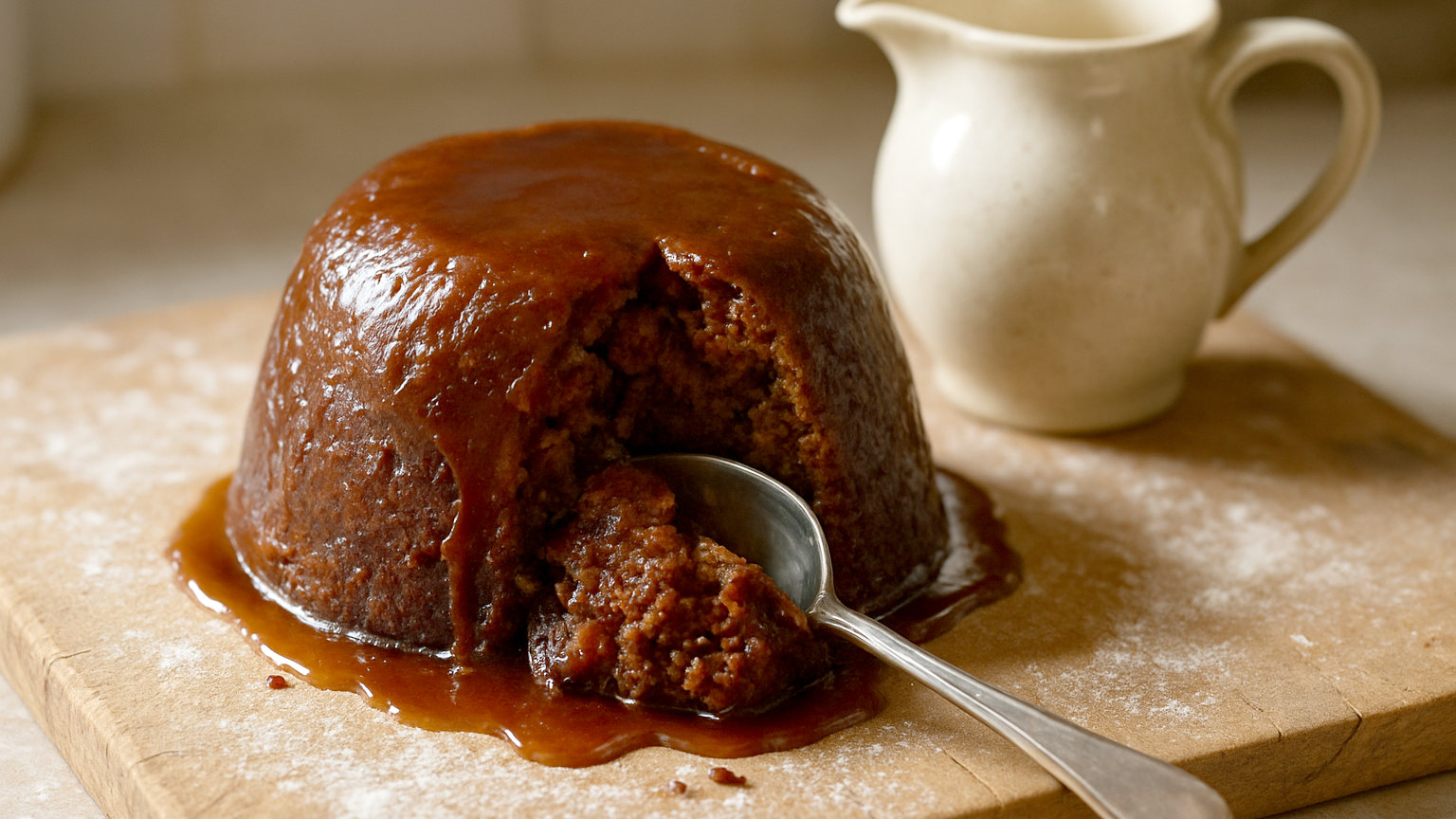
Sticky toffee pudding is a relatively modern British pudding, associated with the Lake District since the 1970s, and it depends almost entirely on what happens to the dates. Soaked in boiling water with bicarbonate of soda they break down into a dark paste that gives the sponge its colour, its moisture and its slightly caramelised flavour. Skip that step and you have an ordinary sponge.
What do you need for 8 people?
- 250g pitted dates, chopped
- 300ml boiling water
- 1 teaspoon bicarbonate of soda
- 85g softened butter and 150g dark brown soft sugar
- 2 eggs
- 175g self raising flour
- 1 teaspoon vanilla extract
- For the sauce: 200g dark brown sugar, 150g butter, 250ml double cream, 1 tablespoon black treacle
How do you make it?
- Put the dates in a bowl, pour over the boiling water and stir in the bicarbonate of soda.
- Leave for 20 minutes until the dates have collapsed, then mash roughly.
- Heat the oven to 160C fan, 180C conventional, gas mark 4.
- Beat the butter and sugar until light, then beat in the eggs one at a time.
- Fold in the flour, then the date mixture and vanilla. The batter will be very loose.
- Pour into a buttered 20cm square tin and bake for 35 to 40 minutes.
- For the sauce, melt the butter, sugar and treacle together, then add the cream and simmer for 3 minutes.
- Prick the hot sponge all over and pour over a third of the sauce.
The batter should look far too wet. That is correct and it is what makes the finished pudding so moist. A batter of normal sponge consistency will bake into something dry and disappointing.
What does the bicarbonate of soda do?
It makes the soaking water alkaline, which breaks the dates down far faster and more completely than water alone would.
It also darkens them and encourages browning in the oven, which is where much of the colour comes from.
Which dates should you use?
Ordinary pitted dates work perfectly and are cheap. Medjool dates are softer and sweeter and give a slightly richer result.
Check for stones even in pitted packs, since one occasionally survives.
Should it be baked or steamed?
Baked is the usual modern method and gives a slightly firmer, darker sponge. Steamed in a basin for 90 minutes gives a lighter, more traditional pudding.
Both work. Baking is easier and the recipe above is written for it.
Why prick the sponge?
So the first pouring of sauce soaks in rather than sitting on the surface. This is what makes it sticky throughout rather than just on top.
Do it while both the sponge and the sauce are hot.
How do you stop the sauce splitting?
Melt the butter and sugar gently before the cream goes in, and do not boil it hard afterwards. Three minutes at a gentle simmer is enough.
If it does split, take it off the heat and whisk in a tablespoon of cold cream.
Can it be made ahead?
Yes, and it improves. Make it a day ahead, keep it covered, and reheat portions in the microwave for 40 seconds or in a low oven.
The sponge freezes for three months and the sauce for one, kept separately.
Where does it come from?
It is associated with the Lake District and particularly with the Sharrow Bay hotel, which popularised it from the 1960s onwards.
Similar date puddings appear earlier, and the exact origin is disputed, but it is a twentieth century dish rather than a Victorian one.
Can it be made in individual portions?
Yes, in dariole moulds or a muffin tin, baking for 20 to 22 minutes. They turn out neatly and reheat quickly.
This is the form most restaurants use, and it freezes better than a large tray.
What should you serve with it?
The remaining sauce poured over, with cream, custard or vanilla ice cream. It is very sweet, so something unsweetened alongside helps.
Cool leftovers quickly, refrigerate within two hours and use within three days, in line with Food Standards Agency guidance.
Worth reading next: Treacle Sponge Pudding. There is more in our Puddings recipes.

