
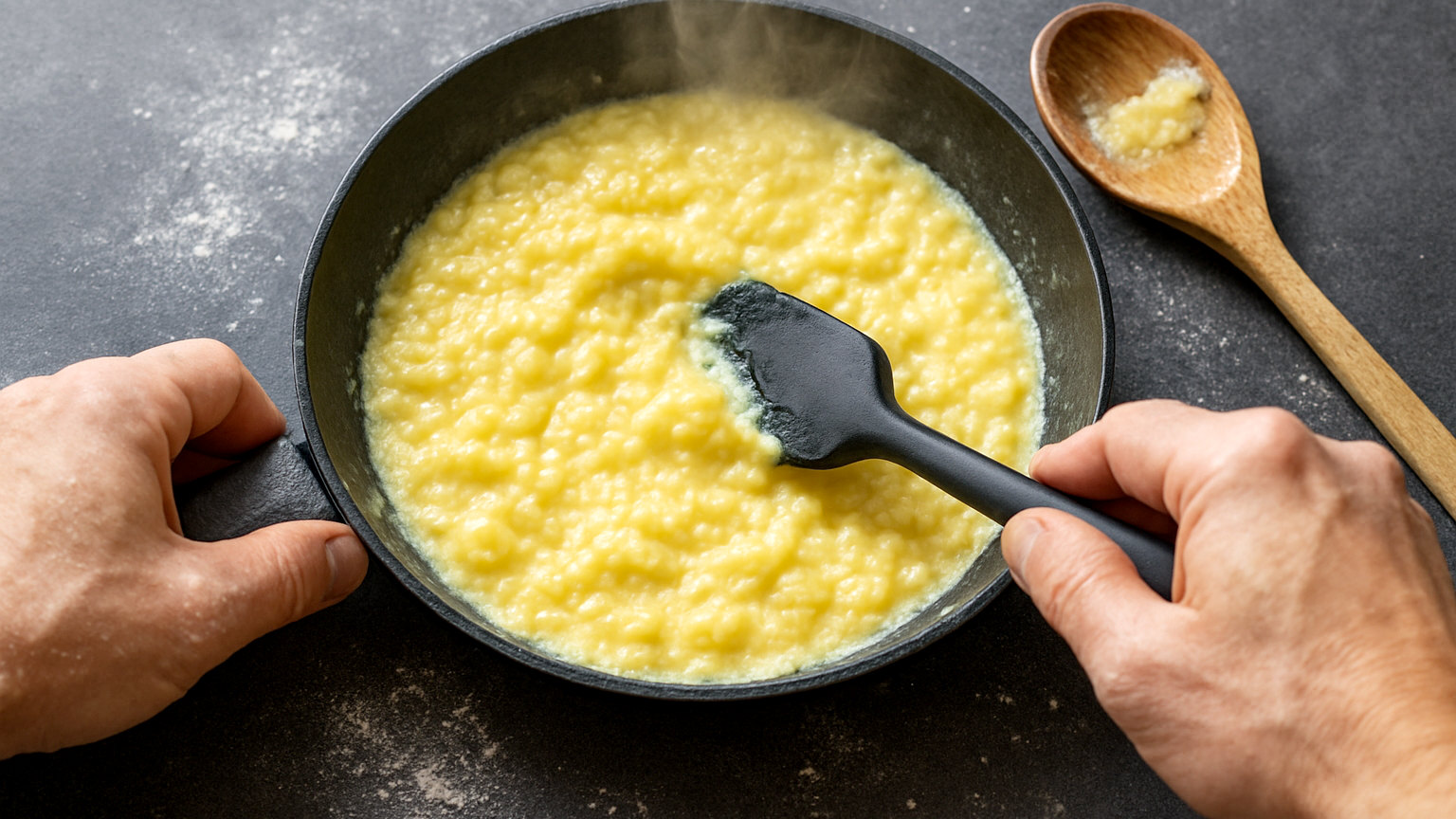
Curdled custard is scrambled egg suspended in milk, and it happens for one reason: the eggs got too hot. Everything else that goes wrong with custard is a variation on that, whether the heat was too high, the stirring stopped, or the eggs met hot milk too suddenly. The fix in every case is the same, which is more control over the temperature.
What is actually happening?
Egg proteins uncoil and link together as they heat, trapping liquid between them, which is what thickens the custard.
Above about 85C those links tighten and squeeze the liquid back out. The proteins clump into visible curds and the custard separates into lumps and watery milk.
Was the heat too high?
The most common cause. Custard should be cooked over a low heat and it will take eight to ten minutes.
Rushing it on a medium heat gives you three or four minutes and a far narrower margin.
Did the stirring stop?
The custard nearest the pan base is always hottest. Stirring keeps it moving and stops any part of it overheating.
Use a wooden spoon or a flat spatula and reach into the corners, where it catches first.
Were the eggs tempered?
Hot milk poured onto cold yolks all at once cooks them immediately. Add it in a slow stream while whisking.
This raises the yolks gradually and is the single most important step.
Did it boil?
A true egg custard with no starch in it will curdle the moment it reaches a simmer, so any bubbles breaking the surface mean it has gone too far.
Watch the edges of the pan, where the first bubbles appear.
Was it left in the hot pan?
A heavy pan holds enough heat to carry on cooking the custard after it leaves the hob.
Strain it into a cold bowl the moment it thickens rather than leaving it to sit.
Can a curdled custard be rescued?
Often, if you catch it early. Take it off the heat immediately, pour it into a cold bowl and whisk hard, or blitz it with a stick blender.
Straining afterwards removes any remaining lumps. Once it has fully separated into curds and liquid it cannot be saved.
Does cornflour prevent it?
Largely, yes. Cornflour interferes with the proteins binding too tightly, so a custard containing a teaspoon of it can be boiled without curdling.
It is slightly less silky, which is why classic recipes leave it out.
Can you fix it by adding cornflour?
Not once it has curdled. Cornflour prevents the problem rather than curing it, so it has to go in at the start.
Slake it in cold milk with the yolks before any heat.
What pan should you use?
A heavy based pan, which spreads heat evenly and avoids hot spots. A thin pan is the enemy of custard.
Does the type of milk matter?
Whole milk gives a richer custard that curdles slightly less readily, since fat slows the proteins binding.
Skimmed milk makes a thin custard that is easier to overcook.
Is a thermometer worth using?
Very much so. Take the custard off at 82C and it will be perfect every time, with no judgement required.
A digital probe costs little and removes the whole problem.
Does the sugar protect the eggs?
To a degree. Sugar raises the temperature at which egg proteins set, so a sweetened custard is slightly more forgiving than an unsweetened one.
Whisk the yolks and sugar together properly before any milk goes near them.
Why did it thicken unevenly?
Hot spots in the pan, usually from a thin base or a burner that is too small for the pan.
Stir continuously and move the pan off the heat every so often to even it out.
What about reheating?
Reheat gently over a low heat or in short bursts in a microwave, stirring between each. Boiling reheated custard curdles it just as readily.
Reheat once only and until piping hot, in line with Food Standards Agency guidance.
Worth reading next: How to Make Custard Without Eggs. There is more in our Puddings recipes.

