
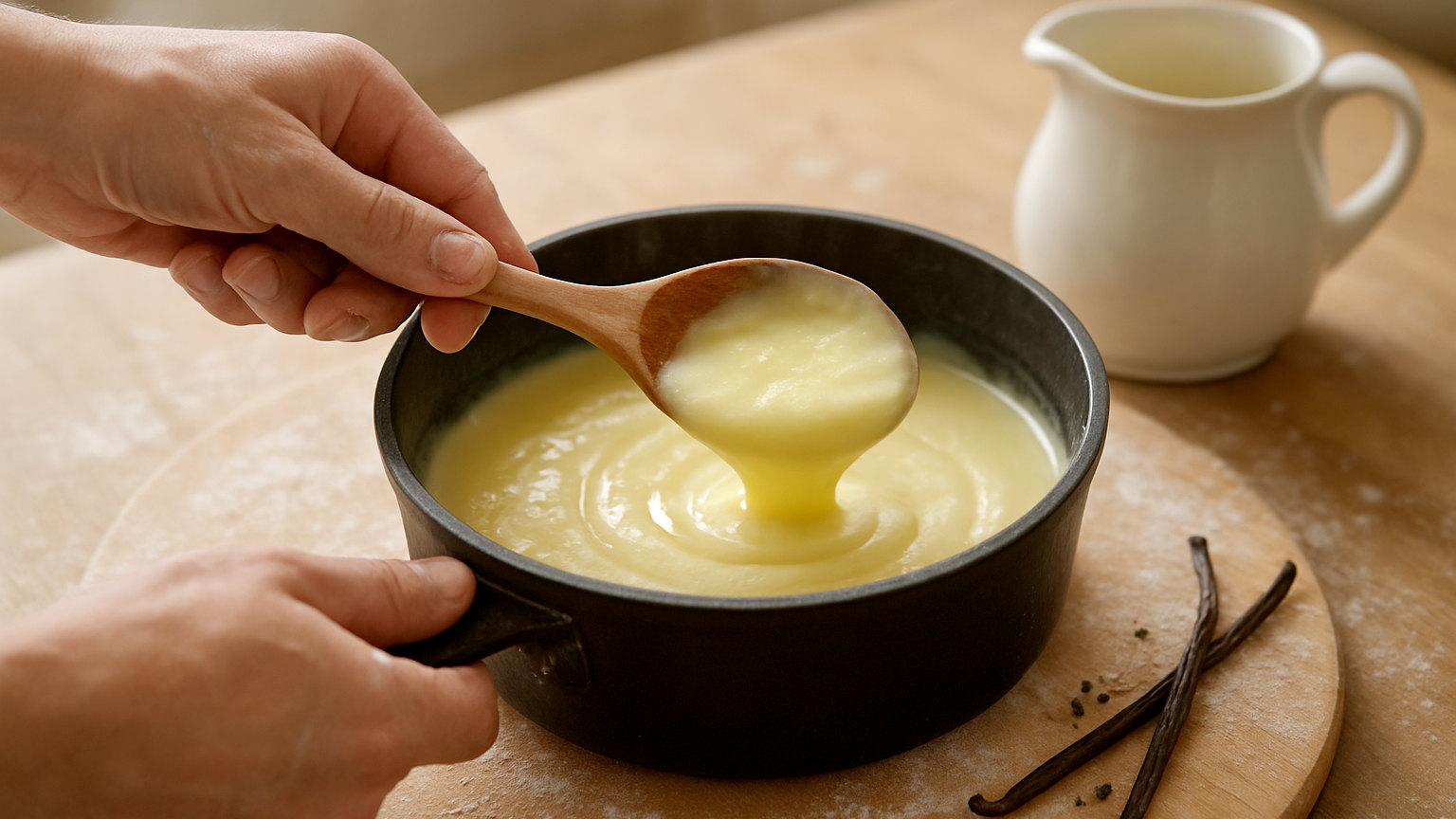
Custard without eggs is set with starch rather than protein, which changes almost everything about how it is made. Where an egg custard must never boil, a cornflour one must boil to work at all. Once that reversal is clear, egg free custard is considerably easier and more reliable than the traditional kind.
What replaces the eggs?
Cornflour, which swells and gels when heated in liquid. Custard powder is essentially cornflour with colouring and flavouring added.
Arrowroot and potato starch work similarly and give a slightly clearer, glossier result.
What are the proportions?
About 30g of cornflour to 600ml of milk for a pouring custard, and 45g for one thick enough to hold a trifle layer.
Sugar to taste, usually 40g to 60g for the same quantity.
How do you make it?
- Mix the cornflour and sugar to a smooth paste with 4 tablespoons of the cold milk.
- Heat the rest of the milk with vanilla to just below a simmer.
- Pour a little onto the paste, whisk, then return everything to the pan.
- Bring to the boil, whisking constantly.
- Boil for 1 to 2 minutes until thickened and glossy.
- Take off the heat and whisk in a knob of butter or vegan block.
Slake the cornflour in cold liquid first. Starch tipped into hot milk seizes instantly into lumps that will not whisk out, and this single step prevents the only common failure.
Why must it boil?
Cornflour reaches full thickening power only at boiling point. Below that it thickens partially and then slackens again as it stands.
Boiling also cooks out the chalky raw starch flavour.
Which plant milks work?
Oat milk is closest to dairy in body and flavour. Soya is thicker and sets well. Almond is thin and gives a weaker custard.
Coconut milk makes a rich custard that tastes strongly of coconut.
How do you make it richer?
Use a portion of oat cream or coconut cream in place of some milk, and beat in butter or a vegan block at the end.
A pinch of turmeric gives the yellow colour that egg yolks would otherwise provide.
Can you set a pudding with it?
Yes, and blancmange is exactly that: a cornflour custard poured into a mould and left to set firm enough to turn out.
It needs roughly 50g of cornflour per 750ml of liquid to hold its shape unsupported.
How does it differ in texture?
It is glossier and slightly more gelatinous, and it sets much more firmly when cold.
Egg custard is silkier and stays pourable when chilled.
Can you combine the two?
Yes, and many British recipes do. A teaspoon of cornflour in an egg custard makes it far harder to curdle.
That is the version worth using in a trifle.
Can you use arrowroot instead?
Yes, and it gives a glossier, slightly clearer custard that sets a little less firmly. Use about the same weight as cornflour.
It also tolerates acidic ingredients better, which matters if you are adding fruit.
Why did it go thin after cooling?
It was not boiled long enough, or it was stirred vigorously after thickening, which breaks the starch structure down.
Stir gently once it has thickened.
Does it taste different?
Cleaner and less rich, since there is no egg. Many people who grew up on custard powder prefer it and find egg custard heavy.
Vanilla and a little butter close most of the gap.
Can it be used in baked puddings?
Poured over a bread pudding it will not set in the oven the way an egg custard does, so the result is softer and wetter.
For anything that needs to set, egg or a vegan setting agent is required.
How long does it keep?
Three days refrigerated with cling film on the surface. It thickens when cold and loosens with gentle reheating and a splash of milk.
Reheat once only, in line with Food Standards Agency guidance.
Next, try Which Custard for Which Pudding?, or see the rest of our Puddings recipes.

