
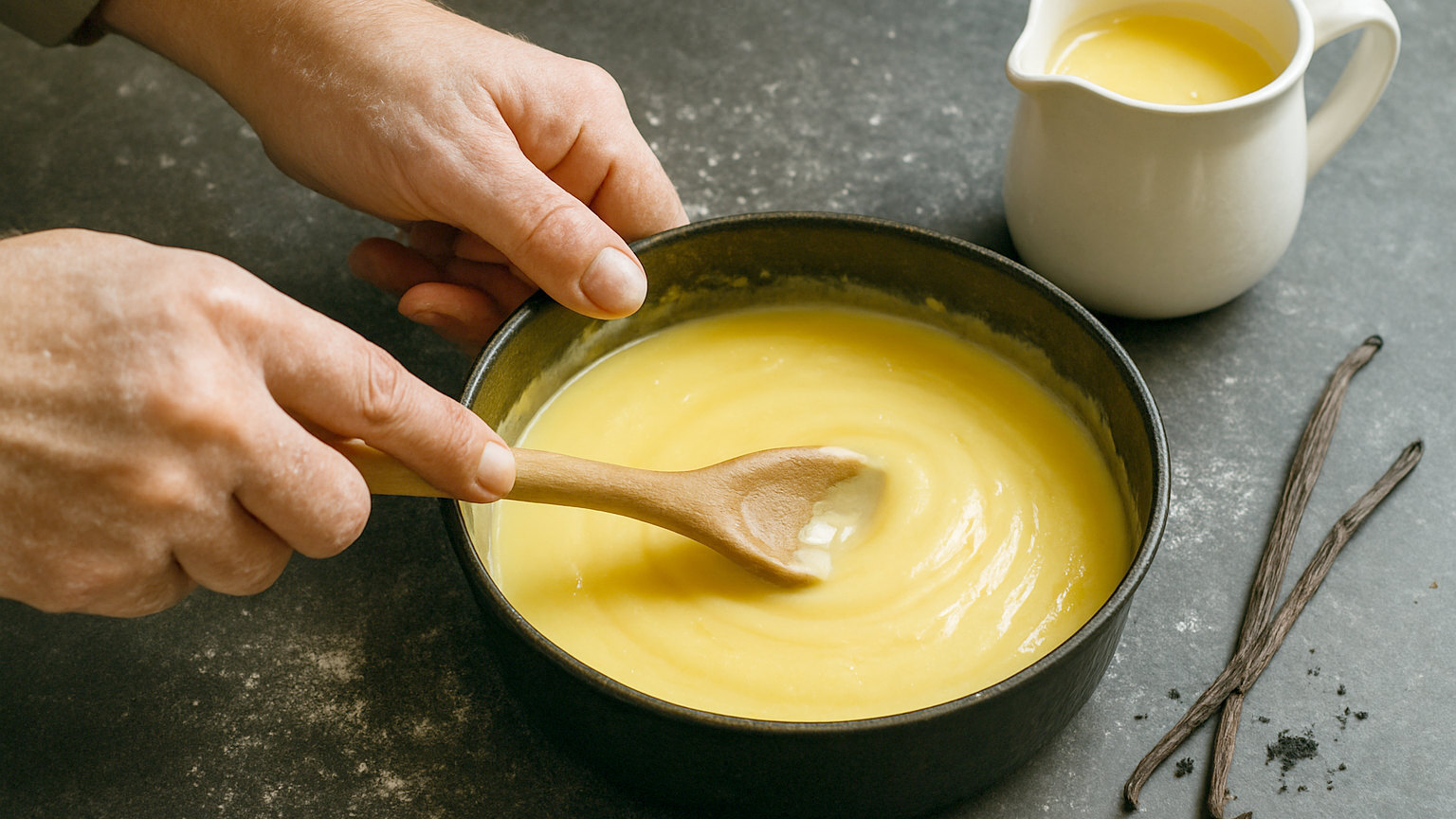
A vanilla slice is thick custard between two sheets of crisp puff pastry, and both elements need managing. The pastry has to be baked flat under a weight or it puffs into something impossible to cut, and the custard has to be considerably firmer than a pouring one so the slice holds together when it meets a knife.
What do you need for 9 slices?
- 500g all butter puff pastry
- For the custard: 600ml whole milk, 1 vanilla pod, 6 egg yolks, 150g caster sugar, 60g cornflour, 50g butter
- 200ml double cream, whipped
- For the icing: 200g icing sugar and 2 tablespoons water
- Icing sugar for dusting, if not icing
How do you make it?
- Heat the oven to 200C fan and roll the pastry into two 20cm squares.
- Sit each on a lined tray, cover with baking paper and put a second tray on top.
- Bake for 20 to 25 minutes until deep golden and completely crisp, then cool.
- Heat the milk with the vanilla and infuse for 20 minutes.
- Whisk the yolks, sugar and cornflour, pour on the milk and return to the pan.
- Bring to the boil, whisking, and cook for 2 minutes until very thick.
- Beat in the butter, cover the surface and cool completely, then fold in the whipped cream.
- Spread over one pastry sheet, top with the second and chill for 4 hours before cutting.
Bake the pastry under a second tray. Puff pastry left to rise gives layers that shatter and slide apart, and a vanilla slice needs two flat, dense, crisp sheets to hold the custard between them.
How firm should the custard be?
Firm enough to hold its shape on a spoon and not flow at all. It should be closer to a thick paste than a sauce.
The cornflour does that work, and 60g to 600ml of milk is a high proportion deliberately.
Why fold in cream?
Straight creme patissiere is dense and slightly heavy. Folding in whipped cream lightens it while keeping enough structure to cut.
This mixture is sometimes called creme diplomate.
Does the custard need to boil?
Yes, unlike an egg custard. Cornflour only thickens fully once boiled, and two minutes at a boil also cooks out the raw starch taste.
Whisk constantly, since it catches easily once thick.
How do you cut it cleanly?
With a long serrated knife, using a gentle sawing motion and no downward pressure. Wipe the blade between cuts.
Chilling it properly first is what makes clean cuts possible.
How long should the pastry bake?
Longer than feels right, about 25 minutes, until deep golden throughout. Pale puff pastry is soft in the middle and will collapse under the custard.
Check the underside as well as the top.
Should it be iced?
Glace icing on top is the traditional British bakery finish. A dusting of icing sugar is the simpler alternative.
Ice the top sheet before assembling, which is far easier than icing the finished slice.
Can you use ready rolled pastry?
Entirely, and all butter ready rolled puff is a sensible shortcut. Cut it to size and bake it under a tray as described.
Is it the same as a mille feuille?
Closely related. A mille feuille has three layers of pastry and two of custard, and is usually not iced.
How thick should the custard layer be?
About 3cm, which is roughly twice the thickness of the two pastry sheets combined. A thin layer makes it a pastry sandwich rather than a custard slice.
This quantity gives that depth in a 20cm square.
Why does the pastry go soggy?
The custard was still warm when it went on, or the slice has been standing too long.
Cool the custard completely and assemble as close to serving as you can.
How long does it keep?
Best within a few hours of assembly, since the pastry softens. A day refrigerated at most.
Keep it chilled and use within two days, in line with Food Standards Agency guidance.
If that was useful, Custard Based Vanilla Ice Cream covers related ground, and there is plenty more in Puddings recipes.

