
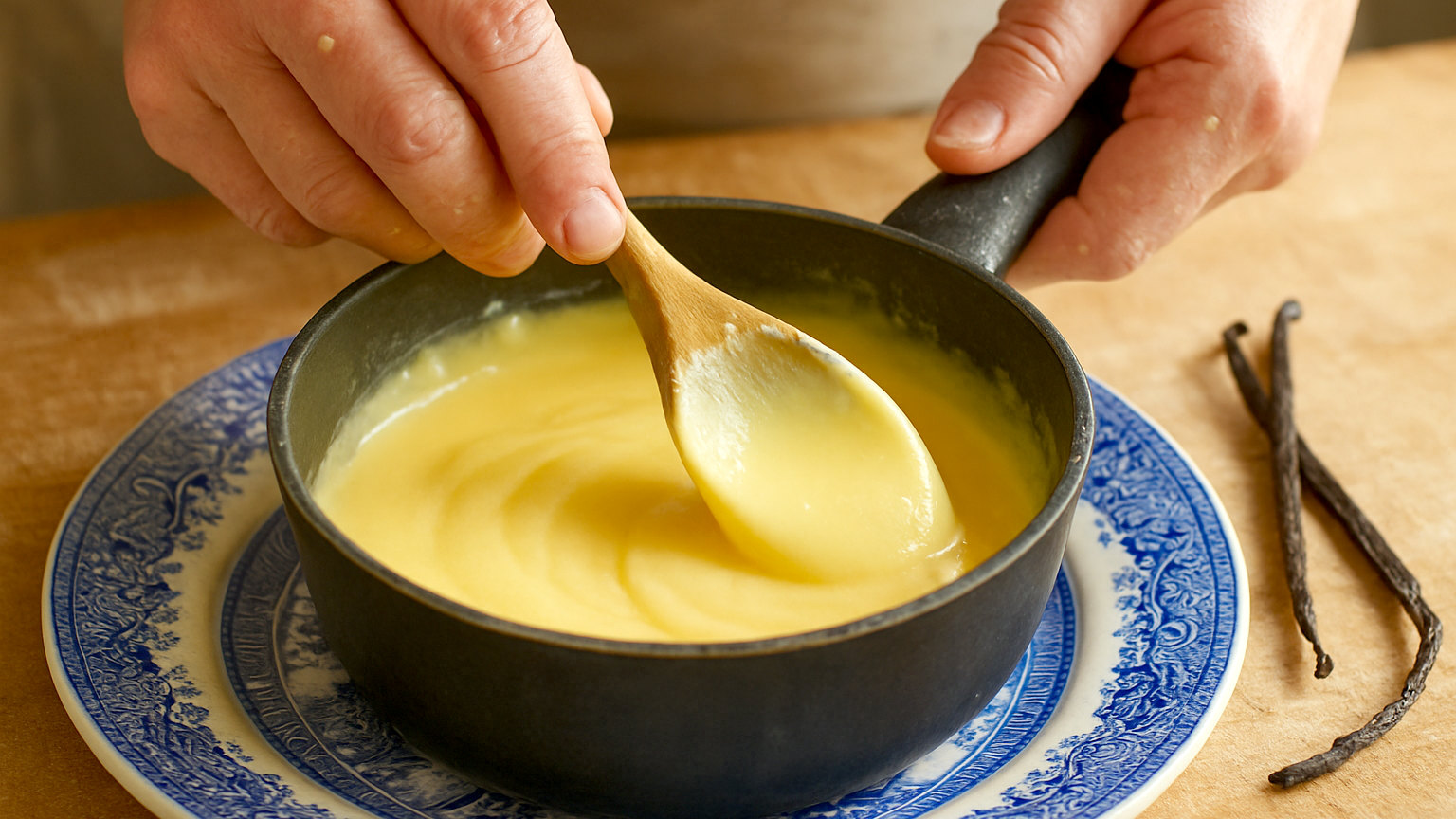
Proper vanilla ice cream is a rich egg custard frozen while being agitated. The agitation is what matters: it breaks up ice crystals as they form, and without it you get a solid block rather than something scoopable. A machine does it best, and it can be done by hand with more effort.
What do you need for about 1 litre?
- 300ml whole milk
- 450ml double cream
- 1 vanilla pod, split
- 8 egg yolks
- 150g caster sugar
- A pinch of salt
How do you make it?
- Heat the milk, cream and vanilla to just below a simmer and infuse for 30 minutes.
- Whisk the yolks, sugar and salt together until pale.
- Pour the warm cream over in a slow stream, whisking.
- Return to a low heat and stir until it coats the back of a spoon, about 8 minutes.
- Strain into a cold bowl and cool quickly.
- Refrigerate overnight, or at least 6 hours.
- Churn in an ice cream machine for 25 to 35 minutes.
- Transfer to a container and freeze for 3 hours until firm.
Chill the base overnight before churning. A cold base freezes faster, which means smaller ice crystals and a smoother result, and the flavour also develops as it rests.
What can you do with the whites?
Eight whites is a great many, and they make meringues, an Eton mess or a pavlova. They freeze for three months.
Freeze them individually in an ice cube tray and label the number.
Why so many yolks?
Fat and emulsifiers from the yolks interfere with ice crystal formation, so a rich custard freezes softer and smoother than a lean one.
Eight yolks per litre is a generous, restaurant style proportion.
Can you make it without a machine?
Yes. Freeze the base in a shallow container and beat it hard with a fork or whisk every 30 minutes for the first three hours.
It is more work and the result is slightly coarser but perfectly good.
Why does it go icy?
Slow freezing, not enough fat, or not enough agitation. All three let large ice crystals form.
Make sure the machine bowl is fully frozen, which usually means 24 hours.
Does the machine bowl matter?
A bowl that is not fully frozen is the commonest reason homemade ice cream turns out icy. Most need at least 24 hours in the freezer.
Keep it in there permanently if you have the space.
Why is it rock hard from the freezer?
Homemade ice cream has no commercial stabilisers, so it freezes harder. Let it stand for 10 minutes before scooping.
A tablespoon of vodka in the base lowers the freezing point and keeps it softer.
Does the sugar quantity matter?
Sugar lowers the freezing point as well as sweetening, so reducing it substantially gives a harder, icier ice cream.
150g per litre is close to the minimum for a good texture.
How do you flavour it?
Infuse the cream with coffee, mint, cardamom or citrus zest. Fold in fruit puree, honeycomb or chocolate after churning.
Anything wet added before churning increases the iciness.
Does the base need to be strained?
Yes, to catch the vanilla pod and any egg that has begun to set. A single strand of cooked egg is noticeable in frozen ice cream.
Should it be salted?
A pinch, which sharpens the vanilla and stops it tasting flatly sweet.
What container should it go in?
A shallow wide container rather than a deep tub, since it freezes faster and scoops more easily.
Chill the container in the freezer before the ice cream goes in.
How long does churning take?
Between 25 and 35 minutes in a domestic machine, by which point it should have the texture of soft serve.
It firms properly during the three hours in the freezer afterwards.
How long does it keep?
Two months in a sealed container, though the texture is best in the first fortnight.
Press greaseproof paper onto the surface to prevent ice crystals. Do not refreeze ice cream that has fully melted, in line with Food Standards Agency guidance.
If that was useful, Vanilla Slice covers related ground, and there is plenty more in Puddings recipes.

