
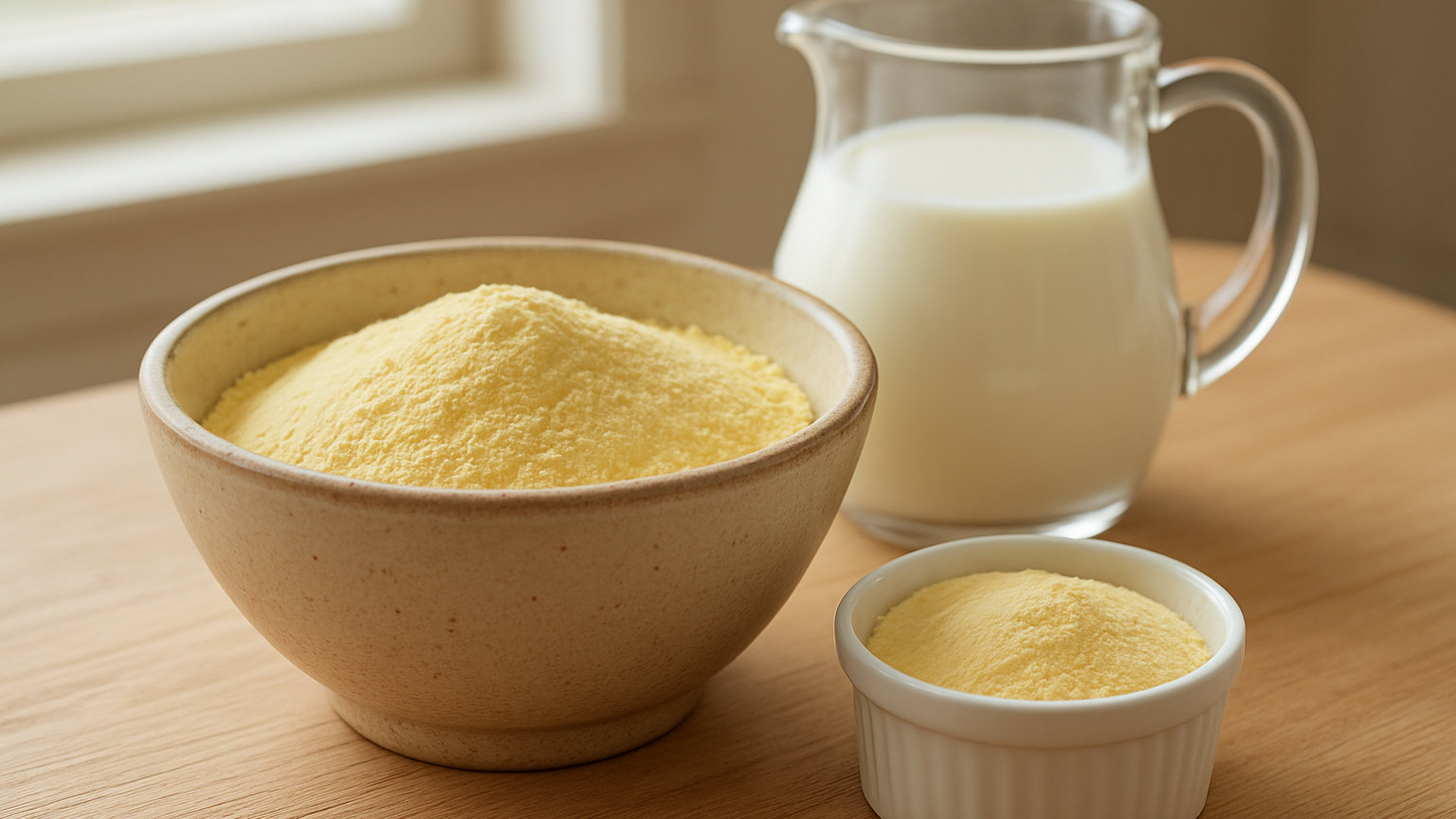
Custard powder is cornflour with colouring and vanilla flavouring, and it contains no egg at all. It was invented in Birmingham in 1837 by Alfred Bird, a chemist whose wife was allergic to eggs, and it has been a fixture of British puddings ever since. It is not a poor substitute for real custard so much as a different thing that happens to share a name.
What is actually in it?
Cornflour, salt, annatto or a similar colouring for the yellow, and vanilla flavouring. That is essentially all.
The yellow colour exists purely to suggest egg yolks that are not there.
How do you make it without lumps?
Slake the powder in cold milk first. Mix it to a smooth paste with a few tablespoons of cold milk before any heat is involved, then add the hot milk gradually.
Tipping powder into hot milk creates lumps instantly and no amount of whisking will fully remove them.
What are the proportions?
Roughly 2 tablespoons of powder and 2 tablespoons of sugar to 600ml of milk for a pouring custard.
Three tablespoons gives a thick custard for a trifle that will hold cream on top.
Does it need to boil?
Yes, unlike egg custard. Cornflour only reaches full thickening power once it has boiled, so bring it to the boil and hold it there for a minute, stirring.
Undercooked cornflour tastes chalky and thins again as it stands.
Can you improve it?
Considerably. Use whole milk rather than semi skimmed, replace 100ml with double cream, add a real vanilla pod, and stir in a knob of butter at the end.
An egg yolk whisked in off the heat brings it closer to the real thing.
Is it better than tinned custard?
Made with whole milk and a little cream, yes. Tinned custard is convenient and tends to be sweeter and thinner.
Fresh chilled custard from a supermarket is usually the best of the ready made options.
Can you use it in a trifle?
It is arguably better than egg custard for the purpose, since it sets firmly when cold and holds a layer of cream without sinking.
Make it slightly thicker than pouring consistency.
Why is it so popular in Britain?
It is cheap, it keeps indefinitely in the cupboard, it cannot curdle, and generations grew up with it at school and at home.
A great many people prefer the taste to egg custard, which is a legitimate position rather than a failure of education.
How do you get it lump free after the fact?
A stick blender or a pass through a fine sieve removes lumps completely, and neither harms the texture.
It is quicker than trying to whisk them out.
Is it suitable for a vegan pudding?
The powder itself contains no egg or dairy, so made with plant milk it produces a vegan custard.
Oat milk gives the closest result. Check the pack, since formulations vary.
How much does a tin make?
A standard 300g tin makes several litres of custard, so it works out considerably cheaper than ready made and keeps for a year or more in the cupboard.
Store it somewhere dry, since the powder clumps if it takes up moisture.
Why does it go thin again?
It was not boiled properly, or it has been stirred vigorously after thickening, which breaks down the starch structure.
Stir gently once it has thickened.
Does it set when cold?
Firmly, unlike egg custard, because cornflour sets to a gel as it cools. That is why custard powder makes a good trifle layer.
Loosen it with a little milk over a low heat if you want it pourable again.
Who was Alfred Bird?
A Birmingham chemist who developed the powder in 1837 because his wife could not eat eggs. It was sold commercially from the 1840s.
The company he founded is still the best known brand of custard powder in Britain.
How long does it keep?
Made up, three days refrigerated with cling film on the surface. It thickens considerably when cold and loosens on reheating.
Reheat gently and use once, in line with Food Standards Agency guidance.
For something along the same lines, see Proper Custard, or browse all our Puddings recipes.

