
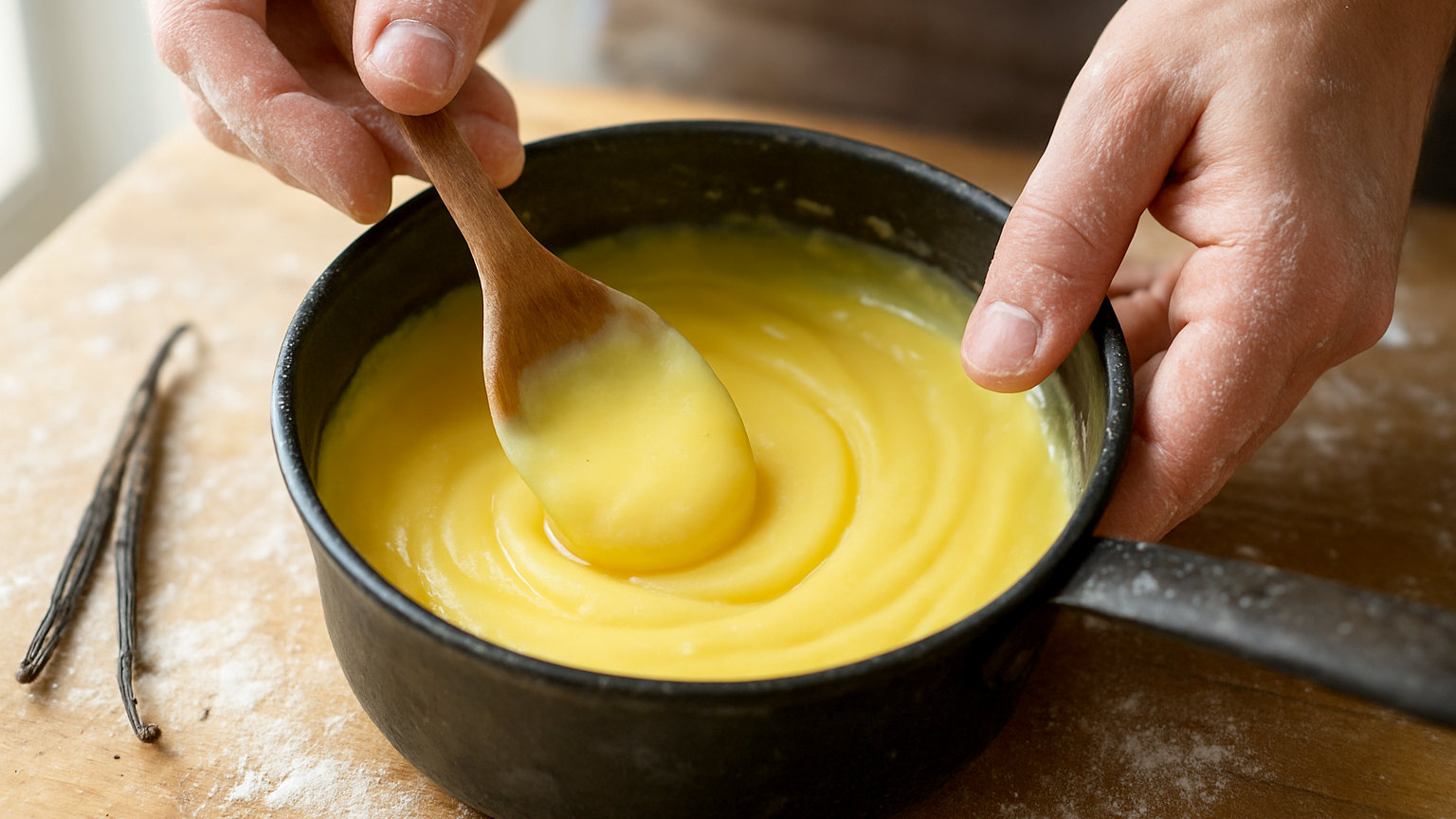
Creme patissiere is the thick custard that fills fruit tarts, eclairs, doughnuts and custard slices. It is set with cornflour as well as egg yolks, which means it can and must be boiled. That makes it considerably easier than a pouring custard, since the anxiety about curdling largely disappears.
What do you need for 600ml?
- 500ml whole milk
- 1 vanilla pod, split
- 6 egg yolks
- 125g caster sugar
- 40g cornflour
- 25g butter
How do you make it?
- Heat the milk with the vanilla to just below a simmer and infuse for 20 minutes.
- Whisk the yolks, sugar and cornflour to a smooth paste.
- Pour a little hot milk in and whisk, then add the rest.
- Return to the pan over a medium heat.
- Whisk constantly until it thickens, then let it boil for 2 minutes.
- Take off the heat and beat in the butter.
- Pass through a sieve into a shallow tray.
- Cover the surface with cling film and chill for at least 2 hours.
It must reach a proper boil for two minutes. Cornflour does not reach full thickening power until it boils, and undercooked pastry cream tastes of raw starch and slackens as it stands.
Why does it not curdle?
The cornflour gets between the egg proteins and stops them binding too tightly, so the custard can go well above the temperature that would curdle a creme anglaise.
That is why the method is so much more forgiving.
How thick should it be?
Very. It should hold its shape completely and not flow at all once cold.
It stiffens considerably as it chills, so what looks almost too thick in the pan is right.
Why cool it in a shallow tray?
It cools far faster spread thin than in a deep bowl, which matters for food safety and stops it setting into a solid block.
Whisk it smooth again before using.
Should the yolks be whisked before the milk goes in?
Yes, to a smooth paste with the sugar and cornflour. Lumps of dry cornflour at that stage will not disperse once the hot milk arrives.
Why beat in butter at the end?
It adds richness and gloss and helps the surface stay smooth as it cools.
Add it off the heat so it does not split.
What is it used for?
Fruit tarts, eclairs and profiteroles, custard slices, doughnuts, danish pastries and as a base layer in a trifle.
Folded with whipped cream it becomes lighter and suits a tart topped with fresh fruit.
Can it be piped?
Yes, once cold and whisked smooth. It holds its shape well enough for eclairs, profiteroles and filling doughnuts.
Use a plain nozzle and fill from the end rather than the side.
Can you flavour it?
Infuse the milk with coffee, citrus zest or cardamom, or beat in melted chocolate or praline at the end.
Chocolate versions need slightly less cornflour, since the chocolate sets firm.
How much does this quantity fill?
Enough for a 23cm fruit tart, about twelve eclairs, or one custard slice in a 20cm square.
It scales cleanly if you keep the cornflour in proportion to the milk.
Why did it go lumpy?
The whisking stopped, or the cornflour was not fully dispersed at the start. Pass it through a sieve and it will be smooth again.
What is the cornflour ratio?
About 40g per 500ml of milk for a filling that holds its shape. Reduce it to 25g for a softer cream to fold into other things.
Weigh it rather than measuring by spoon, since it compacts.
How is it different from creme anglaise?
Creme anglaise is a thin pouring sauce set by egg alone and must never boil. Pastry cream contains starch, must boil, and sets thick enough to pipe.
They are not interchangeable in a recipe.
How long does it keep?
Three days refrigerated with the surface covered. It does not freeze, since the starch separates on thawing.
Cool it quickly and refrigerate within two hours, in line with Food Standards Agency guidance.
See also Creme Brulee, or browse more Puddings recipes.

