
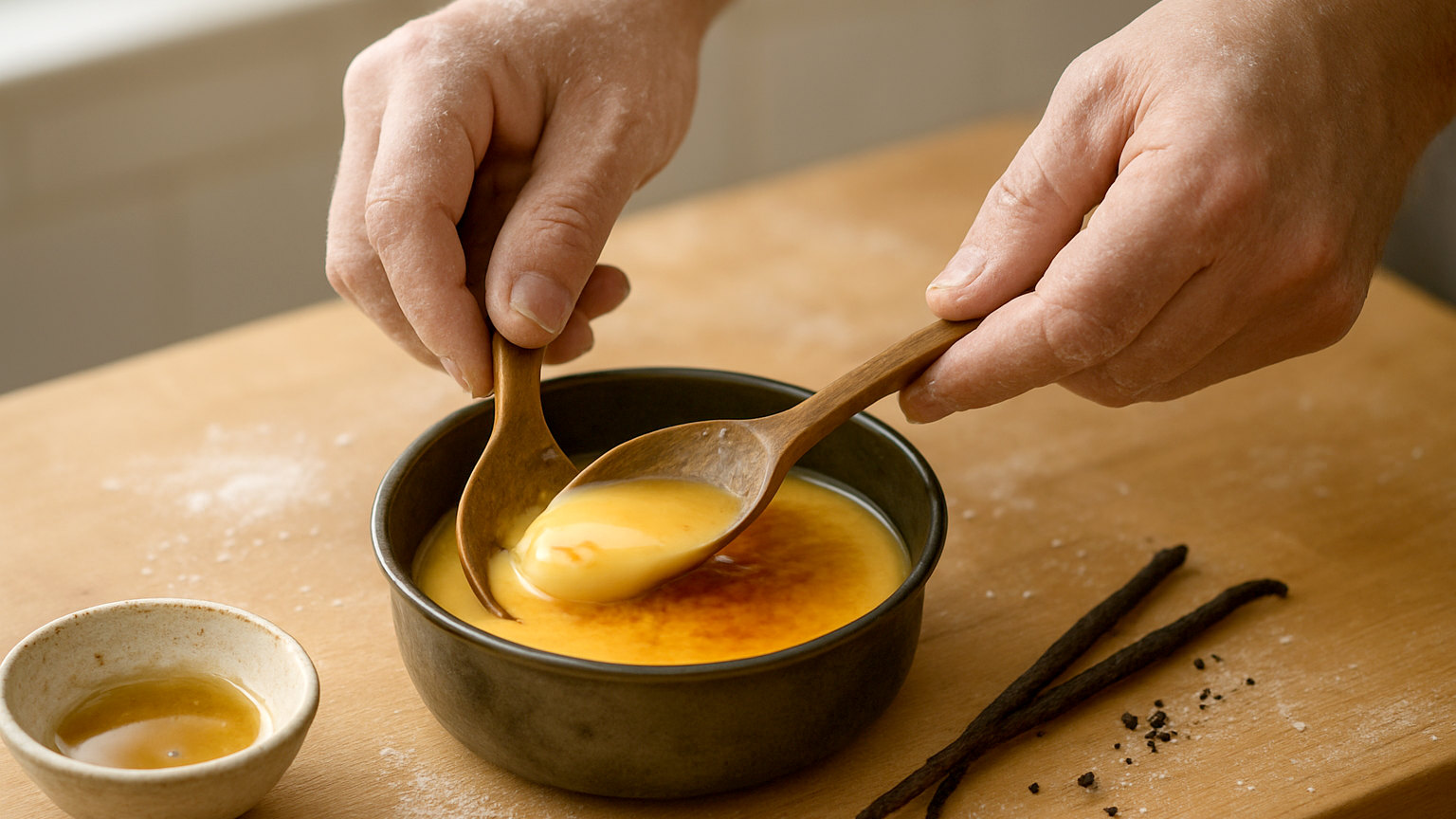
Creme caramel is a baked custard set over caramel and turned out so the caramel becomes a sauce. It is lighter than a creme brulee because it is made with milk and whole eggs rather than cream and yolks, and it has to be firmer, since it must hold its shape when unmoulded.
What do you need for 6 moulds?
- For the caramel: 150g caster sugar and 3 tablespoons water
- 500ml whole milk and 100ml double cream
- 1 vanilla pod, split
- 3 whole eggs and 2 egg yolks
- 75g caster sugar
How do you make it?
- Heat the oven to 140C fan, 160C conventional, gas mark 3.
- Heat the sugar and water without stirring until it turns a deep amber.
- Pour immediately into the base of six ramekins and tilt to coat.
- Heat the milk, cream and vanilla to just below a simmer and infuse for 20 minutes.
- Whisk the eggs, yolks and sugar together without making it foamy.
- Pour on the warm milk, whisking, then strain into the ramekins.
- Bake in a water bath for 35 to 45 minutes until just set with a slight wobble.
- Cool, then chill overnight before turning out.
Chill it overnight before turning out. The caramel needs that time to dissolve into a liquid sauce, and a custard turned out after two hours brings almost no caramel with it.
Why whole eggs rather than just yolks?
Egg whites set firmer than yolks, and this custard has to stand up on a plate rather than being eaten from the dish.
Yolks alone give a softer, richer set that would collapse.
How do you make the caramel?
Heat sugar and water in a clean pan without stirring. Swirl the pan as it colours and take it off at a deep amber.
Stirring encourages crystals to form. Pale caramel tastes only of sugar and the slight bitterness of a dark one is what balances the custard.
How do you turn it out?
Run a thin knife around the edge, put a rimmed plate over the mould and invert it firmly in one movement.
If it sticks, dip the base briefly in hot water for ten seconds.
Why a rimmed plate?
The caramel runs freely once released and a flat plate lets it escape across the table.
What is the difference from a flan?
None. Flan in Spain and much of Latin America is the same dish, and creme caramel is the French name for it.
Portuguese pudim and Italian creme caramel are close relatives.
Should the moulds be greased?
No. The caramel lines the base and the custard releases from the sides on its own once chilled.
Why does it have bubbles in it?
Air whisked into the eggs, or the oven too hot. Whisk gently, strain the mixture and skim the foam before baking.
A smooth custard should be almost glassy when cut.
How full should the moulds be?
Almost to the top, leaving about 5mm. The custard does not rise, so a part filled mould simply gives a small pudding.
Fill them at the oven to avoid spilling custard over the caramel.
Can it be made in one large dish?
Yes, in a 1 litre dish, baking for about an hour. It is harder to turn out cleanly and looks impressive when it works.
Why does the caramel set hard in the mould?
It sets solid within a minute of being poured, which is correct. Overnight in the fridge the moisture from the custard dissolves it back into a syrup.
That slow dissolving is why the pudding cannot be rushed.
What if the caramel burns?
Start again. Burnt caramel is acrid and there is no way to correct it once it is in the mould.
Have the ramekins ready before you start, since caramel darkens fast at the end.
How long does it keep?
Three days refrigerated in the moulds. Turn it out on the day of serving.
Keep it chilled throughout, in line with Food Standards Agency guidance.
See also Creme Brulee, or browse more Puddings recipes.

