
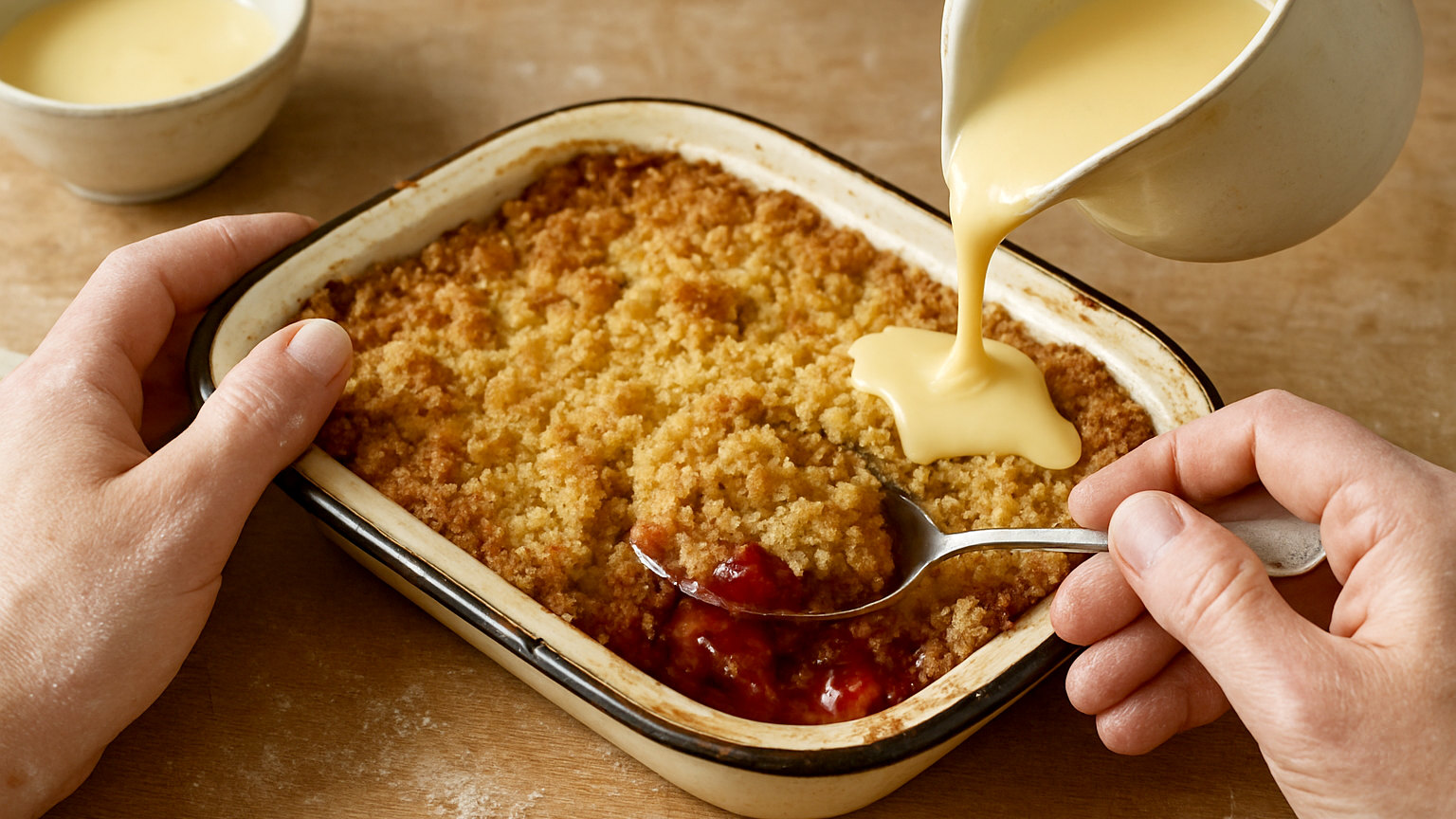
A crumble needs something wet alongside it, since the topping is dry and the fruit is hot and concentrated. Which of the three traditional options you choose is largely a matter of household loyalty, and the argument between custard and cream is conducted with more heat than the question deserves. All three work and each suits different fruit.
Why does it need anything at all?
The topping is dry and sandy and the fruit is intense, so something cool and rich balances both. A crumble eaten alone is noticeably harder work.
The temperature contrast is part of it, which is why cold cream on hot crumble is more than the sum of its parts.
What is the case for custard?
It is the traditional British choice and it suits sharp fruit best, since the sweetness and the eggy richness balance acidity in a way cream does not.
Rhubarb and gooseberry are custard fruit. Both are sharp enough that cream alone leaves the pudding feeling austere.
Should custard be homemade?
Proper creme anglaise made with egg yolks is a different and better thing, and it takes about fifteen minutes. Tinned and powdered custard are both entirely respectable and widely preferred.
Nobody at a family table has ever objected to Bird's, and a good many people prefer it.
What about cream?
Pouring cream is the simplest option and lets the fruit come through most clearly. Double cream is richer, and clotted cream is the West Country choice for a special occasion.
Cold cream on hot crumble is the classic combination for apple and blackberry.
Does ice cream work?
Very well, and it gives the sharpest temperature contrast of the three. Good vanilla is the right choice, since anything more elaborate competes with the fruit.
It melts into the crumble, which some people consider the point and others consider a failure.
Is there a regional difference?
Custard is more firmly the default in the north and cream more common in the south west, where clotted cream is local. Neither is a rule.
What suits which fruit?
Custard with rhubarb, gooseberry and damson. Cream with apple, blackberry and plum. Ice cream with anything, particularly in summer.
These are conventions rather than rules and swapping them offends nobody except relatives.
Are there other options?
Greek yoghurt or creme fraiche cut through very sweet fruit well and are considerably lighter.
A jug of the reduced fruit juice, if you drained the fruit before baking, is worth serving alongside whatever else is on the table.
Should custard be hot or cold?
Hot is traditional with a hot crumble. Cold custard poured over hot fruit is a legitimate minority position and gives a sharper contrast.
Cream is almost always served cold, which is the point of it.
How much should you allow?
About 100ml of custard or cream per person, and rather more if it is custard, which people take generously.
Warm the jug if you are serving hot custard, since a cold jug takes the heat out of it immediately.
Should the crumble be hot?
Warm rather than straight from the oven. Ten minutes of resting lets the fruit stop bubbling, which otherwise scalds mouths.
It is also perfectly good cold the next day, eaten standing up at the fridge.
Does anything else belong on the plate?
Nothing. A crumble and something poured over it is a complete pudding, and additions such as fruit compote or a biscuit crowd it.
A sprig of mint is decoration rather than food and can be left off.
What about a dairy free option?
Oat cream and coconut cream both pour well, and vegan custard made with plant milk works perfectly since custard powder contains no dairy itself.
Check the topping too, since it will need a vegan block in place of butter.
Can you serve two?
Custard and cream together is a recognised position in some households and there is no reason to argue with it.
Refrigerate anything dairy within two hours and use it within the date on the pack, in line with Food Standards Agency guidance.
Next, try Pear and Ginger Crumble, or see the rest of our Puddings recipes.

