
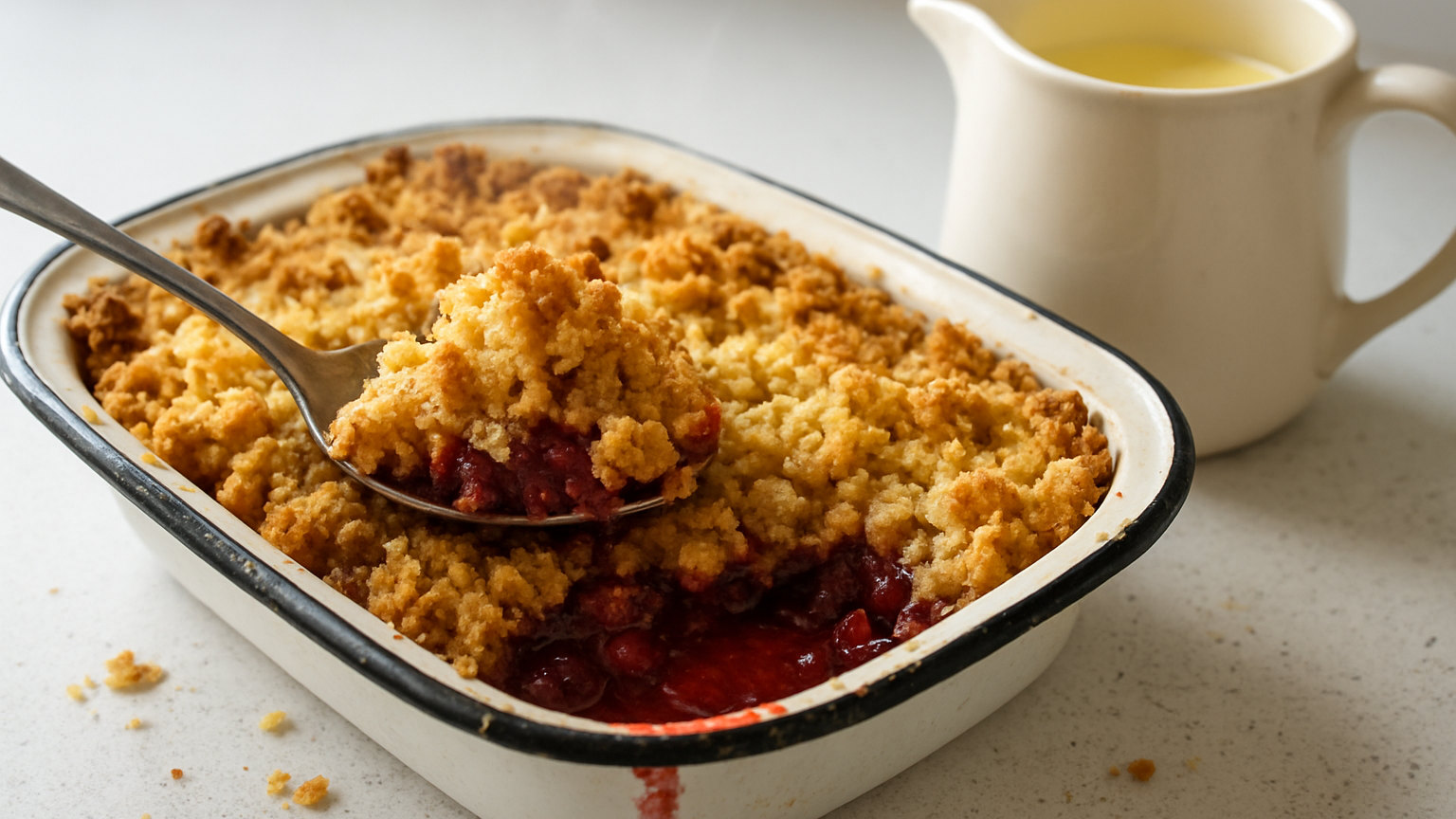
A soggy crumble topping is almost always a liquid problem rather than a topping problem. Fruit releases water as it heats, that water turns to steam and rises through the crumble, and if there is too much of it the topping is effectively being boiled from below rather than baked from above. There are five contributing causes and all are avoidable.
Was the fruit too wet?
Some fruit releases far more than others. Rhubarb, plums, berries and gooseberries are all considerably wetter than apple.
Macerate wet fruit with sugar for half an hour and drain it. The liquid that comes out is significant, and pouring it off before baking is the single most effective fix.
Was the fruit thickened?
Two teaspoons of cornflour tossed through the fruit binds the juices into a light syrup rather than letting them run free.
Ground almonds, semolina or a tablespoon of plain flour do the same job with a slightly different texture.
Was the topping pressed down?
It should be scattered loosely and left alone. Pressing it into a compact layer stops steam escaping, so it condenses within the crumble instead.
A loose topping with gaps lets the moisture out and bakes into distinct crumbs.
Was the oven hot enough?
Crumbles want 180C fan. Below about 160C fan the topping cooks without ever crisping, and the fruit has longer to release liquid before the surface sets.
If the top is browning too fast, cover it loosely with foil rather than turning the oven down.
Was the dish too small?
An overfilled dish means the fruit is deep, so more steam has to pass through the topping, and the juices bubble over the edges.
Use a wider dish so the fruit is no more than about 5cm deep, which gives a better ratio of topping to fruit as well.
Was there enough topping?
A thin layer soaks through completely. Allow a topping about 2cm deep, which for a dish serving six means around 200g of flour and 100g of butter.
Does adding oats help?
Considerably. Oats absorb some moisture and give a more open, crunchy texture that stands up better to steam from below.
Around a quarter of the topping weight as oats is a good proportion.
Should the fruit be cooked first?
For very wet fruit, yes. Ten minutes in a pan drives off liquid and lets you see how much sugar it needs before it goes in the dish.
Cool it before adding the topping, or the butter melts before the oven can set it.
Was the topping ratio wrong?
Half fat to flour by weight is the standard, so 200g of flour to 100g of butter. Too little butter gives a dry, floury topping and too much makes it dense and greasy.
Sugar is roughly half the butter weight, and it also helps the topping crisp.
Should the dish be preheated?
Putting the dish on a preheated baking tray helps the base of the fruit cook and reduces the time the topping spends absorbing steam.
It also catches anything that bubbles over.
Can a soggy crumble be rescued?
Partly. Return it to a hotter oven at 200C fan for 10 to 15 minutes uncovered, which drives off some moisture and firms the surface.
It will improve rather than transform, since the topping has already absorbed liquid.
Was the butter warm?
The butter should be cold and diced when it goes into the flour. Warm butter blends in completely rather than staying in pieces, and the topping bakes into a solid sheet rather than crumbs.
If the kitchen is warm, chill the rubbed topping for twenty minutes before scattering it.
Does it matter if it is slightly soft?
Not much. A crumble with a soft layer where the topping meets the fruit is normal and arguably part of the appeal.
The problem is only when the whole topping is wet rather than just the underside.
Next, try Crumble Topping Variations Worth Making, or see the rest of our Puddings recipes.

