
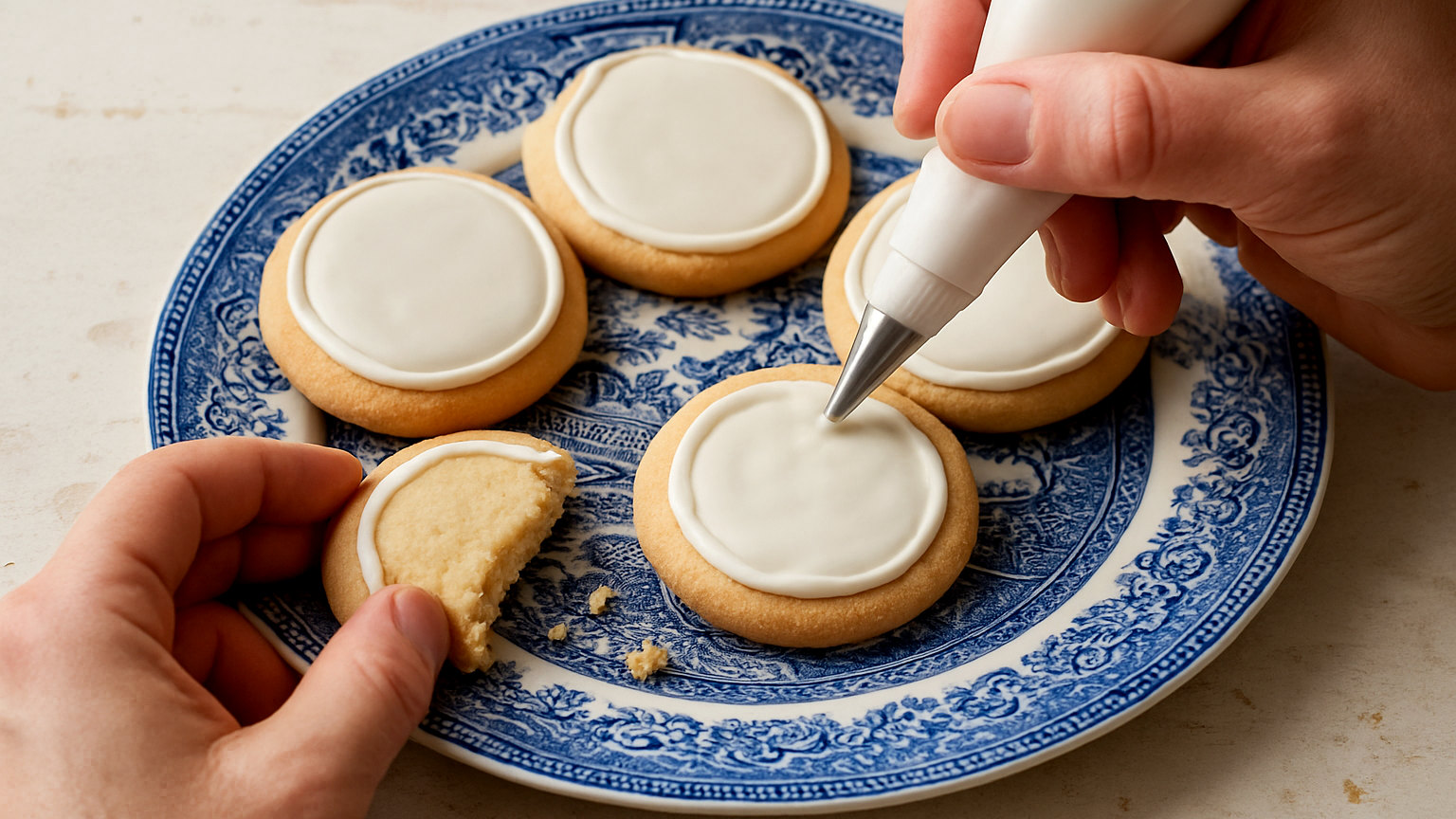
Neatly iced biscuits look like skilled work and are mostly a matter of getting two consistencies right. A firm icing pipes a wall around the edge, a looser one is flooded inside it to fill the space, and the wall holds it in. Everything else is patience while each stage dries.
What icing should you use?
Royal icing, which is icing sugar beaten with egg white or dried albumen. It dries hard and holds a clean edge.
Use pasteurised egg white or royal icing sugar rather than raw egg, particularly for children or anyone vulnerable.
What are the two consistencies?
Outline icing holds a peak, flood icing settles smooth in about ten seconds. Make one batch stiff, pipe the outlines, then thin the rest with water a few drops at a time for flooding.
The ten second test is the reliable check: drag a knife through the surface and it should close up in about that time.
How do you outline and flood?
- Pipe a line just inside the edge of the biscuit with the firm icing.
- Leave it for 15 minutes to crust over.
- Flood the centre with the looser icing, using a squeezy bottle or a bag.
- Spread it into the corners with a cocktail stick.
- Tap the biscuit gently on the worktop to level the surface and burst bubbles.
- Leave to dry for at least 6 hours, or overnight.
How do you colour it?
Gel colours rather than liquid ones, since liquid thins the icing and changes the consistency.
Colours deepen over a couple of hours, so mix slightly paler than you want.
How long does it take to dry?
Touch dry in about two hours and fully hard overnight. Humidity slows it considerably.
Do not stack or bag them until the icing is completely hard.
Can you add detail on top?
Wait until the base layer is fully dry, then pipe details with firm icing. Piping onto wet icing makes the colours bleed into each other.
Wet on wet is a deliberate technique for marbling, done within a minute of flooding.
What about glace icing?
Icing sugar and water or lemon juice. It is quicker and sets softer, so it is fine for a simple drizzle but will not hold sharp detail.
About 200g of icing sugar to 2 tablespoons of liquid.
How do you get sharp edges?
Chill the cut biscuits before baking so they hold their shape, and choose a dough that spreads very little, such as a rolled gingerbread.
A biscuit that has spread has no clean edge to ice against.
Which biscuits take icing best?
Flat, firm ones with a smooth surface. Gingerbread, plain rolled biscuits and shortbread all work.
Anything domed, cracked or crumbly is a poor base.
Does the icing need to dry between colours?
For clean separation, yes. Flood one colour, let it crust for at least an hour, then flood the next against it.
Adjacent wet colours bleed into each other within seconds.
Why is the icing bubbly?
Air beaten in during mixing. Let it stand for half an hour before use and tap the flooded biscuits to bring bubbles to the surface.
Burst any that remain with a cocktail stick.
How much icing do you need?
About 500g of icing sugar made up covers roughly 24 medium biscuits with outline and flood.
Make more than you think, since thinning for flooding uses it quickly.
Can children do it?
Flooding and sprinkles are easy and satisfying for children. Fine outlining needs a steady hand and more patience.
Give them a thicker glace icing and a spoon rather than a piping bag.
What can you use instead of piping bags?
A small squeezy bottle for flooding and a food bag with the corner snipped off for outlining.
Neither is as precise as a proper bag and nozzle, and both work.
How should they be stored?
In a single layer until fully dry, then in an airtight tin with baking paper between layers.
They keep about a week, though the biscuit softens slightly under the icing over that time.
For something along the same lines, see Digestive Biscuits, or browse all our Puddings recipes.

